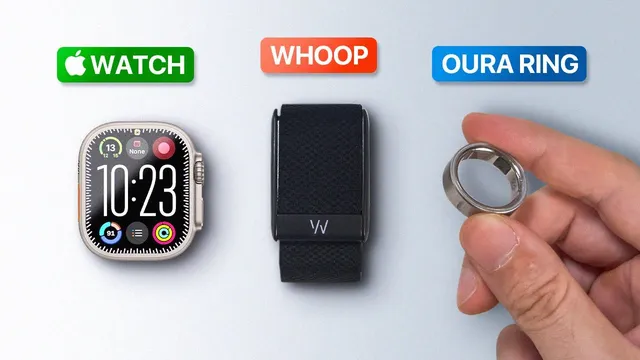
Apple Watch vs Whoop vs Oura - Don't Choose Wrong
Based on FromSergio's video on YouTube. If you like this content, support the original creators by watching, liking and subscribing to their content.
Choose based on your primary goal: Oura Ring for sleep and long-term wellness trends, Whoop for recovery-driven training, Apple Watch for all-in-one smartwatch functionality.
Briefing
Three top-tier wearables—Apple Watch, Oura Ring, and Whoop—track overlapping health signals, but they differ sharply in what they optimize for and how they fit into daily life. The biggest practical takeaway is that “best” depends less on raw sensor quality and more on whether the device’s comfort, charging routine, and scoring system match the user’s goals—sleep improvement, training performance, or an all-in-one smartwatch.
Comfort and usability shape the data quality because these devices are meant for near-constant wear. Apple Watch is described as fine during the day but unpleasant to sleep in, even after years of use. Oura Ring flips that trade-off: it’s highly comfortable at night, yet it can interfere with hand-heavy activities like lifting, gripping bars, washing hands, and sports; it also scratches easily. Whoop is positioned as the most forgettable option—light, slim, and worn via a sensor pressed against the body (wrist, arm, or even underwear). The charging workflow is also a major differentiator: Apple Watch and Oura require taking the device off, while Whoop can be charged while worn using a battery pack, and it typically lasts 12–14 days versus roughly a day for Apple Watch and about five days for Oura.
Sleep tracking is where Oura most consistently wins. Apple Watch provides a relatively basic breakdown—sleep duration, time in stages, and a sleep score that largely tracks habits like bedtime timing and awakenings. Oura adds deeper timing and quality metrics such as time to fall asleep, restfulness, sleep depth, and personalized recommendations based on chronotype (night owl vs early bird). It also emphasizes heart-rate patterns during the night, including the timing of the lowest heart-rate point and overnight HRV, and its sleep score is described as tightly aligned with how the user actually feels. Oura also handles naps well and monitors breathing for disturbances, while Apple Watch is the only one here that can detect sleep apnea.
Whoop takes a different stance: sleep matters mainly because it drives recovery and readiness to perform. Instead of treating sleep quality as the headline, Whoop centers a recovery score that can stay low after hard training, stress, or delayed catch-up—even after a good night’s sleep. That recovery framing extends into training with a daily strain target (0–21) and real-time strain feedback, pushing users to train based on how recovered they are. The trade-off is that Whoop’s strain is heart-rate dominated, so cardio-heavy days can score higher than intense lifting sessions.
Beyond sleep and workouts, the devices diverge in how they interpret stress and readiness. Oura tracks physiological stress throughout the day in categories like stressed, engaged, relaxed, or restored, and it can flag unusual vital-sign patterns that may precede illness. Whoop offers high/medium/low stress signals but with less explicit “restored” context and fewer trend alerts. Apple Watch adds features like ECG and broad smartwatch functionality without a subscription.
Cost and subscription models further influence the decision. Apple Watch is the least expensive upfront ($400 for a base Series 11 model, no subscription). Oura requires a subscription (about $6/month), while Whoop’s device is “free” but membership tiers apply; most users land on a plan around $240/year. Over time, the total cost can converge, but Whoop’s hardware upgrade model shifts value toward ongoing membership.
In the end: Oura is the clear pick for sleep and long-term wellness patterns, Whoop is best for serious training and recovery-driven effort, and Apple Watch is the most sensible single-device option for people who want smartwatch features without subscribing. The most effective setups can also be hybrid—using Apple Watch for daytime workouts and Oura for nighttime sleep—depending on which weakness a user is trying to eliminate.
Cornell Notes
Apple Watch, Oura Ring, and Whoop all measure sleep, recovery, and training signals, but each system is built around a different priority. Oura Ring is strongest for sleep: it tracks detailed sleep timing and quality, uses HR patterns and HRV, scores sleep in a way the user says matches how they feel, and handles naps well. Whoop is strongest for training because it turns sleep and health metrics into a recovery/readiness score and then into daily strain targets that guide how hard to push. Apple Watch is the best all-in-one option for workouts and smartwatch features, with no subscription, and it uniquely detects sleep apnea and offers ECG. The practical lesson: choose the device whose comfort, charging routine, and scoring philosophy fit your goals—then use patterns over time to adjust behavior one variable at a time.
Why does comfort and charging matter as much as sensor accuracy for these wearables?
How do the sleep scoring philosophies differ across Apple Watch, Oura Ring, and Whoop?
What makes Oura Ring’s sleep data actionable for behavior changes?
How does Whoop turn recovery into training decisions during the day?
What unique health features distinguish Apple Watch, Oura Ring, and Whoop?
Why can these apps become counterproductive for some users?
Review Questions
- Which device’s sleep score is described as most aligned with how the user feels, and what additional metrics support that claim?
- How does Whoop’s recovery/readiness system change training compared with simply tracking workouts?
- What are the trade-offs between Apple Watch’s smartwatch convenience and its limitations for sleep tracking and charging?
Key Points
- 1
Choose based on your primary goal: Oura Ring for sleep and long-term wellness trends, Whoop for recovery-driven training, Apple Watch for all-in-one smartwatch functionality.
- 2
Comfort and wearability directly affect data quality—Apple Watch is described as least comfortable for sleep, Oura Ring can interfere with hand-heavy workouts, and Whoop is designed to be “forgotten” on-body.
- 3
Charging routines matter: Apple Watch and Oura require removing the device, while Whoop can be charged while worn and typically lasts 12–14 days.
- 4
Sleep tracking depth differs: Apple Watch emphasizes duration and stages, Oura adds timing/quality plus HR/HRV patterns, and Whoop treats sleep mainly as a driver of recovery.
- 5
Recovery and readiness are the bridge between sleep and training—Whoop’s daily strain target (0–21) operationalizes readiness into effort.
- 6
Oura’s stress and vital-flagging features focus on physiological stress patterns and early warnings, while Whoop provides stress levels but less explicit “restored” context.
- 7
Subscriptions and upgrade models change total cost over time: Apple Watch has no subscription, Oura and Whoop rely on membership, and Whoop includes hardware upgrades through membership.