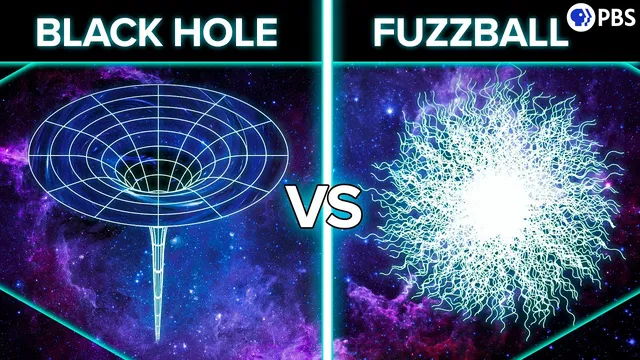
Are Black Holes Actually Fuzzballs?
Based on PBS Space Time's video on YouTube. If you like this content, support the original creators by watching, liking and subscribing to their content.
General relativity predicts both a central singularity and an event horizon, but quantum mechanics conflicts with both, producing the singularity problem and the information paradox.
Briefing
Black holes may be “fuzzballs” rather than empty, hairless regions—an idea from string theory that aims to resolve both the singularity problem and the black hole information paradox. In standard general relativity, matter collapsing under extreme density forms a singularity of infinite density and an event horizon from which nothing escapes. Yet quantum mechanics and general relativity clash at the singularity, and the event horizon creates a second crisis: the no-hair theorem says only mass, charge, and spin are observable from outside, while black hole entropy calculations imply an enormous number of hidden microstates. When black holes evaporate via Hawking radiation, that hidden information would seemingly vanish, violating conservation of quantum information.
String theory offers a different picture. Instead of collapsing into a point, the mass is distributed across the ring-like structure of fundamental strings, removing the infinite-density singularity. The event horizon also stops behaving like a featureless boundary. A key milestone came in 1996, when Andrew Strominger and Cumrun Vafa used string theory to construct a black hole in a controlled “theory-space” setting and counted the microstates associated with the horizon. Those counts matched the Bekenstein entropy formula exactly, suggesting that the information responsible for entropy is encoded in stringy degrees of freedom—specifically configurations involving strings and higher-dimensional objects called D-branes.
The next step was showing that these stringy black holes could reproduce not just entropy but radiation. In the year after the Strominger–Vafa result, Samir Mathur examined whether the model could generate Hawking-like emission. The radiation profile from the stringy setup matched the traditional Hawking radiation behavior, offering a mechanism for how information might leak out during evaporation rather than being erased.
The fuzzball concept then reframes what a black hole “is.” As gravity strengthens, ordinary intuition suggests objects shrink, but black holes grow. In the string-theoretic version, dense strings would not collapse into an empty interior; instead they would expand into an agglomerate whose radius matches a classical black hole. From far away, the object would still look like a black hole—light would be massively redshifted and the spacetime would produce the familiar gravitational lensing and time dilation. But near the would-be horizon, the surface would be a thick, Planck-scale layer of tangled strings and branes.
Crucially, there is no conventional interior. The fuzzball paradigm describes spacetime ending at the surface: the matter dissolved into strings is pushed outward, and the interior region of spacetime effectively disappears. A simplified “lower-dimensional” analogy helps illustrate this: in a one-dimensional black hole, adding compact extra dimensions turns the horizon into a place where spacetime closes off, eliminating the central singularity because there is no longer a meaningful center.
Despite its promise, the fuzzball program is incomplete. The detailed constructions so far rely on simplified, nonrealistic cases like the Strominger–Vafa setup. Building fuzzballs that closely match real astrophysical black holes remains a major open challenge. Still, the framework provides a coherent route to resolving multiple paradoxes at once: singularities are avoided, microstates are accounted for, and information need not be destroyed during evaporation.
Cornell Notes
String theory’s “fuzzball” idea replaces the classical picture of a black hole as a singularity hidden behind a featureless event horizon. In this framework, fundamental strings spread the collapsing mass so the infinite-density singularity does not form. Microstates associated with the horizon can be counted, and the result matches the Bekenstein black hole entropy formula (in a controlled setting). Further work shows the radiation emitted by these stringy black holes can reproduce Hawking-like behavior, suggesting information can escape rather than vanish. The model also predicts a horizon-scale, Planck-thick surface of strings and branes, with no conventional interior spacetime region.
What two paradoxes arise when combining general relativity’s black holes with quantum mechanics?
How does string theory address the singularity problem?
Why was the 1996 Strominger–Vafa result so important?
How does the fuzzball framework aim to resolve the information paradox during evaporation?
What does a fuzzball look like from far away versus up close?
What is “fractionation,” and why does it matter for fuzzball size?
Review Questions
- How do the no-hair theorem and black hole entropy calculations jointly motivate the black hole information paradox?
- What does it mean, in the fuzzball picture, to say there is “no interior” behind the horizon?
- Which specific results (entropy counting and radiation profile) are used to connect stringy black holes to classical black hole thermodynamics?
Key Points
- 1
General relativity predicts both a central singularity and an event horizon, but quantum mechanics conflicts with both, producing the singularity problem and the information paradox.
- 2
The no-hair theorem limits observable external black hole properties to mass, electric charge, and angular momentum, while entropy calculations imply an enormous number of hidden microstates.
- 3
Hawking radiation’s apparent randomness would erase the information tied to those microstates, violating conservation of quantum information.
- 4
String theory replaces the singularity with distributed string structure and reframes the horizon as a place where string and D-brane microstates live.
- 5
The Strominger–Vafa microstate counting matched the Bekenstein entropy formula, strengthening the case that horizon entropy has a concrete microscopic origin.
- 6
Mathur’s analysis found that stringy black holes can emit radiation with a profile matching Hawking radiation, offering a route for information to escape during evaporation.
- 7
Fuzzballs behave like black holes from a distance but have a Planck-thick, stringy surface and no conventional interior spacetime region; realistic astrophysical fuzzballs remain an open research goal.