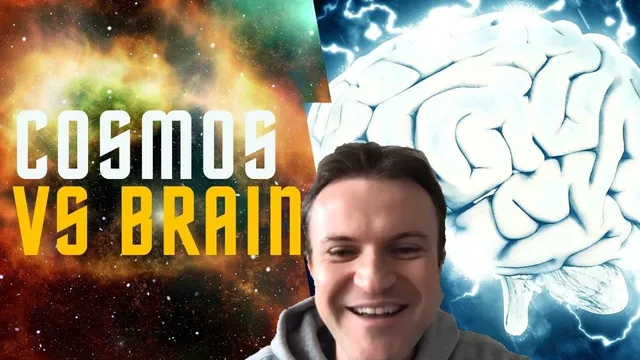
Are Brain and Cosmic Web similar? | Dr Alberto Feletti
Based on Qualitative Researcher Dr Kriukow's video on YouTube. If you like this content, support the original creators by watching, liking and subscribing to their content.
Applying the power spectrum to both the cosmic web and the cortical neuron network yields a similar scale-dependent distribution pattern, suggesting shared architectural logic.
Briefing
A neurosurgeon and an astrophysicist report quantitative similarities between the brain’s cortical neuron network and the universe’s cosmic web—similar enough to suggest shared organizing principles, even though the underlying physics is completely different. The key result comes from applying the same astrophysics tool, the power spectrum, to both systems and finding that the way “matter” is distributed across spatial scales follows a strikingly similar pattern. That scale-by-scale resemblance points to common architectural logic rather than a superficial visual analogy.
The study’s central comparison focuses on the cerebral cortex (and related cortical structures), not the entire brain. That distinction matters because the brain includes long-range connections beyond the local cortical network, while the cosmic web is mapped through galaxies, filaments, and the large-scale structure of matter. By restricting the comparison to the cortical network, the researchers argue they’re comparing like with like—networks whose geometry and connectivity can be analyzed in comparable ways.
Beyond structure, the researchers also examine density and composition. They note that roughly 70–75% of the cosmic web’s density is associated with dark energy, while the cortical network’s material is made up of neurons and their surrounding biological components—proteins, lipids, carbohydrates, and salts. In the comparison, dark energy is treated as the dominant “background” density component in the universe, while the cortical network is treated as floating within a more passive medium (analogized to water). The parallel is not that dark energy equals water, but that both systems share a similar dominant fraction of density tied to a largely “passive” component whose deeper role remains uncertain in each domain.
The analysis goes further than the power spectrum. The researchers also test whether the similarity could be explained by generic natural patterns by comparing both systems to other natural networks—tree branches and cloud turbulence configurations. Those controls did not reproduce the same match with the cosmic web, strengthening the claim that the neuron–cosmic-web resemblance is not just a broad feature of complex networks.
Another important boundary condition: the cosmic web and the cortical network do not appear to be organized in a fractal way. Fractality would imply repeating architecture across scales; instead, the researchers report that this kind of scale-invariant replication is absent.
The implications are framed cautiously. The work is presented as an early, structural step—showing quantitative similarity in architecture—while functional parallels (how information processing in the brain relates to how structure in the universe evolves) remain an open question. The researchers emphasize that the next stage should use more complex network analyses and move from structure toward function.
Finally, the findings have attracted off-topic interpretations, including claims that the results support metaphysical or creationist ideas. The researchers stress that the study stays within scientific comparison and does not justify those conclusions. The collaboration’s broader promise, they suggest, is methodological: borrowing tools across neuroscience and astrophysics could accelerate progress in both fields, including future work on artificial neural networks and improved cosmological modeling.
Cornell Notes
Neuroscientist Alberto Feletti and astrophysicist Franco Vaza report quantitative parallels between the cosmic web and the cortical neuron network. Using an astrophysics method—the power spectrum—they find that both systems distribute matter across spatial scales in a similar way, suggesting shared organizing principles despite different physical laws. They also compare density composition, noting that both systems have a dominant ~70–75% fraction associated with a largely “passive” component (dark energy in cosmology; a water-like medium in the cortex), while clarifying that this is not an equivalence of substances. Control comparisons with tree branches and cloud turbulence do not reproduce the same pattern, and the researchers report the structures are not fractal. The work is positioned as a structural starting point, with functional comparisons left for future, more complex analyses.
What method lets the study compare the cosmic web and cortical neurons in a quantitative way?
Why does the comparison focus on the cortex rather than the whole brain?
How do density and composition similarities enter the argument?
What control comparisons help rule out a generic “complex network” explanation?
What does the study say about fractality?
What’s the next step beyond structural similarity?
Review Questions
- How does the power spectrum help reveal similarities between two systems that obey different physical laws?
- What reasons does the study give for limiting the brain side of the comparison to the cortex?
- Why do the researchers treat the ~70–75% density parallel as suggestive but not as an equivalence of dark energy and water?
Key Points
- 1
Applying the power spectrum to both the cosmic web and the cortical neuron network yields a similar scale-dependent distribution pattern, suggesting shared architectural logic.
- 2
The comparison is intentionally limited to the cerebral cortex (and related cortical structures) rather than the whole brain to avoid confounds from long-range connections.
- 3
A density parallel is discussed: both systems have a dominant ~70–75% fraction tied to a largely “passive” component (dark energy in cosmology; a water-like medium in the cortex), without claiming the substances are equivalent.
- 4
Control analyses using tree branches and cloud turbulence do not reproduce the same cosmic-web–neuron similarity, arguing against a purely generic complex-network explanation.
- 5
The cosmic web and cortical network do not appear to be organized fractally, meaning the architecture does not replicate identically across scales.
- 6
The work is positioned as a structural starting point; functional comparisons require additional, more complex network analyses.
- 7
Off-topic interpretations (including metaphysical or creationist claims) are explicitly rejected as outside the study’s scientific scope.