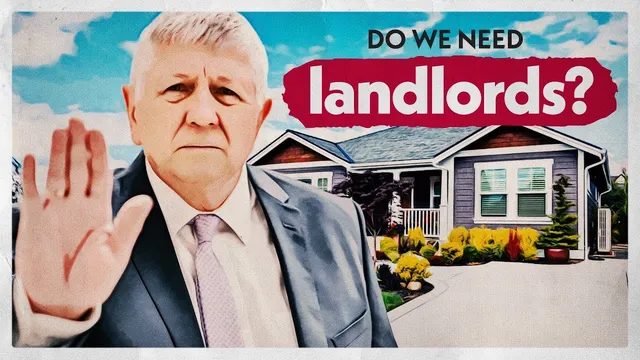
Are Landlords Really That Bad?
Based on Second Thought's video on YouTube. If you like this content, support the original creators by watching, liking and subscribing to their content.
Landlording is framed as rent-seeking: landlords earn from owning housing rather than producing value.
Briefing
Landlording is framed as a rent-seeking system: landlords earn money largely from owning a necessary asset—housing—rather than producing value. With rent rising far faster than inflation, the arrangement concentrates wealth while doing little to expand supply or improve living conditions. The core claim is that this “passive income” model depends on legal ownership of housing, not on building it, designing it, financing it, or maintaining it beyond minimal requirements.
The argument draws a sharp line between workers who transform materials or provide services and landlords who, in the standard case, do not. Housing already exists because developers, architects, construction workers, electricians, and others have done the work. Landlords then collect rent by controlling access to that housing, often outsourcing maintenance to property managers or doing only the bare minimum needed to keep units “livable.” When landlords argue that they “provide housing,” the transcript compares them to scalpers: the housing is already there, and the landlord’s role is portrayed as skimming money by controlling supply they did not create.
The transcript backs this with income and affordability claims. It cites an average landlord income of about $97k in the U.S., described as more than double the average renter’s income, and argues that even full-time minimum-wage workers cannot afford modest two-bedroom rentals in every U.S. state, metro area, or county. It also claims that only 9% of counties allow a full-time minimum-wage worker to afford a one-bedroom rental. In this framing, rent becomes so high that it blocks the “just buy your own home” response.
That “buy instead of rent” rebuttal is treated as structurally unrealistic. The transcript emphasizes that homeownership requires down payments from savings, not just mortgages, and that banks often deny mortgages based on credit risk—while still allowing the same people to pay rent. It also describes a common dynamic where renters effectively cover the landlord’s mortgage costs, leaving the landlord with the asset while the tenant exits with nothing. For younger renters, it adds, the path to down payments is made harder by high housing costs and limited wealth.
The consequences are presented as both economic and political. If renting is exploitative and ownership is out of reach, the transcript argues the remaining options narrow toward homelessness—then adds that homelessness is criminalized or made harder through anti-camping laws and aggressive enforcement. It cites official figures of 3.6 million eviction notices filed each year and claims homelessness affects millions annually, including children.
Finally, the transcript expands the critique from individual landlords to large investment firms and policy influence. It argues that for-profit companies control a large share of housing—citing Pew estimates of about 45% of the supply (21.7 million units)—and that investor-owned housing tends to bring aggressive rent hikes, fee gouging, and higher eviction rates. It names major firms including Blackstone and Blackrock, and argues these players lobby against rent control and profit from tenant turnover and enforcement mechanisms. The piece concludes that removing profit-driven middlemen could make affordable or even free housing feasible, pointing to examples of public housing models abroad (including Vienna) and to the existence of vacant homes in the U.S. as evidence that the problem is allocation and incentives, not housing scarcity.
Cornell Notes
The transcript portrays landlords as rent-seekers who profit from owning housing rather than producing it. It argues that housing already exists due to developers, builders, and tradespeople, while landlords mainly control access and collect rent—often with minimal added labor. Because rent is portrayed as unaffordable even for minimum-wage workers, the “just buy a home” argument is framed as structurally false due to down-payment barriers and mortgage denials. The harms are described as extending beyond individual landlords to investor-owned housing firms, which are said to drive rent hikes, fees, and evictions while using political influence to block rent control. The conclusion is that affordable or public housing is feasible if profit incentives are removed.
What does “rent-seeking” mean in this argument, and why is it applied to landlords?
How does the transcript challenge the claim that landlords “provide housing”?
Why does the transcript say “just buy your own home” doesn’t work for most renters?
What are the described consequences of the landlord-tenant system?
How does the critique expand from individual landlords to large investors and politics?
What alternative does the transcript point to?
Review Questions
- Which parts of the housing process does the transcript attribute to non-landlord roles, and how does that support the rent-seeking claim?
- What specific barriers to homeownership does the transcript list, and how do they undermine the “buy instead of rent” argument?
- How does the transcript connect eviction, enforcement, and anti-homeless policies to its conclusion about renting under duress?
Key Points
- 1
Landlording is framed as rent-seeking: landlords earn from owning housing rather than producing value.
- 2
Housing is portrayed as created by developers, architects, construction workers, and tradespeople, while landlords mainly control access and collect rent.
- 3
The transcript argues rent growth has outpaced inflation and that minimum-wage workers cannot afford typical rentals in most U.S. locations.
- 4
“Just buy your own home” is challenged using down-payment requirements, mortgage denial risk, and the claim that renters often pay landlords’ mortgage costs.
- 5
Homelessness is presented as a likely downstream outcome of unaffordable rent, with enforcement and anti-camping measures described as worsening the situation.
- 6
The critique extends to investor-owned housing firms, which are said to drive higher rents, fees, and evictions and to oppose rent control.
- 7
The proposed remedy is affordable or public housing funded by removing profit incentives from housing supply.