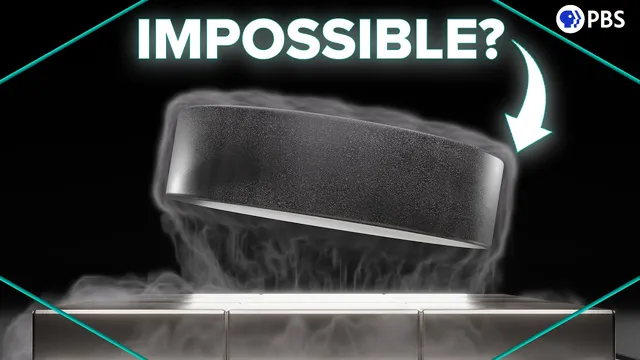
Are Room Temperature Superconductors IMPOSSIBLE?
Based on PBS Space Time's video on YouTube. If you like this content, support the original creators by watching, liking and subscribing to their content.
Room-temperature superconductivity would eliminate the need for extreme cryogenic cooling and could enable practical levitation and high-field magnet technologies.
Briefing
Room-temperature superconductivity remains unproven, and the recent LK-99 claim collapsed under replication attempts—yet the broader dream isn’t dismissed so much as constrained by incomplete physics. Superconductors are defined by zero electrical resistance and the ability to expel magnetic fields (the Meissner effect), but achieving those properties typically requires cooling to extremely low temperatures. If superconductivity could truly occur at room temperature, it would unlock practical technologies ranging from levitating transport systems to high-performance magnets without cryogenic infrastructure.
The LK-99 episode became a modern test case for that hope. A research team reported a sharp resistance drop below 127°C and suggested partial levitation in a magnetic field—signals that, if real, would imply superconductivity far above typical limits. But multiple independent groups later synthesized the same material and found no evidence of superconductivity. Explanations for the earlier “signal” include the possibility that impurities made the sample unusually conductive without being superconducting, and that the observed levitation could have come from ordinary ferromagnetism rather than the Meissner effect, which is the hallmark of true superconductivity.
To understand why room-temperature superconductivity is so hard, the transcript walks through how superconductivity works at a fundamental level. In normal conductors, electrons scatter and exchange energy through collisions, producing heat and resistance; cooling reduces that random motion and lowers resistance, but it doesn’t automatically eliminate it. The breakthrough came in 1911 when Heike Kamerlingh Onnes cooled mercury below 4.2 K and observed resistance vanish—an early confirmation that “near-zero resistance” can occur, though not for naive reasons.
Superconductivity also produces magnetic behavior that looks like magic: a superconductor can float above a magnet. The Meissner effect is tied to how superconductors generate persistent shielding currents at their surfaces. These currents cancel the applied magnetic field inside the material, expelling magnetic flux. Early theory by Fritz and Heinz London captured the exponential decay of magnetic fields inside superconductors, but it assumed perfect conductivity and equilibrium. Later, the Ginzburg–Landau framework treated superconductivity as a phase transition and predicted that magnetic fields can destroy superconductivity beyond critical limits.
That phase-transition view led to two distinct categories: Type I superconductors lose superconductivity abruptly when the magnetic field crosses a critical threshold, while Type II superconductors enter a vortex state where magnetic flux penetrates in quantized tubes. In Type II materials, flux pinning can lock vortices in place, enabling stable levitation and fixed orientations in magnetic fields.
The transcript then connects the “why” to the BCS theory developed by John Bardeen, Leon Cooper, and John Robert Schrieffer. As materials cool, electrons form Cooper pairs and condense into a coherent quantum state. In that state, energy excitations needed for scattering become unavailable, preventing the collisions that normally cause resistance. Still, high-temperature superconductivity does not follow a single universally accepted mechanism, especially in copper-oxide-based materials where Cooper pairing is debated. That uncertainty makes it difficult to predict an absolute maximum temperature for superconductivity.
Historically, progress has pushed critical temperatures upward—from 4.2 K in early experiments to 35 K in 1986 (Georg Bednorz and K. Alex Müller) and beyond 93 K, enabling cooling with liquid nitrogen. Yet even the best known results remain far below room temperature, and the physics behind high-temperature superconductivity is not fully settled. The LK-99 failure therefore doesn’t end the quest; it highlights that extraordinary claims require extraordinary, reproducible evidence—and that the underlying theory still lacks the clarity needed to confidently engineer superconductivity at ambient conditions.
Cornell Notes
Superconductors lose electrical resistance and expel magnetic fields, but they usually require extreme cooling. The LK-99 claim—resistance dropping below 127°C and partial levitation—did not survive replication: later syntheses found no superconductivity, and the levitation may have been ordinary ferromagnetism rather than the Meissner effect. Physics progress explains how superconductivity works: in the BCS picture, cooling allows electrons to form Cooper pairs that condense into a coherent quantum state where energy excitations needed for scattering are suppressed, eliminating resistance. Theory also predicts magnetic-field limits and two superconductor types: Type I (abrupt loss) and Type II (vortex state with flux pinning). Room-temperature superconductivity remains unknown because high-temperature mechanisms—especially in copper-oxide materials—aren’t fully agreed upon, making temperature limits hard to calculate.
What makes a material “superconducting” rather than merely “conductive,” and why does that matter for LK-99?
How does the Meissner effect produce levitation?
Why did theory shift from London’s approach to Ginzburg–Landau?
What distinguishes Type I and Type II superconductors in a magnetic field?
How does BCS theory connect cooling to zero resistance?
Why is room-temperature superconductivity still an open question?
Review Questions
- What experimental signatures distinguish the Meissner effect from ordinary ferromagnetism in a levitation claim?
- In BCS theory, what role do Cooper pairs and the inability to excite energy states play in eliminating resistance?
- Why does the lack of a single accepted mechanism for high-temperature superconductors make it hard to predict a room-temperature limit?
Key Points
- 1
Room-temperature superconductivity would eliminate the need for extreme cryogenic cooling and could enable practical levitation and high-field magnet technologies.
- 2
LK-99’s reported superconductivity signals (resistance drop near 127°C and partial levitation) were not reproduced by independent groups.
- 3
The Meissner effect—magnetic-field expulsion via shielding currents—is a defining superconducting signature that ferromagnetism can imitate superficially.
- 4
London equations modeled magnetic-field decay inside superconductors but relied on assumptions (perfect conductivity and equilibrium) that later theories refined.
- 5
Ginzburg–Landau theory treated superconductivity as a phase transition and predicted critical magnetic-field limits and the existence of Type I vs Type II behavior.
- 6
BCS theory attributes zero resistance to Cooper-pair formation and a coherent quantum state that prevents the excitations required for scattering.
- 7
High-temperature superconductivity mechanisms remain unsettled, especially in copper-oxide systems, limiting confidence in any predicted maximum temperature.