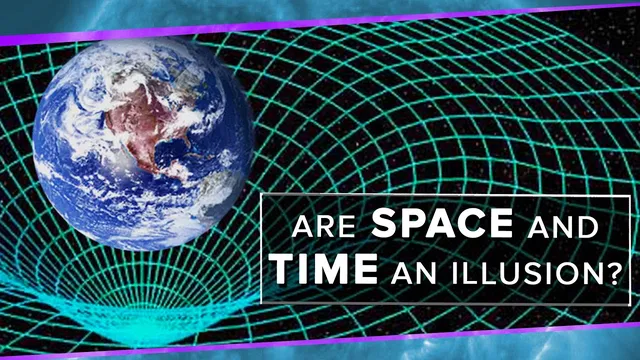
Are Space and Time An Illusion?
Based on PBS Space Time's video on YouTube. If you like this content, support the original creators by watching, liking and subscribing to their content.
Relativity permits observers in different motion to disagree about elapsed time, spatial separation, and even event order while remaining internally consistent.
Briefing
Relativity forces a sharp split between what observers can disagree about and what they can’t: people may not agree on the order of events, the amount of time elapsed, or even the spatial separation between things, yet they still converge on a single, objective quantity—the spacetime interval. That mismatch matters because it undermines the usual idea that there is one universal past, present, and future that everyone shares, raising direct philosophical pressure on notions like free will and whether the future can be changed.
The core setup is simple but destabilizing. When two observers move relative to each other, they can measure different elapsed times and different distances between the same events. They can also disagree about which event comes first. Still, each observer’s measurements remain internally consistent, so neither perspective is “wrong” in the usual sense. The disagreement becomes especially consequential when it extends to event sequence: if two observers can’t agree on ordering, then what counts as someone’s past can correspond to someone else’s future. For nearby events the effect is tiny, but the principle is global—there is no single, observer-independent division of reality into past, present, and future.
So what remains objective? The episode points to causality as the anchor. Even when time and space measurements differ, observers agree on the spacetime interval (also called spacetime separation) between two events. That interval can be positive, zero, or negative, and its sign determines whether influence is possible. When the interval is positive, no signal can travel between the events; observers will disagree about which happened first. When the interval is zero or negative, signals can connect the events, and everyone agrees on their sequence. In this framing, causality—not time—acts as the real invariant.
From there, the discussion leans into a geometric interpretation associated with Hermann Minkowski. The spacetime interval resembles a distance measure in a non-Euclidean geometry, motivating the idea that reality is best modeled as a four-dimensional, tenseless mathematical space where all events exist as points. In this view, spacetime isn’t a three-dimensional space that “evolves” through time; it’s a 4D structure that already contains every event everywhere, ever. What’s objectively real are the geometric relations among those event-points—especially causal relations encoded by the spacetime interval. Human experience of time and space, by contrast, is treated as a useful coordinate system imposed by brains, not something that exists independently.
The episode then pushes the idea further by describing a person as a geometric object: a line segment connecting the event of birth to the event of death. There is no literal motion along that segment; rather, the “you” is the segment itself. The future isn’t merely predetermined in a conventional sense—it already exists within the 4D structure. The result is a reality picture that is less about traveling through time and more about the geometry of event relations.
Finally, the episode flags that this is “flat spacetime,” a stepping stone before general relativity introduces multiple possible spacetime geometries. The takeaway is that the most observer-independent feature isn’t the flow of time or the shape of space, but the causal structure encoded by spacetime intervals.
Cornell Notes
Relativity allows observers in different motion to disagree about elapsed time, spatial distance, and even the order of events, while still agreeing on a single invariant: the spacetime interval (spacetime separation). The sign of that interval determines whether one event can causally influence another—positive intervals block influence and permit ordering disagreements, while zero or negative intervals allow signals and force agreement on sequence. This shifts the focus from time as the driver of causality to causality as the invariant feature that time-like descriptions must respect. Minkowski’s geometric view treats spacetime as a four-dimensional, tenseless non-Euclidean structure where all events exist as points, and objective reality is encoded in geometric relations among those points, especially causal ones.
How can two observers disagree about the order of events without either being “wrong”?
What invariant do all observers agree on, even when time and space measurements differ?
How does the sign of the spacetime interval connect to causality?
Why does the discussion claim causality is more fundamental than time?
What does Minkowski’s geometric picture add to the relativity story?
What does it mean to say a person is a line segment in spacetime?
Review Questions
- What does it mean for two events to have a positive versus zero/negative spacetime interval, and how does that affect causal influence?
- How does the episode’s argument connect disagreement about event order to the absence of a universal past/present/future?
- In Minkowski’s tenseless spacetime view, what counts as objectively real: experienced time/space or geometric relations among event-points?
Key Points
- 1
Relativity permits observers in different motion to disagree about elapsed time, spatial separation, and even event order while remaining internally consistent.
- 2
The spacetime interval (spacetime separation) is the shared invariant across all observers for any pair of events.
- 3
A positive spacetime interval blocks causal influence and allows ordering disagreements; a zero or negative interval permits signals and forces agreement on sequence.
- 4
Causality functions as the observer-independent backbone, while time and space measurements behave like frame-dependent coordinates.
- 5
Minkowski’s geometric interpretation treats spacetime as a four-dimensional, tenseless non-Euclidean structure where all events exist as points.
- 6
In the 4D picture, a person can be represented as a line segment connecting birth and death events, with no literal “motion through spacetime.”
- 7
The discussion is limited to flat spacetime and sets up the next step: general relativity’s multiple possible spacetime geometries.