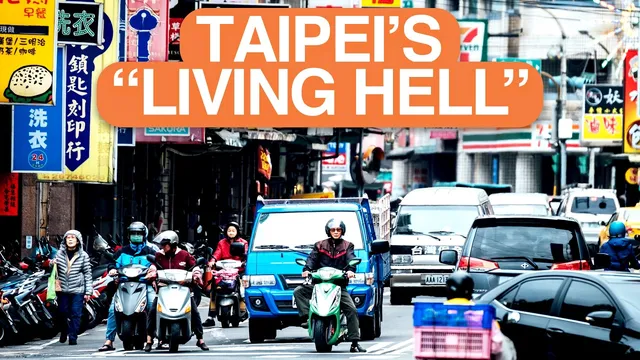
Are Taipei's Roads Still a "Living Hell"?
Based on Not Just Bikes's video on YouTube. If you like this content, support the original creators by watching, liking and subscribing to their content.
A 3-meter minimum distance rule for vehicles at pedestrian crossings, backed by steep fines and visible enforcement, correlates with drivers stopping more consistently for pedestrians.
Briefing
Taipei’s streets have improved since the early 2010s, but the “living hell” label still fits parts of the city—especially outside the most redesigned districts—because cars, mopeds, and street design choices continue to dominate public space.
A turning point came after a 2022 CNN report highlighted Taiwan’s poor road-safety record, including daily pedestrian injuries and deaths in Taipei and a disproportionate share involving people over 65. That coverage amplified long-running complaints from residents and foreigners, and it helped accelerate Safe Streets initiatives. When visiting again after more than a decade, the traveler noticed immediate behavioral changes: cars and even moped riders were more likely to stop for pedestrians at crossings. A new rule requiring motor vehicles to keep at least 3 meters away from people at pedestrian crossings, along with steep fines for drivers who fail to yield, appears to be changing day-to-day conduct—because enforcement, not just legislation, seems to be happening.
Physical infrastructure has also shifted in targeted ways. Sidewalks remain a weak spot overall—many are still too narrow or uneven—but there are visible upgrades: some streets have been widened, bike lanes have appeared, and curb ramps have smoothed out dangerous sidewalk level changes. In Shinyi District, Taipei’s best-known urban-design showcase, there’s more bike infrastructure and a docked bike-share system (Ubike) with thousands of docks planned to expand further. The Metro system has expanded rapidly too, with new stations, an airport express line opened in 2017, and additional lines under construction—improvements that reduce reliance on cars for many trips.
Yet the improvements come with limits. Painted “sidewalk” areas—green stripes intended to make wider roads safer—are treated as temporary fixes that can become permanent and may not help much on narrow streets. The more fundamental problem is that narrow lanes still lack enough space for pedestrians, and car traffic remains privileged. The traveler argues that the most effective approach on narrow streets would be to reduce through traffic—through one-way street mazes or modal filters—rather than simply marking space for walking.
Cycling infrastructure shows the same pattern: some new lanes are good, but many are unprotected, poorly connected, or end abruptly. In several places, bike lanes take space from already tight sidewalks, creating conflicts between walkers and cyclists. Mopeds intensify the challenge: they’re everywhere, often fast, sometimes ride on sidewalks, and their presence makes it harder to separate modes safely. The traveler compares Taipei’s moped culture to Amsterdam’s earlier bike-lane approach, noting that speed control and enforcement matter.
Outside Taipei’s most investment-heavy areas—especially in New Taipei City’s Jonghe District—the “living hell” label returns. Wide intersections, high traffic volumes, uneven and obstructed sidewalks (often narrowed by parked mopeds), and buses stuck in congestion make walking feel genuinely unsafe. Even when new Metro lines arrive, the benefits can be undercut by difficult transfers and continued car-first street layouts.
The bottom line: Taipei has made sustained progress in transit and selective street safety measures, but achieving consistently safe walking and cycling will require taking space away from cars and mopeds—wider sidewalks, more car-free streets, better crossing design, removal of street parking, stronger traffic calming, and dedicated bus lanes. The next decade hinges on whether those changes can scale beyond the districts where they already work.
Cornell Notes
Taipei’s road safety has improved since the early 2010s, with stronger pedestrian yielding behavior linked to a new 3-meter crossing rule and enforcement after major media attention in 2022. Sidewalks and cycling infrastructure have seen upgrades in places like Shinyi District, alongside major Metro expansion (including an airport express line and ongoing projects) that reduces dependence on cars. Still, many streets remain unsafe for pedestrians and cyclists because cars and mopeds retain priority: sidewalks are often too narrow or uneven, bike lanes can be unprotected or poorly connected, and mopeds frequently move unpredictably and sometimes on sidewalks. In New Taipei City’s Jonghe, the “living hell” conditions—traffic, obstructed sidewalks, and congestion—persist, suggesting the hardest work is shifting street space away from motorists citywide.
What specific policy change is credited with making drivers more likely to stop for pedestrians?
Why are painted “sidewalk” markings viewed as a limited safety solution?
What design principle is proposed for narrow streets to improve safety more effectively than markings?
How does moped traffic undermine both walking and cycling safety in Taipei?
What’s the strongest evidence that transit investment is changing mobility patterns?
Why does New Taipei City’s Jonghe District feel less improved than central Taipei?
Review Questions
- Which combination of legal requirements and enforcement is linked to improved pedestrian yielding at crossings?
- What tradeoffs does the traveler identify between bike-lane expansion and sidewalk space in Taipei?
- Why does the traveler argue that reducing car volumes may be more effective than adding painted pedestrian zones on narrow streets?
Key Points
- 1
A 3-meter minimum distance rule for vehicles at pedestrian crossings, backed by steep fines and visible enforcement, correlates with drivers stopping more consistently for pedestrians.
- 2
Sidewalk safety improvements are uneven: curb ramps and smoothing of sidewalk level changes help, but many sidewalks remain too narrow or obstructed.
- 3
Green-striped, painted “sidewalk” markings are treated as temporary fixes that may not deliver the physical space pedestrians need, especially on wider roads.
- 4
Safer narrow streets likely require traffic reduction (one-way street patterns or modal filters) rather than simply designating walking space with paint.
- 5
Bike infrastructure progress is real but inconsistent: some lanes are widened and improved, while others lack protection, end abruptly, or steal space from already narrow sidewalks.
- 6
Mopeds are a central safety constraint due to speed, unpredictability, and frequent sidewalk/pedestrian-area use, making separation of modes difficult.
- 7
Metro expansion—new stations, an airport express line, and ongoing projects—provides a practical alternative to car travel, but street-level car priority still limits overall safety gains.