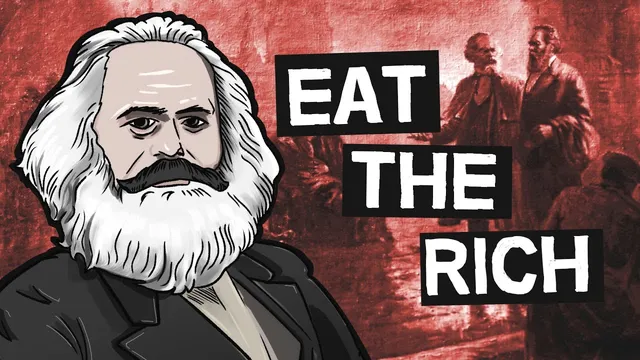
Are the Rich Screwing Us Over? | Marxism Explored
Based on Einzelgänger's video on YouTube. If you like this content, support the original creators by watching, liking and subscribing to their content.
Marxism frames capitalism as a system where workers create value but do not control the means of production, enabling owners to capture surplus as profit.
Briefing
Marxism’s core claim is that capitalism systematically transfers the value created by workers to a small class that owns the means of production—producing exploitation, widening inequality, and eventually destabilizing economies. The argument matters because it frames today’s wage work not as a neutral market arrangement, but as a recurring structure of power: workers sell their labor power for wages, while employers capture the surplus as profit. Even when capitalism brings more legal freedoms than slavery or feudalism, Marx treats that progress as real but incomplete—because the basic split between those who decide and those who work remains.
The transcript traces how Marx connects capitalism to earlier “modes of production.” It begins with “primitive communism,” where hunter-gatherer societies are described as egalitarian and collectively owned, with little drive for surplus or profit. As agriculture and settled life expand production, the account says surplus enables private property and class divisions, leading to slavery: masters own people, and slaves produce both what they need to survive and an additional surplus that goes to owners. After slavery, feudalism replaces masters with landowning lords and serfs who are tied to land but retain some rights; the serfs work for themselves part of the week and for the lord the rest.
Capitalism then appears as a further shift: the means of production are privately owned, and the goal becomes profit. Workers are no longer owned as property, but they still do not control the productive assets that generate income. The transcript uses a time-based example to illustrate Marx’s surplus-value logic: by midweek, a worker’s output is said to cover the wage, while the remainder of the workday produces surplus that becomes profit. It also cites Richard David Wolff’s framing that wages correspond to “necessary labor time,” while employer-retained revenue comes from “surplus labor time.” The result is a paradox—formal freedom from ownership coexists with economic dependence on employers.
Marx’s critique deepens in two directions. First is exploitation: increasing productivity through technology and efficiency, the account says, often intensifies pressure on workers—through quotas, monitoring, longer hours, and automation that speeds production without sharing gains. Second is estrangement (alienation): specialization breaks work into repetitive tasks, leaving workers disconnected from the product, from their own human potential, and even from one another as competition replaces solidarity. The transcript links this to inequality’s feedback loop: wages are kept low, the proletariat stays dependent, and the bourgeoisie accumulates more capital, hires more labor, and expands profit.
Finally, the transcript argues that capitalism is unstable. It points to boom-and-bust cycles, shifting employment and purchasing power, and the political temptation to scapegoat groups during downturns—setting the stage for populist leaders. Marx’s hoped-for resolution is class struggle: workers overthrow the capitalist order and build a more democratic economy where collective ownership replaces employer control.
Yet the transcript also confronts the historical record. Marxist-inspired regimes in the 20th century—named through China and the Soviet Union—are described as improving some conditions (ending feudalism, expanding education and healthcare) while deviating from Marx’s vision. Instead of bottom-up worker revolution, power is said to have been seized by factions that imposed communism from above, producing “state capitalism,” corruption, oppression, and widespread poverty. The account closes by noting that capitalism has evolved—citing Nordic welfare models as a partial balance—but inequality remains global, with wage stagnation, housing and mental-health crises, environmental problems, and even forms of forced labor in some regions. The takeaway is that Marx’s diagnosis still resonates because the underlying pattern—workers producing value without controlling it—has not disappeared.
Cornell Notes
Marxism, as presented here, argues that capitalism creates exploitation and inequality by separating those who own the means of production from those who do the work. Workers receive wages for “necessary labor time,” while employers capture the value created during “surplus labor time” as profit. The transcript links this structure to alienation: specialization makes work repetitive, disconnects people from the products of their labor, and turns coworkers into rivals. It also describes capitalism as unstable, producing cycles of boom and bust that can fuel scapegoating and populism. Attempts to implement Marx’s ideas in the 20th century are portrayed as deviating from his democratic, worker-led vision, often resulting in oppressive “state capitalism.”
How does the transcript explain exploitation under capitalism using the “necessary” vs “surplus” labor idea?
Why does the transcript say capitalism can be “free” yet still resemble earlier exploitative systems?
What does “estrangement” (alienation) mean in this account, and how does specialization contribute?
How does the transcript connect productivity increases to harsher conditions for workers?
What historical outcomes does the transcript cite for Marxist-inspired regimes, and how do they differ from Marx’s vision?
What does the transcript say about capitalism’s instability and its political consequences?
Review Questions
- According to the transcript’s surplus-value example, what changes after the worker’s output equals their wage, and why does that matter for profit?
- How does specialization produce both economic exploitation and psychological/social alienation in the transcript’s account?
- What specific ways does the transcript say Marxist-inspired governments diverged from Marx’s democratic, worker-led ideal?
Key Points
- 1
Marxism frames capitalism as a system where workers create value but do not control the means of production, enabling owners to capture surplus as profit.
- 2
The transcript uses a “necessary labor time” versus “surplus labor time” distinction to explain why wages do not equal the full value workers produce.
- 3
Capitalism is portrayed as formally freer than slavery or feudalism while still creating economic dependence through wage labor.
- 4
Estrangement (alienation) is linked to specialization and repetitive work, plus competition among workers that erodes solidarity.
- 5
Rising productivity is described as often increasing pressure on workers because profit maximization—not shared gains—drives technological change.
- 6
The transcript argues capitalism’s boom-and-bust cycles contribute to political instability, scapegoating, and populist appeals during downturns.
- 7
Historical attempts to implement Marx’s ideas are described as often producing oppressive “state capitalism” rather than the democratic, classless society Marx envisioned.