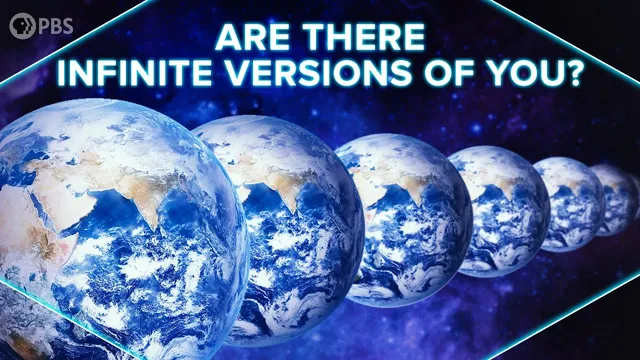
Are there Infinite Versions of You?
Based on PBS Space Time's video on YouTube. If you like this content, support the original creators by watching, liking and subscribing to their content.
An infinite universe makes repeated, near-identical cosmic regions plausible, which would generate infinite versions of a person if matching initial conditions lead to matching histories.
Briefing
An infinite universe would make “infinite yous” hard to avoid—not because every possible outcome must occur, but because the laws of physics and the range of allowed starting conditions likely force repeated, near-identical regions. If the cosmos extends without bound and the initial conditions that seed each region can only take a finite number of distinguishable values, then some regions must match closely enough that their later evolution becomes effectively the same. In that case, countless versions of a person—down to the same “you” emerging after 13.5 billion years of cosmic history—would exist somewhere.
The argument starts with the cosmological possibility of an infinite universe. Even though the universe could be finite (if it contains enough matter and energy to “close” on itself) or the simplest reading of cosmological equations could be wrong, an infinite cosmos remains plausible under current theoretical frameworks. If infinity holds, then every physically allowed configuration could appear in infinite multiplicity. To make the idea intuitive, the discussion borrows the “infinite monkey theorem”: with infinitely many monkeys randomly typing, any event with non-zero probability eventually happens. The Shakespeare example is astronomically unlikely, but not impossible—so with enough trials, it becomes inevitable somewhere.
Translating that to people requires a key refinement: not every logically possible scenario must occur, only those consistent with the laws of physics and with the kinds of initial conditions the universe can actually realize. A universe with “standard typewriters” could reproduce Shakespeare, but might never generate a version requiring characters that the system can’t produce (like an inverted question mark). Likewise, there’s no version of someone with Captain Marvel superpowers if those powers violate physical laws. The real question becomes whether an infinite universe repeats the same kinds of starting conditions.
Here the reasoning shifts from probability to counting. In a deterministic universe, the future history of a region is fixed by its starting conditions—until influences from neighboring regions arrive. Quantum processes set those initial conditions, but the number of distinguishable possibilities may still be finite. If the set of allowed configurations is finite, then with infinitely many regions, repetition becomes unavoidable: some regions must be identical (or close enough) in the properties that matter for later evolution. Chaos amplifies tiny differences, but there’s still a threshold of “ridiculously tiny” deviation that would keep two 13.5-billion-year histories effectively indistinguishable.
The discussion also notes that the laws of physics themselves could vary between regions via different constants or vacuum energy. Yet if those values also come from a finite menu, repetitions still follow. Eternal inflation—where regions with different vacuum energies expand and spawn new subregions—offers a route to an effectively infinite universe, and it naturally produces many “copies” of cosmic patches.
To support the finiteness claim, the transcript invokes a bound from black-hole thermodynamics: Bekenstein and Hawking’s entropy limit ties the maximum information in a region to the number of Planck-scale areas covering its boundary. That translates into an upper limit on how many distinct configurations a region can have. For the observable universe, the count is capped at no more than 2^(10^123) possible configurations, and likely far fewer for non-black-hole regions. If the larger universe contains more regions than that, at least one region must match the observable one closely enough to yield the same “you.”
The conclusion is conditional: infinite yous are not guaranteed unless the universe is truly infinite (or infinite enough to duplicate itself). The transcript ends with a reality check—monkeys in a real experiment didn’t type randomly—and with the admission that the biggest assumption remains whether the cosmos is infinite. Still, given current theoretical pathways to infinity, the existence of infinite versions of a person becomes a difficult idea to dismiss.
Cornell Notes
If the universe is infinite, then repeated cosmic “patches” become likely because the number of physically distinguishable starting conditions in any region is probably finite. In a deterministic (or effectively deterministic) setting, matching initial conditions lead to matching histories, and chaos allows only tiny deviations before outcomes diverge—yet there’s still a tolerance where two histories become indistinguishable over 13.5 billion years. With infinitely many regions, some must repeat, producing infinite versions of the same person. The argument is conditional: it depends on the universe being infinite (or effectively so) and on the laws of physics allowing only a finite range of distinguishable configurations. Entropy bounds from Bekenstein and Hawking provide a quantitative ceiling on how many configurations a region can have, strengthening the duplication claim.
How does the “infinite monkey theorem” connect to the idea of infinite versions of you?
Why doesn’t the argument claim every possible scenario must occur infinitely often?
What does it mean for two regions to have the “same” starting conditions?
What role do entropy bounds (Bekenstein–Hawking) play in the duplication argument?
Why is eternal inflation relevant to the “infinite universe” premise?
What real-world result challenges the “infinite monkey theorem” intuition?
Review Questions
- What assumptions about initial conditions and determinism are required for repeated regions to produce repeated versions of a person?
- How does the Bekenstein bound translate entropy into a limit on the number of possible configurations, and why does that matter for duplication in an infinite universe?
- What kinds of physical constraints prevent “every possible thing” from occurring, even if the universe is infinite?
Key Points
- 1
An infinite universe makes repeated, near-identical cosmic regions plausible, which would generate infinite versions of a person if matching initial conditions lead to matching histories.
- 2
The argument does not require every conceivable scenario; only physically allowed outcomes consistent with the laws of physics can repeat.
- 3
Chaos means tiny differences in starting conditions can cause divergence, but there is still a threshold where two histories become effectively indistinguishable over 13.5 billion years.
- 4
Repeated initial conditions become unavoidable if the number of distinguishable starting configurations for a region is finite and the universe contains infinitely many regions.
- 5
Bekenstein–Hawking entropy bounds provide a quantitative ceiling on the number of possible configurations in a region, strengthening the finiteness—and thus repetition—claim.
- 6
Eternal inflation offers a mechanism for producing an effectively infinite universe, making duplication more likely.
- 7
The biggest uncertainty remains whether the universe is truly infinite (or infinite enough) and whether the extrapolated cosmological framework applies indefinitely.