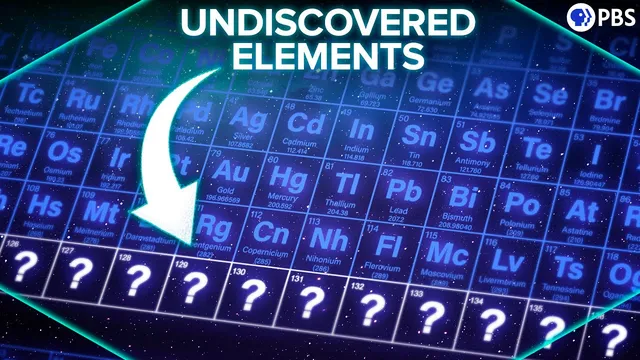
Are there Undiscovered Elements Beyond The Periodic Table?
Based on PBS Space Time's video on YouTube. If you like this content, support the original creators by watching, liking and subscribing to their content.
Technetium (element 43) was predicted by Mendeleev but absent from nature because it decays too quickly after stellar material reaches Earth.
Briefing
New elements beyond the periodic table are not only possible—they’ve already happened—but the most realistic path forward is not “missing slots” filled by magic chemistry. The periodic table is organized by atomic number (the number of protons), and every element is defined that way. Still, nature leaves gaps because many nuclei are unstable: even when an element exists, most of its isotopes may decay quickly enough that it won’t survive long on Earth. That’s why the first “missing” element, technetium, had to be made in the lab even though it can be produced in stars.
Mendeleev’s periodic table predicted a missing element between molybdenum and ruthenium—atomic number 43—based on recurring chemical patterns as atomic weight increased. For decades, chemists searched and found nothing in nature. In 1937, Emilio Segrè and Carlo Perrier produced technetium by irradiating molybdenum foil in Ernest Lawrence’s cyclotron, effectively transmuting some nuclei by adding a proton. The result matched Mendeleev’s placement: technetium’s chemistry sits between its neighboring elements, even though Earth lacks long-lived technetium. The reason is timing and instability. Technetium is forged in massive stars and delivered to planets after supernovae, but it decays so fast that by the time Earth forms, essentially none remains.
The transcript then broadens from one element to the rules of nuclear stability. Every element has unstable isotopes, not just the heaviest ones. Carbon-14, for example, decays into nitrogen with a half-life of about 5,700 years, while technetium isotopes vary wildly—Tc-97 lasts about 4.2 million years, but Tc-96 survives only 51 minutes. Larger atomic numbers generally mean fewer stable isotopes and shorter half-lives, and beyond 118 protons nuclei decay so quickly that detection has remained out of reach.
Stability depends on a tug-of-war inside the nucleus. Electromagnetism pushes protons apart, while the strong nuclear force binds nucleons together—but that strong force is short-range, and it can’t hold arbitrarily large nuclei. Neutrons help by buffering protons, yet that alone doesn’t explain everything, including why technetium has no stable isotope even when it’s given “magic” neutron counts. The transcript describes nuclear shell effects—“magic numbers” of protons and neutrons that complete energy levels—along with pairing and spin-coupling that favor even numbers. Still, the outcome isn’t governed by a simple checklist. Nuclear dynamics are complex enough that researchers rely on computational modeling (including density functional theory) to predict an “island of stability”: a region at extreme proton and neutron counts where some superheavy isotopes might last millions of years.
Humans have already synthesized 24 artificial elements and extended the table to 118, Oganesson, but reaching the island likely requires new techniques beyond conventional reactors and particle accelerators. If it’s reached, the payoff could be substantial. Technetium’s short half-life makes it useful for medical imaging; plutonium and americium underpin power generation and smoke detectors. The same pattern could emerge for future superheavy elements—hard to make, somewhat radioactive, but potentially transformative. The transcript closes by pivoting to a separate, contentious theme: anthropic reasoning and the “dark forest” framing of the Fermi paradox, where the emergence of later civilizations may be precluded in a fully colonized universe.
Cornell Notes
The periodic table is fixed by atomic number, but new elements can still be created because many nuclei are unstable and don’t survive long in nature. Technetium (element 43) illustrates the point: Mendeleev predicted it, chemists found none on Earth, and Segrè and Perrier produced it in 1937 by irradiating molybdenum in a cyclotron. Nuclear stability depends on competing forces (electromagnetism vs. the strong nuclear force), neutron buffering, and nuclear shell “magic numbers,” yet no simple rule guarantees stability—small changes can drastically alter half-lives. Computational nuclear models suggest an “island of stability” for superheavy nuclei near predicted magic numbers (around 184 neutrons and 126 protons), potentially with million-year half-lives. Reaching it likely demands new experimental methods beyond today’s accelerators and reactors.
Why did element 43 (technetium) remain missing from nature for decades even though it fits Mendeleev’s periodic table?
What does “every element has unstable isotopes” mean, and how is that different from the common association of radioactivity with only very heavy elements?
How do the strong nuclear force and electromagnetism jointly determine whether a nucleus holds together?
What are nuclear “magic numbers,” and why do they matter for stability?
Why can technetium have no stable isotope even when it’s near some “helpful” nuclear features?
What is the “island of stability,” and what conditions are predicted to produce it?
Review Questions
- How does technetium’s absence in nature connect to its production in stars and its half-life relative to Earth’s formation timeline?
- Which two forces inside the nucleus compete to determine stability, and how do neutrons change the balance?
- Why doesn’t the presence of magic numbers (shell closures) guarantee a stable isotope, as illustrated by technetium?
Key Points
- 1
Technetium (element 43) was predicted by Mendeleev but absent from nature because it decays too quickly after stellar material reaches Earth.
- 2
Artificial elements exist because unstable isotopes can be created and studied before they decay, even if they don’t persist naturally.
- 3
Nuclear stability reflects a balance between electromagnetic proton repulsion and the short-range strong nuclear force, with neutrons acting as a buffer.
- 4
Nuclear shell effects (“magic numbers”) and pairing/spin coupling favor certain even-number configurations, but they don’t fully determine stability.
- 5
Isotopes of the same element can differ dramatically in half-life; Tc-97 lasts millions of years while Tc-96 decays in under an hour.
- 6
Computational nuclear modeling (including density functional theory) is essential because nuclear dynamics are too complex for simple rules.
- 7
An “island of stability” may exist for superheavy nuclei near predicted magic numbers (around 184 neutrons and 126 protons), but reaching it likely requires new experimental approaches.