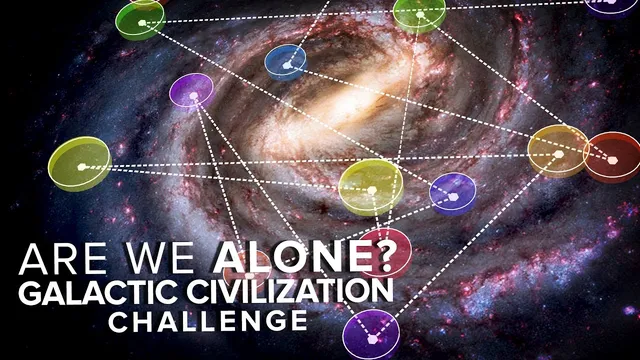
Are We Alone? Galactic Civilization Challenge
Based on PBS Space Time's video on YouTube. If you like this content, support the original creators by watching, liking and subscribing to their content.
The Drake Equation multiplies astrophysical, biological, and sociological terms, and early estimates were wide because most inputs were unconstrained.
Briefing
The core takeaway is that the odds of humanity being the only technological civilization—anywhere in the observable universe, or even just within our galaxy—must be extraordinarily tiny. That conclusion matters because it turns the Drake Equation from a wide, uncertain estimate into a constraint on how likely technological life is to emerge at all.
The classic Drake Equation estimates the number of currently existing technological civilizations in the Milky Way by multiplying together astrophysical, biological, and sociological factors: how many stars form, how many planets can support life, what fraction of those planets develop life, what fraction of life becomes intelligent, what fraction of intelligent species develop detectable technology, and how long advanced civilizations last. When Frank Drake first proposed the framework in the early 1960s, most of those inputs were essentially unconstrained, producing a huge range—from tens of millions to at least thousands of technological civilizations in the Milky Way. The low end implies we might never detect anyone; the high end implies nearby civilizations should be within roughly 100 light-years and could already have noticed our radio leakage.
Over the last half-century, astrophysical inputs have tightened dramatically. Kepler data suggest the Milky Way contains on the order of 14 billion terrestrial planets in the “Goldilocks” habitable zone of their stars—roughly 40 billion rocky worlds capable of sustaining liquid water conditions. About 11 billion of those are Earth-like planets around Sun-like stars. Yet the biological and sociological terms remain the weak links: how quickly life arises, how often it becomes intelligent, and especially how long technological civilizations survive are still largely guesswork.
That imbalance led some researchers to reframe the question. Instead of asking how many civilizations exist now, Adam Frank and Woodruff Sullivan asked: if humanity is the only technological civilization ever to arise in the known universe, what must the underlying probability of technological emergence be? Under that deeply pessimistic assumption, they estimate only a 1% chance that any advanced civilization ever appeared across the universe’s history. To make that scenario work, the chance for each habitable planet to produce a detectable technological civilization would have to be less than 2.5 × 10^-24—about a 1 in 400 billion trillion chance. The same logic applied to the Milky Way implies that for humans to be the only advanced civilization to ever appear in our galaxy, the probability per suitable planet would need to be around 1 in 60 billion. Those numbers are so small that the most natural inference is that other technological civilizations likely existed—at least at some point—and may still exist.
The episode then turns the reasoning into a challenge. Using Frank and Sullivan’s method, viewers are asked: if no other technological civilization emerged on any habitable planet within 100 light-years, how low would the probability of technological emergence have to be, and what would that imply about how close the nearest neighbors might be? An extra-credit twist adds Tabby’s Star (KIC 8462852), an F-type star about 1,500 light-years away with unusual dimming. If that dimming were attributed to a single Dyson-swarm-building civilization in the Kepler sample, the challenge asks how far away the nearest such civilization outside that sample would be—and what that would suggest about the likelihood of Tabby’s Star hosting one.
Cornell Notes
The Drake Equation multiplies astrophysical, biological, and sociological factors to estimate how many technological civilizations exist. Kepler has tightened the astrophysical side, but the biological and especially sociological terms remain uncertain. Adam Frank and Woodruff Sullivan reframed the problem: if humanity were the only technological civilization ever to arise in the known universe (or only in the Milky Way), the per-habitable-planet probability of technological emergence would have to be vanishingly small (e.g., <2.5×10^-24 for the universe-wide case). That extreme requirement implies other technological civilizations likely existed. The episode then challenges viewers to compute the probability needed to explain “no neighbors within 100 light-years,” and optionally to extend the logic using Tabby’s Star as a hypothetical Dyson-swarm signal.
Why does the Drake Equation produce such a wide range of possible civilizations, and what has improved most over time?
What does the Frank–Sullivan reframing change about the question we’re asking?
How do the astrophysical constraints from Kepler affect the logic of “where are the neighbors”?
What probability would need to be extremely low to explain “no technological civilizations within 100 light-years”?
How does Tabby’s Star enter the extra-credit scenario, and what does it ask you to infer?
Review Questions
- In the Frank–Sullivan universe-wide counterfactual, what numerical probability per habitable planet is required to keep the chance of any advanced civilization at only 1%?
- Which Drake Equation factor remains most speculative in the transcript, and why does that matter for interpreting the number of detectable civilizations?
- How would shrinking the search region from the whole galaxy to within 100 light-years change the probability threshold needed to make “no neighbors” plausible?
Key Points
- 1
The Drake Equation multiplies astrophysical, biological, and sociological terms, and early estimates were wide because most inputs were unconstrained.
- 2
Kepler data have tightened the astrophysical side by estimating billions of potentially habitable planets in the Milky Way.
- 3
Biological and sociological uncertainties—especially how long technological civilizations last—remain the biggest drivers of uncertainty.
- 4
Frank and Woodruff Sullivan’s reframing shows that if humanity were the only technological civilization ever, the per-habitable-planet probability of technological emergence must be smaller than 2.5×10^-24.
- 5
The same logic applied to the Milky Way implies an even smaller per-planet probability (about 1 in 60 billion) to make humans the only advanced civilization in our galaxy.
- 6
Because the required probabilities are so extreme, the most consistent inference is that other technological civilizations likely existed at some point.
- 7
The episode challenges viewers to compute the probability needed to explain “no technological civilizations within 100 light-years,” and optionally to extend the reasoning using Tabby’s Star as a hypothetical Dyson-swarm case.