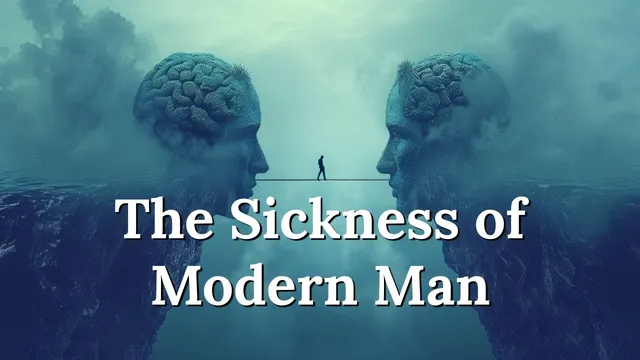
Are We Enslaved to One Side of the Brain? - The Sickness of Modern Man | Iain McGilchrist
Based on Academy of Ideas's video on YouTube. If you like this content, support the original creators by watching, liking and subscribing to their content.
The transcript’s central claim is that modern social problems stem from an imbalance in attentional style: left-hemisphere dominance favors narrow grasping and control over right-hemisphere understanding and integration.
Briefing
Modern life is increasingly shaped by a “left-hemisphere” mindset—narrow, controlling attention that turns people and nature into resources—creating a social pathology marked by stubbornness, low empathy, power-seeking, and a growing disconnect from reality. The core claim is that human brains evolved as a bipartite system: the left hemisphere excels at focused grasping and manipulation, while the right hemisphere sustains open, vigilant attention needed for understanding complexity and relating to others. When one mode crowds out the other, character and culture tilt toward a partial “take” on the world, with predictable moral and practical consequences.
The argument begins with the brain’s asymmetry. Popular descriptions that map the left to logic and the right to emotion are treated as misleading because both hemispheres participate in nearly every mental activity. The more meaningful difference is how each hemisphere approaches the world. Left-hemisphere attention is narrow and precise—useful for survival tasks that require selecting and acting on specific targets. Right-hemisphere attention is broad and sustained—useful for monitoring threats and integrating many strands of experience into a coherent whole. The transcript uses a survival analogy: a bird foraging for food must both focus tightly on prey and keep an open watch for predators. Evolution makes this possible by creating two neuronal “masses” that can function independently yet work together, so consciousness can be oriented in two ways at once.
In healthy balance, the discrepancies between these two perspectives don’t dominate awareness; otherwise everyday survival would become impossible. But dominance can shift. Physical injury such as stroke can cause one hemisphere to take over, yet the same imbalance can arise without damage. Lifestyle and culture can “tune” people toward one attentional mode—compared to a radio that keeps landing on one station until the dial is never turned. The modern shift, according to the account, favors the left hemisphere: habits and institutions increasingly reward narrow attention, procedural compliance, and technical control.
Several forces drive that tilt. The reductive-materialist paradigm in mainstream science privileges understanding by breaking wholes into parts and tracing mechanisms—an approach aligned with left-hemisphere strengths in analysis and control. Technology intensifies the pattern: computers, smartphones, and virtual reality demand precise attention and are designed to manipulate environments. Bureaucratization further entrenches it by rewarding rule-following and reducing spontaneity, making the left hemisphere’s “following familiar procedures” feel normal. Meanwhile, activities that cultivate right-hemisphere attention—nature time, religious practice, art appreciation, and creative problem solving—are crowded out.
The consequences are framed as both psychological and political. Left-hemisphere dominance encourages viewing the world as utility: nature becomes a set of resources and other people become means. It also undermines accountability, because narrow action toward targets can interpret unexpected outcomes as someone else’s responsibility. Studies of right-hemisphere injury are used to support claims about empathy—right-hemisphere capacities for reading facial and vocal cues and understanding another’s viewpoint. Finally, the transcript argues that left-hemisphere models can become internally consistent “virtual worlds” that fail to stay anchored in reality.
The warning is that societies may keep gaining power while losing understanding. Success at manipulation is treated as a logical trap: exerting control requires knowing what happens when levers are pulled, not necessarily understanding the deeper system being coerced. The result, in this account, is a widening gap between technological leverage and wisdom—an unstable recipe for disaster.
Cornell Notes
The transcript argues that human brains evolved as a bipartite system: the left hemisphere specializes in narrow, precise attention for grasping and manipulation, while the right hemisphere sustains broad, vigilant attention for understanding complexity and relating to others. When one hemisphere dominates—through injury, habits, or modern cultural pressures—people develop a distorted “take” on reality. That imbalance is linked to social harms such as stubbornness, low empathy, power-seeking, and an inability to take responsibility for mistakes. The proposed drivers include reductive-materialist science, technology that demands focused attention and enables control, bureaucratic rule-following, and the decline of practices that foster right-hemisphere attention like art, nature, religion, and creative mind-wandering.
What is the key difference between the hemispheres in this account, beyond pop-psychology stereotypes?
Why does the transcript claim that hemisphere discrepancies don’t show up in everyday awareness?
How does the transcript explain left-hemisphere dominance without brain injury?
Which modern institutions and trends are presented as reinforcing left-hemisphere attention?
What specific character and social problems are linked to left-hemisphere dominance?
Why does the transcript warn that increasing control can still worsen understanding?
Review Questions
- What attentional functions does the transcript assign to the left versus right hemisphere, and how does the bird-foraging example support the need for both?
- Which three modern forces are described as pushing society toward left-hemisphere dominance, and what mechanism does each use to do so?
- How does the transcript connect left-hemisphere dominance to empathy deficits and to a disconnect from reality?
Key Points
- 1
The transcript’s central claim is that modern social problems stem from an imbalance in attentional style: left-hemisphere dominance favors narrow grasping and control over right-hemisphere understanding and integration.
- 2
The left hemisphere is portrayed as optimizing precise, target-focused attention for manipulation, while the right hemisphere is portrayed as sustaining open, vigilant attention needed to comprehend complexity and relate to others.
- 3
A bipartite brain evolved to handle conflicting survival demands at once—focused foraging and broad threat monitoring—without making the hemispheres’ discrepancies obvious in everyday awareness.
- 4
Left-hemisphere dominance can arise from habits and culture, not only from injury, via a “tuning” effect that trains people to rely on one attentional mode.
- 5
Reductive-materialist science, technology that demands focused attention, and bureaucratic rule-following are presented as reinforcing the left hemisphere’s worldview.
- 6
When left-hemisphere attention dominates, the world is treated as utility: nature becomes resources and people become means, while accountability and empathy tend to erode.
- 7
The transcript warns that control can outpace understanding: success at manipulation may be mistaken for comprehension, increasing long-term risk.