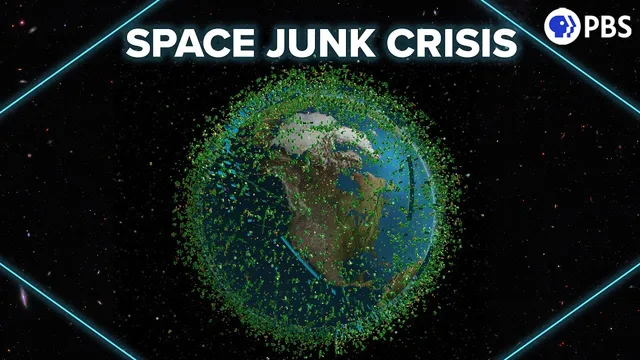
Are We Running Out of Space Above Earth?
Based on PBS Space Time's video on YouTube. If you like this content, support the original creators by watching, liking and subscribing to their content.
The public fear from rocket debris burning up on re-entry is different from the larger operational threat: debris that remains in orbit and can collide.
Briefing
A growing cloud of untracked, fast-moving debris in low Earth orbit is pushing space operations toward a collision cascade known as Kessler Syndrome—an outcome that could make the most useful orbits prohibitively expensive and difficult to use for years. Recent public anxiety over rocket debris burning up on re-entry misses the bigger risk: objects left in orbit can collide, generating more fragments that then collide again, steadily increasing the danger.
More than 3,300 operational satellites circle Earth, but they share space with roughly 10,000 trackable debris objects and potentially over 100 million smaller pieces that radar can’t follow. At orbital speeds around 7 km/s, even paint chips and screw-sized fragments carry enough energy to obliterate spacecraft. The International Space Station has already had to dodge tracked debris about once a year, and a puncture event on a robotic arm underscores how quickly a single shard can become mission-ending.
The core mechanism is a positive feedback loop. As satellite numbers rise, collision probability rises; collisions then create additional debris, which raises collision probability further. Donald Kessler warned in 1978 that the first major collision could occur within a few decades, and the 2009 Iridium 33–Kosmos 2251 collision—at 11.6 km/s—produced hundreds of fragments capable of destroying other satellites and tens of thousands more that could disable them. Since then, the cascade has been unfolding more slowly than Hollywood depictions, but it is already in motion: debris production has outpaced debris removal.
Mitigation depends on what size and altitude the debris occupies. Large objects can be tracked using radar, optical systems, and lidar, allowing operators to maneuver satellites away from predicted conjunctions. But tracking fails for the “sweet spot” of 1–10 cm fragments, which are hard to observe yet lethal on impact. Even smaller pieces—down to shards from prior collisions—are essentially untrackable; they can only be removed when their orbits decay.
Orbital decay is the main cleanup process in low Earth orbit, driven by drag from the upper atmosphere. That decay is helpful, but it also complicates tracking because atmospheric conditions change with solar activity, altering drag and causing debris to drift unpredictably. The lowest orbits are also where most launches concentrate, making them the most densely populated—and therefore the most vulnerable. Even if the International Space Station orbits hundreds of kilometers below a major collision site, it has still performed avoidance maneuvers as debris from above sinks through its orbital region.
Whether the cascade accelerates hinges on the balance between new launches and debris removal. A major example is the planned expansion of satellite constellations, including SpaceX’s plan for over 40,000 StarLink satellites. While rapid decay (under five years) may limit long-term buildup in very low orbits, any hit by an untracked shard can instantly turn a functioning satellite into more debris, and future constellations could scale the problem further.
In the worst case, low Earth orbit could become temporarily “unusable,” with satellite lifetimes shrinking and operating costs spiking as the junk field grinds on. The path forward is practical: deorbit spent stages and defunct satellites, move them to safer graveyard orbits, and use technologies such as deployable drag sails or electromagnetic tethers to hasten re-entry. Ultimately, avoiding exponential growth requires coordinated international and commercial discipline—removing debris faster than it is created.
Cornell Notes
The biggest threat isn’t rockets falling from the sky—it’s debris that stays in orbit and keeps colliding. As satellite numbers grow, collisions become more likely, and each collision generates more fragments, creating a positive feedback loop called Kessler Syndrome. Mitigation works best for large, trackable objects, but the most dangerous debris is often 1–10 cm: hard to track yet capable of destroying satellites. The main long-term cleanup mechanism is orbital decay from atmospheric drag in low Earth orbit, which can be accelerated by deorbiting and by technologies like drag sails or electromagnetic tethers. The timeline is already in the “slow exponential rise,” but it could speed up if launch practices outpace debris removal—especially with large satellite constellations.
Why is low Earth orbit the focal point of the Kessler Syndrome risk?
What makes 1–10 cm debris especially dangerous even when tracking exists?
How does orbital decay both solve and complicate the debris problem?
What did the Iridium 33–Kosmos 2251 collision demonstrate about collision outcomes?
Why can deliberate satellite destruction worsen long-term tracking and avoidance?
How could large satellite constellations change the odds of Kessler Syndrome?
Review Questions
- What conditions make debris removal via atmospheric drag most effective, and why does solar activity matter?
- How do tracking limits for 1–10 cm fragments change the practical strategy for preventing collisions?
- What balance determines whether the debris environment stays in a slow-growth regime or accelerates into a cascade?
Key Points
- 1
The public fear from rocket debris burning up on re-entry is different from the larger operational threat: debris that remains in orbit and can collide.
- 2
Kessler Syndrome is driven by a positive feedback loop where more collisions create more debris, which increases the probability of further collisions.
- 3
Large objects can often be tracked and avoided, but 1–10 cm fragments are both hard to track and capable of catastrophic impacts.
- 4
Untrackable debris is mainly removed when its orbit decays due to atmospheric drag, which varies with solar activity.
- 5
The 2009 Iridium 33–Kosmos 2251 collision at 11.6 km/s produced hundreds of destructive fragments and tens of thousands of damaging ones, showing how one event can seed long-term risk.
- 6
Deliberate satellite destruction can worsen the problem by spreading fragments into rings and across altitude ranges, complicating avoidance.
- 7
Avoiding exponential escalation requires deorbiting and safer disposal of defunct spacecraft and boosters, plus international coordination to remove debris faster than new launches create it.