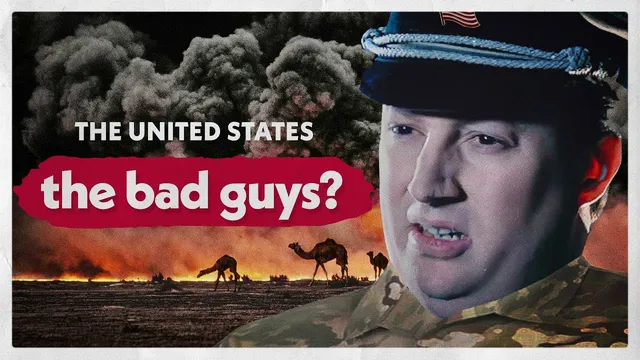
Are We The Baddies?
Based on Second Thought's video on YouTube. If you like this content, support the original creators by watching, liking and subscribing to their content.
The transcript argues that U.S. actions across centuries—from colonization to modern wars—consistently prioritize strategic interests over stated ideals like freedom and self-determination.
Briefing
The United States is portrayed as a long-running imperial power whose actions—ranging from genocide and nuclear war to coups, proxy conflicts, and mass civilian casualties—consistently contradict its stated ideals of freedom and self-determination. The core message is blunt: the country’s global role functions as a barrier to progress, and “patriotism” often means accepting a sanitized history that hides the scale of harm.
The argument begins with the founding era and expands outward. European colonization is described as an extermination campaign against Indigenous peoples, with population estimates used to emphasize magnitude. The “Trail of Tears” is singled out as a government-approved removal program under President Andrew Jackson, backed by Congress, where relocation was enforced through mass killing, disease, starvation, and exposure. The narrative then links early frontier violence—such as attacks on Indigenous communities and efforts to eradicate bison—to a broader pattern: seize land and resources, kill or coerce the people living there, and profit from the resulting system, including slavery.
From there, the focus shifts to war crimes and foreign intervention. The Philippine-American War is presented as a case of annexation met with resistance, followed by scorched-earth tactics and concentration camps. World War II’s end is framed through the U.S. decision to drop atomic bombs on Hiroshima and Nagasaki—argued to be chosen as population targets rather than purely military objectives—while also stressing that Japan was already prepared to surrender. The Cold War is described as a period of intensified covert and overt interference, including regime-change operations across Latin America and the 1953 CIA-backed coup in Iran.
Cuba becomes another example of persistent destabilization efforts, with the CIA’s repeated attempts to assassinate Fidel Castro cited as extensive and ultimately unsuccessful. Chile is treated as a centerpiece: after Salvador Allende’s election, the U.S. and the CIA are described as orchestrating destabilization leading to the 1973 coup, followed by repression under Augusto Pinochet and a later economic overhaul associated with Milton Friedman and Chicago School economists. Vietnam and Korea are framed as proxy wars driven by the fear that communism could offer a viable alternative to capitalism, with heavy emphasis on civilian deaths and chemical warfare in Vietnam and mass killing in Korea.
The Iraq War is then presented as a modern template for the same pattern: an invasion justified by false claims about weapons of mass destruction, followed by years of occupation and atrocities including the Abu Ghraib prison abuses. The account broadens again to the current Israel-Palestine conflict, arguing that U.S. support for Israel—described as funding, weapons, and unconditional backing—makes the U.S. complicit in the ongoing destruction of Gaza and the wider Palestinian population. The narrative claims that international bodies and humanitarian organizations have challenged Israeli claims, while the U.S. is portrayed as standing alone in shielding Israel.
In the closing, the argument ties these episodes together into a single conclusion: history is written and taught in ways that protect national legitimacy, leaving many Americans unaware of the full record. The result is a call to question official narratives and reject the idea that the U.S. is consistently “the good guys.” Instead, the framing lands on a recurring refrain—“are we the baddies?”—with the answer offered as a warning about power, accountability, and the cost of uncritical patriotism.
Cornell Notes
The transcript argues that the United States repeatedly violates its own stated principles by using military force, covert action, and economic domination to secure interests—often at the expense of civilians and self-determination. It links early colonization and Indigenous genocide to later imperial behavior: annexations, coups, nuclear attacks, proxy wars, and occupations. Examples include the Trail of Tears, the Philippine-American War, Hiroshima and Nagasaki, CIA-backed coups (Iran, Chile), Vietnam and Korea, and the Iraq War’s false WMD justification and Abu Ghraib abuses. It further claims U.S. backing for Israel makes the U.S. complicit in the ongoing destruction of Palestinians. The stakes are presented as legitimacy and moral accountability, not just historical accuracy.
How does the transcript connect early U.S. colonization to later foreign policy?
What evidence is used to claim the U.S. used nuclear weapons for political intimidation rather than military necessity?
Why does Chile function as a key case study in the transcript’s argument?
How does the transcript frame Cold War conflicts like Vietnam and Korea?
What is the transcript’s central claim about the Iraq War’s justification and aftermath?
How does the transcript argue the U.S. is implicated in the Israel-Palestine conflict?
Review Questions
- Which historical episodes are used to establish a “pattern” of U.S. behavior, and what common mechanism links them (e.g., land/resource seizure, regime change, or proxy war)?
- What specific claims does the transcript make about Hiroshima/Nagasaki, and how do those claims support its broader argument about motive?
- How does the transcript connect economic policy (e.g., Chile’s post-coup agenda) to political violence and foreign intervention?
Key Points
- 1
The transcript argues that U.S. actions across centuries—from colonization to modern wars—consistently prioritize strategic interests over stated ideals like freedom and self-determination.
- 2
Indigenous genocide is presented as foundational to the U.S. project, with the Trail of Tears used as an example of government-approved removal enforced through mass death.
- 3
The Philippine-American War is framed as annexation backed by scorched-earth tactics and concentration camps, illustrating a pattern of overriding local sovereignty.
- 4
The Hiroshima and Nagasaki bombings are described as population-targeted intimidation, with Japan portrayed as already prepared to surrender.
- 5
Cold War policy is characterized as extensive covert and overt intervention, including CIA-backed coups in Iran and Chile.
- 6
The Iraq War is presented as launched on false WMD claims, followed by large-scale destruction and documented U.S. abuses at Abu Ghraib.
- 7
U.S. support for Israel is argued to make the U.S. complicit in the ongoing destruction of Palestinians, with ceasefire votes and international scrutiny cited as evidence of shielding.