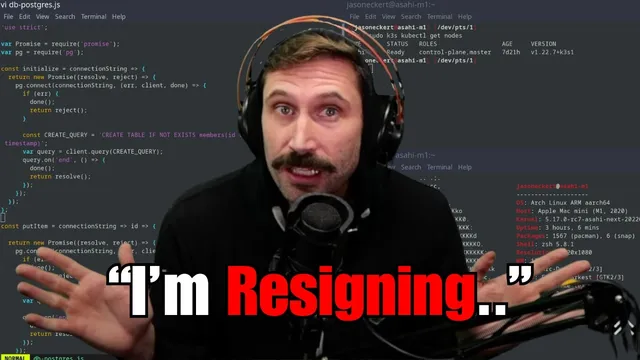
Asahi Linux Maintainer Steps Down
Based on The PrimeTime's video on YouTube. If you like this content, support the original creators by watching, liking and subscribing to their content.
Hector resigned as Asahi Linux project lead effective immediately, citing burnout from upstreaming friction, user feature pressure, declining support, and personal harassment.
Briefing
Asahi Linux project lead Hector (spelled “Hector” in the discussion) has stepped down from his role, citing burnout and a long-running clash over how to integrate Rust into the Linux kernel—along with mounting pressure from upstream processes, recurring demands from users, and personal harassment. The resignation matters because Asahi Linux sits at the center of Apple Silicon Linux enablement, and the leadership transition raises questions about how the project will sustain kernel-level work and its downstream GPU and driver roadmap.
The account traces years of tension that began with disputes on Linux kernel mailing lists and spilled into social media. A prior controversy involved Hector’s frustration with how Rust-for-Linux integration was handled, including claims that Linus Torvalds rejected some Rust-related pull requests while allowing others that broke staging builds—fueling a sense that there was no consistent strategy. Hector also criticized the leadership around Rust integration as a “major failure,” arguing that the Linux kernel’s development model makes downstream work hard to keep alive and that forks are not a viable long-term solution.
Beyond Rust politics, the resignation narrative highlights the operational grind of upstreaming. Hector describes kernel contribution as “a year’s project” rather than a “month’s project,” with complex process, heavy scrutiny, and high stakes: a mistake can break “effectively the entire universe.” He also points to downstream realities that directly affect end users. For example, Mesa GPU acceleration could not be enabled until kernel-side changes were ready, forcing Asahi to ship a Mesa fork and limiting compatibility with container workflows such as Docker and Podman (and other container image ecosystems that assume upstream Mesa).
User pressure also played a role. After Asahi reached a smoother experience on laptops, repeated feature demands—especially around Thunderbolt and DP alt mode—became a daily refrain. Hector frames this as “entitled users” pushing for timelines that ignore the complexity of deep reverse engineering, debugging, and kernel surgery. Donations and pledges, he says, declined over time even as the project continued to deliver major milestones.
The most personal and severe element is harassment. Hector describes being targeted by abusers and stalkers in 2024, including harassment that extended to his family, and he says the situation contributed to stress and guilt that made it harder to keep working. He also alleges that some high-level community figures acted in ways that undermined him—supporting or aligning with people he believed had harassed him—without directly informing him.
Hector’s resignation is effective immediately. He says the Asahi Linux project will continue, with the team transferring responsibilities and administrative credentials. His personal Patreon is paused, and supporters are encouraged to move support to Asahi Linux via Open Collective and GitHub sponsors. The broader discussion that follows centers on “brigading”—coordinated harassment campaigns—while participants argue over what counts as coordinated intent versus ordinary public criticism.
In the end, the resignation reads less like a single technical disagreement and more like a convergence of factors: upstreaming friction, downstream maintenance burdens, feature-demand fatigue, and sustained personal harm. With Asahi Linux’s Apple Silicon momentum still unfolding, the leadership change is a critical inflection point for both the project’s engineering capacity and its community dynamics.
Cornell Notes
Hector has resigned as Asahi Linux project lead, effective immediately, citing burnout driven by difficult upstreaming work, relentless user feature pressure, declining donations, and severe personal harassment. A major thread in the dispute centers on Rust-for-Linux integration: Hector argues that leadership and process around Rust PRs lacked consistent strategy and that downstreaming/forking is not a sustainable long-term path. He also describes practical downstream consequences, including Mesa GPU acceleration being blocked until kernel changes land, forcing Mesa forks and breaking compatibility with common container setups. The resignation shifts Asahi Linux into a new leadership phase while the community continues debating Rust integration, upstream/downstream tradeoffs, and what constitutes coordinated “brigading.”
Why does Hector frame Rust-for-Linux integration as a leadership and process failure rather than a pure technical debate?
What upstreaming friction does Hector say makes kernel work unusually hard for maintainers?
How does kernel readiness affect Asahi Linux users in practice, beyond the Rust debate?
Why does Hector say user demands contributed to burnout even after Asahi reached stability?
What does Hector claim about the role of harassment and personal targeting in his decision?
What does the discussion mean by “brigading,” and why does it matter in the resignation aftermath?
Review Questions
- What specific upstreaming and process issues does Hector cite as making kernel contributions especially demoralizing?
- How does the kernel-side readiness requirement for Mesa GPU support translate into real limitations for Asahi Linux users and containers?
- In Hector’s account, what combination of Rust integration disputes, user pressure, and personal harassment led to the resignation?
Key Points
- 1
Hector resigned as Asahi Linux project lead effective immediately, citing burnout from upstreaming friction, user feature pressure, declining support, and personal harassment.
- 2
The resignation narrative links Rust-for-Linux integration disputes to perceived inconsistency in how Rust PRs were treated and to a lack of clear integration strategy.
- 3
Kernel upstreaming is described as slow, process-heavy, and high-stakes—especially when changes touch many subsystems and drivers.
- 4
Asahi’s downstream GPU acceleration depends on kernel readiness; Mesa support can’t be enabled until the kernel side is ready, forcing Mesa forks and limiting container compatibility (e.g., Docker/Podman).
- 5
Repeated demands for Thunderbolt and DP alt mode are portrayed as a major morale drain because implementing them requires deep reverse engineering and potentially major kernel refactors.
- 6
The discussion emphasizes “brigading” as coordinated harassment campaigns with intent, distinguishing them from ordinary public criticism.
- 7
Hector’s funding and support plan shifts from personal Patreon to Asahi Linux support channels like Open Collective and GitHub sponsors.