Atomic Note-Taking | Demonstration
Based on Zettelkasten's video on YouTube. If you like this content, support the original creators by watching, liking and subscribing to their content.
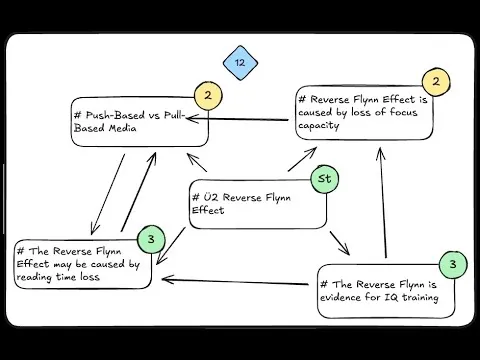
Atomic note-taking is framed as an iterative refactoring loop where notes can move between non-atomic capture (Level 1), practical atomicity (Level 2), and formal knowledge building blocks (Level 3).
Briefing
Atomic note-taking is presented as a practical, “organic” way to turn ongoing thought into connected, increasingly precise notes—without forcing rigid structure up front. The demonstration follows a working example built from a newsletter about the “reverse Flynn effect,” the claim that average IQ rose for decades and then began falling again around 2010. As the notes evolve, the method treats atomicity not as a one-time rule, but as something that can be gained, lost, and regained through refactoring while ideas mature.
The core workflow is staged using three levels of note “atomicity.” Level 1 is deliberately non-atomic: the writer captures ideas without worrying about perfect granularity. Level 2 is atomicity achieved pragmatically—notes become more self-contained once the writer can identify what belongs together. Level 3 is reserved for knowledge building blocks, where the note’s content is formalized into an explicit argument. In the example, the writer upgrades a note to Level 3 after deciding the core of the entry is an argument, then structures it as a modus ponens with numbered premises (including a second premise split into parts). That formal structure is used to clarify reasoning rather than to satisfy a template.
A key theme is that note-taking should mirror thinking, not interrupt it. The writer repeatedly adds one-sentence summaries to force comprehension, but also breaks atomicity when needed—such as when a counterposition naturally arises. Instead of immediately splitting every counterargument into its own fully atomic note (which would fragment attention), the writer keeps writing with a note that temporarily contains both position and counterposition. Later, refactoring restores atomicity by splitting and reconnecting nodes. The result is a branching graph of connected ideas that grows through small actions: create a node, connect it, add an idea, then split it when it stops being atomic.
The demonstration also reframes how information enters the mind. It distinguishes “push” input (video, podcasts) from “pull” input (reading). With push-based media, attention can break down without stopping the flow, leading to forced exposure even when comprehension is weak. With pull-based reading, attention breaks down can halt intake—eyes may move without true reading. This distinction motivates why notes matter: they provide a way to capture and reorganize ideas when attention and understanding fluctuate.
Finally, the example is not treated as a debate about whether society is getting smarter or dumber. The writer’s main interest is whether IQ can be trained and how that could make both the writer and their children smarter. The method is positioned as closely related to the Zettelkasten approach (and described as an integral building block of it), but broader than any single system: the transferable skill is handling multiple ideas, relating them, and letting structure emerge from iterative refactoring rather than from rigid upfront planning.
Cornell Notes
Atomic note-taking is demonstrated as an iterative process that turns rough thoughts into connected, increasingly precise notes. Notes move through three levels: Level 1 captures ideas without strict atomicity, Level 2 makes notes atomic in a practical way, and Level 3 formalizes the core into explicit knowledge building blocks—often as structured arguments. The workflow intentionally breaks atomicity when new material (like a counterposition) arises, then restores it later through refactoring, avoiding constant organizational interruptions. The example uses a newsletter on the reverse Flynn effect to show how reasoning can be unfolded, summarized, and formalized while keeping the note graph “organic.” The approach matters because it treats note-taking as an external manifestation of thinking, not a forced paperwork exercise.
What do Level 1, Level 2, and Level 3 mean in this atomic note-taking workflow?
Why does the writer sometimes “break” atomicity on purpose instead of keeping every note perfectly atomic at all times?
How does the demonstration use one-sentence summaries in the note-building process?
What role does argument formalization play when upgrading notes to Level 3?
How does the “push vs pull” distinction about consuming information relate to why notes are needed?
What is the practical motivation behind the reverse Flynn effect example?
Review Questions
- How would you decide whether a note should be Level 2 or Level 3 in this system?
- Describe a situation where you might intentionally keep a counterposition inside the same note before refactoring. Why could that preserve thinking flow?
- What is the difference between “push” and “pull” information consumption, and how might that change how you take notes while studying?
Key Points
- 1
Atomic note-taking is framed as an iterative refactoring loop where notes can move between non-atomic capture (Level 1), practical atomicity (Level 2), and formal knowledge building blocks (Level 3).
- 2
The method grows a connected node graph through small actions: create a node, connect it, add an idea, then split it when it stops being atomic.
- 3
Position and counterposition are allowed to coexist temporarily to avoid fragmenting attention; refactoring later restores atomic structure.
- 4
One-sentence summaries act as a comprehension tool that helps determine what the note’s core really is before upgrading it.
- 5
Information intake differs between push media (video/podcasts) and pull media (reading), affecting attention and comprehension—notes help compensate for that variability.
- 6
Level 3 upgrades often involve explicit argument structure (e.g., modus ponens with numbered premises) to clarify reasoning.
- 7
The reverse Flynn effect example is used less to settle societal IQ trends and more to explore whether IQ can be trained and how that could benefit the writer and their children.