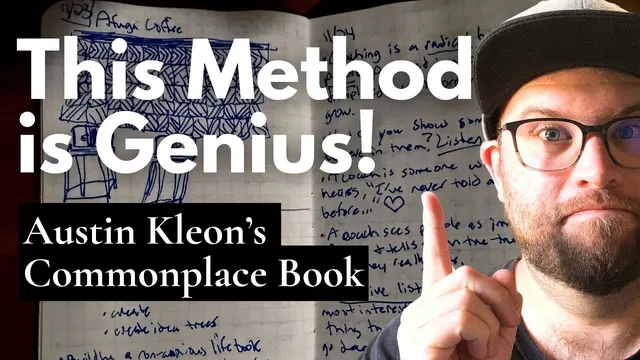
Austin Kleon’s Genius Commonplace Book Method (A Better Way to Save Ideas & Quotes)
Based on Greg Wheeler's video on YouTube. If you like this content, support the original creators by watching, liking and subscribing to their content.
Austin Kleon’s method uses a two-pass workflow: collect quotes digitally, then copy one by hand into a physical notebook each day.
Briefing
Austin Kleon’s “commonplace book” method reframes quote-collecting as a two-step process: first gather lines digitally, then absorb them by copying one by hand into a physical notebook each day. The payoff isn’t convenience or searchability—it’s transformation. Moving a quote from a phone screen into ink slows the moment, routes the words through the eyes and then the body, and turns saved “content” into something closer to lived truth.
Instead of building a searchable database of quotations organized by theme, Cleon keeps his notebook ordered by date. That choice changes how ideas behave when they’re revisited. Flipping through pages becomes less like browsing categories (“creativity,” “creator compass,” or any other topic list) and more like walking through seasons—seeing what mattered at different times, what hungers showed up, and what emotional weather shaped attention. A line about creativity can sit beside grief, a psalm can share a page with Shakespeare, and a YouTube interview can rub shoulders with older scripture. Those mismatched pairings create friction, and friction is where fresh insight can spark.
The method also treats collecting as planting seeds. Small, unrelated phrases—overhearing a turn of phrase on a bus, catching lyrics that land hard, noticing a headline that piques curiosity—may look random at the time, but they can grow later into understanding. Date-based ordering makes that growth visible: what someone leaned on in October, what kept returning in summer, or what beauty they noticed when life felt bright. The transcript draws an analogy to photography: attention shifts automatically with the seasons, and quotes do something similar by tracking “the weather of your soul.”
Several writers are used to reinforce the emotional and spiritual stakes of the practice. Henrik Carlson describes writing as a way to bring the world into the body—reading stays interesting until words are written and made personal enough to transform someone. Andrew Anderson compares commonplace-book collecting to planting seeds that may remain dormant or grow. J.M. Strom’s line about October—trees revealing colors they hid all year—becomes a prompt to write about one’s own October. Ralph Waldo Emerson’s “Make your own Bible” frames the notebook as a personal canon: not famous words for their reputation, but sentences that “found” the reader and pointed them toward hope, clarity, courage, or God.
The transcript then grounds the idea in a personal experiment: the creator previously tried a one-thing-a-day rule to make scripture and other meaningful lines “carved” into memory. Instead of highlighting passively on a phone, they wrote one item daily into field notebooks, sometimes pulling from saved verses or underlined lines, sometimes capturing something noticed while walking. Even a recurring physical landmark on a trail became a cue to pause and record what mattered. Looking back, that routine is described as a personal version of Cleon’s two-pass method—gathering something in the wild and anchoring it through ink and paper—so the words don’t just sit in storage, but become part of who the writer is trying to become.
Cornell Notes
Austin Kleon’s commonplace-book method treats quote-collecting as a two-pass ritual. First, meaningful lines are gathered digitally as they appear. Then, each day one line is copied by hand into a physical notebook, moving the quote from screen to body so it becomes absorbed rather than merely saved. Cleon’s notebook is ordered by date, not theme, which turns revisiting quotes into a walk through emotional seasons and creates productive “friction” between unrelated ideas. The practice is framed as seed-planting: small, seemingly random phrases can later grow into insight and personal transformation.
Why does copying quotes by hand matter more than storing them digitally?
What changes when quotes are organized by date instead of by theme?
How does the “seed planting” idea apply to collecting small, unrelated phrases?
How do the cited writers support the practice’s emotional or spiritual purpose?
What does a “one thing a day” routine look like as a personal version of the two-pass method?
Review Questions
- How does date-based ordering change the way you encounter quotes compared with theme-based categories?
- What specific mechanisms (time, attention, physical action) make handwriting feel like “absorption” rather than storage?
- In what ways could “seed planting” help you collect quotes that don’t seem useful right now?
Key Points
- 1
Austin Kleon’s method uses a two-pass workflow: collect quotes digitally, then copy one by hand into a physical notebook each day.
- 2
Handwriting slows the process and helps quotes move from visual recognition into bodily memory, making them feel more like lived truth than saved content.
- 3
Ordering by date (not theme) turns a quote notebook into a record of emotional seasons, preserving context and revealing patterns over time.
- 4
Random-seeming lines can become meaningful later; collecting is treated as planting seeds that may grow into insight.
- 5
Productive friction comes from placing unrelated ideas near each other, which can spark new connections that category systems miss.
- 6
A practical adaptation is a “one thing a day” rule: pull one line from saved notes or from real-world observation, then anchor it in ink and paper.
- 7
The notebook is framed as a personal canon—words that “found” you—rather than a trophy shelf of famous quotations.