Autoencoders in Python with Tensorflow/Keras
Based on sentdex's video on YouTube. If you like this content, support the original creators by watching, liking and subscribing to their content.
Autoencoders are trained with x as both input and target, so the decoder must reconstruct the input shape exactly.
Briefing
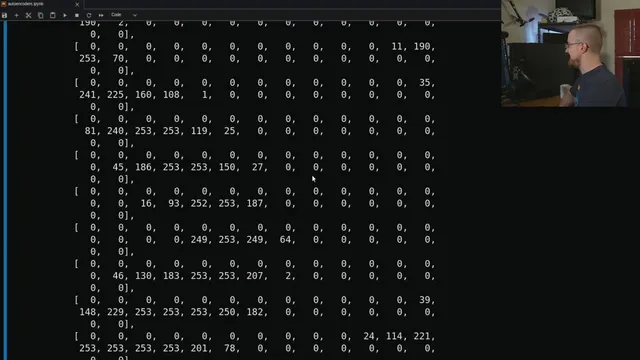
Autoencoders are built to compress data into a smaller “bottleneck” representation and then reconstruct the original input from that compressed form—using the same data as both input and training target. In practice, the tutorial demonstrates this with MNIST digits: 28×28 grayscale images (784 pixel values) are normalized to 0–1, passed through an encoder that reduces the representation to a small vector, and then decoded back to the original 28×28 shape. Training uses mean squared error so the reconstruction stays close to the input.
The core insight is that the bottleneck forces the network to learn the most useful structure in the data, turning a hard learning problem into a simpler one: instead of learning both feature relationships and a separate task like classification, the model’s job is primarily “condense and reconstruct.” The encoder uses dense layers (no convolutions for MNIST in the main walkthrough), flattening the 28×28 image into 784 features, then mapping them down to a compact latent vector (first 64 values). The decoder mirrors the requirement that the output must match the input shape exactly, reshaping the reconstructed 784 values back into 28×28×1.
Once the autoencoder trains, the encoder alone can generate compressed features. The tutorial visualizes this by reshaping the latent vector into a small grid (e.g., 8×8 for 64 values) to make the learned representation tangible. Reconstruction quality is not perfect—outputs are slightly dimmer and can miss details—but the digits remain recognizable, showing that the latent vector retains the “meaning” of the input.
The compression experiment becomes the headline: the bottleneck is pushed from 64 down to 32, and then to 9 (a 3×3 latent vector). Even at nine values out of 784—about 1%—the model still reconstructs clear digits. Different instances of the same digit (like two different sevens) reconstruct as distinct but related outputs, reflecting that the latent space captures general digit structure rather than memorizing exact pixel patterns.
A second major demonstration shows denoising without explicit noise training. Random pixel corruption is applied to a test digit, producing a noisy image. Feeding that noisy input through the trained autoencoder yields a cleaner reconstruction that looks significantly less corrupted. The tutorial emphasizes that this works because the autoencoder learned a compact representation of the underlying digit manifold; it effectively projects noisy inputs back toward the learned “typical” structure.
Finally, the walkthrough sketches a more general approach for images: switching from dense layers to convolutional encoders/decoders. For RGB images (cats and dogs), the model uses convolution and max pooling to reduce a 64×64×3 input (12,288 values if flattened) down to a much smaller bottleneck (e.g., 512). The decoder uses upsampling to return toward the original resolution, with the practical caveat that pooling/upsampling must be compatible with the chosen input size to reconstruct the exact shape.
Overall, the tutorial frames autoencoders as an unsupervised way to learn compact, task-agnostic representations—useful for compression, denoising, and preparing image data for downstream models that expect vectors rather than raw pixel grids.
Cornell Notes
Autoencoders learn an efficient representation by forcing an encoder to compress an input into a small bottleneck vector and a decoder to reconstruct the original input from that vector. Using MNIST, the tutorial normalizes 28×28 grayscale images (784 values) to 0–1, then trains a dense autoencoder with mean squared error so the output matches the input shape. After training, the encoder alone produces compressed features (e.g., 64 values, then 32, then as low as 9) while reconstructions remain recognizable. The same learned representation also reduces random noise: a noisy digit fed into the autoencoder comes out cleaner even without training on noisy examples. Convolutional autoencoders extend the idea to RGB images by using convolution and pooling to shrink spatial information before reconstructing it with upsampling.
Why does an autoencoder’s output have to match its input, and how does that shape the architecture?
What does the bottleneck accomplish when compressing MNIST from 784 values down to 64, 32, or 9?
How does the tutorial justify that autoencoders can make learning easier for neural networks?
Why does denoising work even though the model wasn’t trained on noisy images?
What changes when moving from MNIST dense autoencoders to convolutional autoencoders for RGB images?
What practical preprocessing step is used for MNIST, and why?
Review Questions
- How does the bottleneck size (64 vs 32 vs 9) affect reconstruction quality, and what does that reveal about what the encoder preserves?
- What architectural constraint ensures an autoencoder can reconstruct MNIST images exactly, and where does that constraint appear in the code (flatten/dense/reshape)?
- Why can an autoencoder reduce random noise without being trained on noisy examples, according to the behavior shown in the tutorial?
Key Points
- 1
Autoencoders are trained with x as both input and target, so the decoder must reconstruct the input shape exactly.
- 2
A bottleneck (latent vector) forces the network to learn compact, task-agnostic structure rather than memorizing pixel-perfect copies.
- 3
MNIST grayscale images (28×28×1) are flattened to 784 features, normalized to 0–1, compressed (e.g., 64/32/9), then decoded back to 28×28×1.
- 4
Even extreme compression (784 → 9 values) can still produce recognizable digit reconstructions, showing strong structure in MNIST.
- 5
Random pixel noise can be reduced by a trained autoencoder because it projects inputs toward the learned manifold of valid digits.
- 6
Convolutional autoencoders extend the approach to RGB images by using convolution and max pooling to shrink spatial information before decoding with upsampling.
- 7
Pooling/upsampling choices must be compatible with the input resolution to reconstruct the original dimensions.