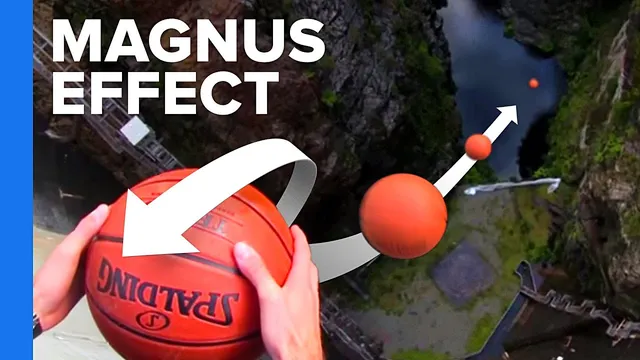
Backspin Basketball Flies Off Dam
Based on Veritasium's video on YouTube. If you like this content, support the original creators by watching, liking and subscribing to their content.
A backspinning basketball curves because rotation creates an uneven airflow pattern around the ball, producing a net aerodynamic force.
Briefing
A basketball dropped from Tasmania’s Gordon Dam lands almost where it’s released—until backspin enters the picture. With a modest amount of rotation, the ball doesn’t just “curve a little”; it visibly takes off in a new direction, demonstrating the Magnus effect in a way that’s hard to miss from the shoreline. The key difference is that the spinning ball interacts with airflow asymmetrically: air on the side where the ball’s spin and the airflow move in the same direction gets dragged along with the ball, while air on the opposite side experiences relative motion that encourages flow separation. That imbalance produces a net force, pushing the ball one way as the ball pushes air the other way.
The Magnus effect—named after Heinrich Gustav Magnus, who described it in 1852—applies to rotating balls and cylinders moving through air. Newton’s earlier work on projectile motion predates Magnus by nearly two centuries, but Magnus’s name stuck for this specific rotating-flow phenomenon. In sports, the effect is already familiar: topspin and backspin in tennis, soccer, and golf can change trajectories enough to shape strategy and outcomes. The dam trickshot turns that physics into a dramatic, real-world demonstration, showing how spin can dominate what would otherwise be a near-vertical drop.
The same aerodynamic principle also scales beyond games. One prominent non-sport application is the Flettner rotor, a spinning cylinder used on sailboats in place of conventional sails. By using the Magnus effect to deflect crosswinds, these rotors can generate propulsion—effectively converting sideways wind into forward thrust. Aircraft have also experimented with rotor-based lift. In one design, spinning cylinders can produce more lift than traditional wings, but the tradeoff is severe: the cylinders create far more drag, which has limited practical adoption. Some prototypes have flown briefly before crashing, underscoring how difficult it is to balance lift and resistance.
Still, interest is returning as engineers look for efficiency gains. An experimental rotor-wing aircraft generates lift from spinning cylinders, and the E-Ship 1 uses four spinning cylinders—four Flettner rotors—to improve efficiency and reduce diesel consumption. The dam’s backspinning basketball may be a spectacle, but it’s also a clear preview of why rotating airflow matters: when spin can be controlled, it can redirect forces in ways that conventional shapes can’t. In that sense, the Magnus effect isn’t just a trick for sports—it’s a candidate tool for future propulsion and lift systems, from boats to aircraft.
Cornell Notes
A basketball dropped from a high dam lands near its release point unless it’s given backspin. Once the ball rotates, airflow interacts differently on opposite sides of the spinning surface: one side’s flow is dragged along with the spin while the other side’s flow separates, creating a net force. That net force is the Magnus effect, named after Heinrich Gustav Magnus (1852), and it explains why spinning balls curve in sports like tennis, soccer, and golf. The same physics can power real machines, including Flettner rotors on sailboats and experimental rotor-wing aircraft that generate lift from spinning cylinders. The challenge is that the lift benefits often come with high drag, but newer designs aim to improve efficiency.
Why does backspin make a basketball’s path change so dramatically compared with a straight drop?
What is the Magnus effect, and who is it named after?
How do Flettner rotors use the Magnus effect to propel a sailboat?
Why are rotor-based aircraft lift systems often impractical despite producing strong lift?
What does the E-Ship 1 aim to achieve with four spinning cylinders?
Review Questions
- How does airflow separation on one side of a spinning ball differ from the airflow behavior on the other side, and how does that difference create a net force?
- What tradeoff limits the practical use of Magnus-effect lift in rotor-cylinder aircraft, and what design strategies might address it?
- In what ways do Flettner rotors convert crosswinds into forward motion, and why does replacing sails change the physics of propulsion?
Key Points
- 1
A backspinning basketball curves because rotation creates an uneven airflow pattern around the ball, producing a net aerodynamic force.
- 2
The Magnus effect arises when one side of a spinning object drags air along while the opposite side encourages flow separation, pushing the object in the opposite direction.
- 3
The Magnus effect is named after Heinrich Gustav Magnus (1852), even though Newton’s earlier work on projectile motion predates it.
- 4
Spin-driven trajectory changes are central to sports such as tennis, soccer, and golf, where topspin and backspin alter flight paths.
- 5
Flettner rotors use spinning cylinders to deflect crosswinds and generate propulsion on sailboats without conventional sails.
- 6
Rotor-cylinder aircraft can produce high lift via the Magnus effect but often suffer from excessive drag, limiting practicality.
- 7
Newer designs like the E-Ship 1 aim to use multiple Flettner rotors to improve efficiency and reduce diesel consumption.