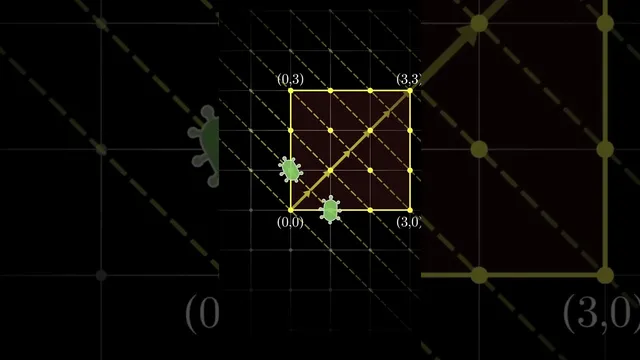
Bacteria Grid Puzzle Solution
Based on 3Blue1Brown's video on YouTube. If you like this content, support the original creators by watching, liking and subscribing to their content.
Choose diagonal-dependent weights that halve each step to the right so every replication preserves a total weighted sum.
Briefing
A conservation law based on weighted “mass” makes the bacteria-grid puzzle collapse: the descendants of the single starting cell can’t be pushed out of the 4×4 box, so clearing all 16 lattice points is impossible. The replication rule—move from a cell to the two cells one step up and one step right, leaving the original empty—creates a process where the total number of bacteria changes, but a carefully chosen weighted sum stays constant. That invariant becomes the key to proving impossibility rather than hunting for an optimal sequence of moves.
The argument starts by tracking how replications shift bacteria across diagonal “layers” of the grid. Each replication replaces one occupied cell with two occupied cells on the next diagonal to the right. If each diagonal is assigned a weight that halves from one layer to the next (so the origin’s diagonal has weight 1, the next has 1/2, then 1/4, and so on), then every legal move preserves the total weighted sum. In other words, although the bacteria multiply, the weighted “mass” does not increase or decrease; it remains fixed at the starting value of 1.
From there, clearing a finite box becomes a question about where the weighted mass must go. If all lattice points inside a given box are emptied, then every remaining bacterium must lie outside the box, meaning the weighted sum of cells outside the box must be at least 1. If the outside weighted sum is smaller than 1, no amount of time or cleverness can make the bacteria escape, because the invariant forbids the required redistribution.
To evaluate that outside capacity, the solution computes the total weighted mass available on the infinite grid. Along the first row, the weights form a geometric series: 1 + 1/2 + 1/4 + …, which converges to 2. Summing analogous contributions across rows yields a total weighted mass of 4 for the entire infinite grid. The crucial step is then to estimate how much of that total lies inside the target 4×4 box. The weights inside the 16-point box add up to a little above 3.5, leaving notably less than 1 outside. That shortfall means the invariant can’t be satisfied if the box is completely cleared.
The conclusion is blunt: clearing the 4×4 box of 16 lattice points is impossible. The same method also blocks smaller cases: even the 3×3 box with nine lattice points can’t be escaped, because the weighted mass inside that box already totals 3.0625—too much to allow the required outside sum. The reasoning even hints at a boundary case: an 8-point shape could only be cleared “just barely” in the limit of infinite time, since its weight sum matches the threshold exactly. The puzzle’s difficulty wasn’t combinatorics—it was a hidden invariant that makes escape mathematically unattainable.
Cornell Notes
A replication rule creates a process where the number of bacteria can grow, but a weighted sum across diagonal layers stays constant. Assign each diagonal a weight that halves each step to the right (origin diagonal weight 1, next 1/2, then 1/4, etc.). Every legal replication preserves the total weighted sum, so the system’s “weighted mass” remains 1 no matter how moves are chosen. Clearing a box would force all bacteria to end up outside it, requiring the outside weighted sum to be at least 1. For the 4×4 box (16 lattice points), the weights inside exceed about 3.5, leaving less than 1 outside—so complete clearing is impossible; the same logic blocks escape from the 3×3 box as well.
Why does assigning weights to diagonal layers matter for proving impossibility?
What invariant value does the process start with, and why is it fixed?
How does “clearing a box” translate into a requirement on weighted mass outside the box?
How is the total weighted mass on the infinite grid computed?
Why does the 4×4 box fail the outside-mass test?
What does the same method say about smaller boxes like 3×3?
Review Questions
- What specific relationship between diagonal weights makes each replication preserve the total weighted sum?
- If the total weighted sum is fixed at 1, what inequality must the weighted mass outside a target box satisfy for clearing to be possible?
- How do geometric series calculations help determine the total weighted mass available on the infinite grid?
Key Points
- 1
Choose diagonal-dependent weights that halve each step to the right so every replication preserves a total weighted sum.
- 2
Treat the invariant as a capacity constraint: clearing a box requires at least the invariant’s value of weighted mass to exist outside it.
- 3
Compute total weighted mass on the infinite grid by summing geometric-series contributions across rows, yielding a total of 4.
- 4
For the 4×4 box, the weighted mass inside exceeds about 3.5, leaving less than 1 outside, which makes complete clearing impossible.
- 5
The same weighted-mass argument blocks clearing a 3×3 box because its internal weight sum is already 3.0625.
- 6
Some smaller shapes can be at or near the threshold where outside weighted mass barely meets the invariant, explaining “just barely” behavior in the limit.