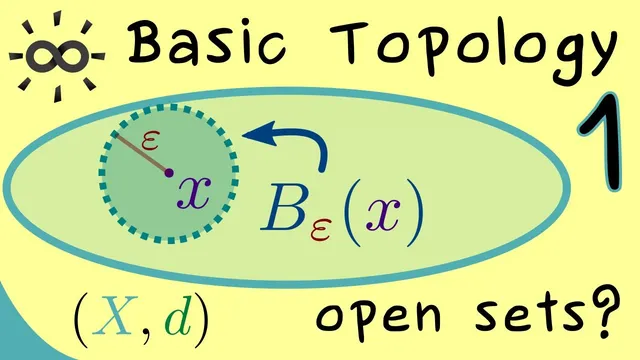
Basic Topology 1 | Introduction and Open Sets in Metric Spaces
Based on The Bright Side of Mathematics's video on YouTube. If you like this content, support the original creators by watching, liking and subscribing to their content.
A metric on X is a distance function d: X×X→[0,∞) that is nonnegative, zero only on identical points, symmetric, and satisfies the triangle inequality.
Briefing
Topology begins with a practical goal: replace “distance” with a more flexible notion of “closeness,” so tools from analysis can work in settings beyond Euclidean space. The starting point is a metric space, where a set X comes with a distance function d that measures how far two points are apart. That distance must be nonnegative, equal to 0 only when the two points coincide (positive definiteness), symmetric (d(x,y)=d(y,x)), and satisfy the triangle inequality (d(x,z) ≤ d(x,y)+d(y,z)). These rules make distance behave predictably, and they also generate the basic topological language of neighborhoods and open sets.
From the metric, the video builds open balls: for a point x and radius ε>0, the open ε-ball consists of all points y with d(x,y)<ε. An open set is then defined in terms of these balls: a subset A of X is open if every point x in A has some ε>0 such that the entire open ε-ball around x lies inside A. Geometrically, this means points on the boundary cannot be included; near any point of A, there is always a “buffer zone” of points still staying within A. The size of ε may shrink as x approaches the boundary, but it must remain positive for every x in A.
The key shift is that topology does not need the metric explicitly. Instead, it uses the structural properties that open sets satisfy in metric spaces. The empty set and the whole space X are automatically open. If A and B are open, then their intersection is open: for any point x in A∩B, x has an ε-ball contained in A and an ε-ball contained in B, and the smaller of the two balls fits entirely inside the intersection. Similarly, unions preserve openness: if {A_i} is any collection of open sets, then any point in the union lies in some A_i, and the ε-ball that works for that A_i also works for the union. Crucially, this works even for arbitrary (possibly infinite) collections, not just finite ones.
These closure properties—open sets containing ∅ and X, closed under arbitrary unions, and closed under finite intersections—are presented as sufficient to characterize the open-set structure coming from a metric. That observation sets up the general definition of a topology, where one can talk about open sets without ever specifying a distance function. The series positions this open-set framework as the foundation for later topics like closed sets and compactness, and as a bridge from real analysis into more abstract spaces used across mathematics.
Cornell Notes
Metric spaces define “closeness” using a distance function d on a set X. The distance must be nonnegative, zero only when points coincide, symmetric, and satisfy the triangle inequality. From d, open ε-balls (points within distance < ε of a center x) are built, and a set A is open if every x in A contains some ε-ball fully contained in A. The crucial insight is that the metric itself can be dropped: openness is governed by rules—∅ and X are open, arbitrary unions of open sets are open, and finite intersections of open sets are open. Those rules motivate the general notion of a topology, enabling topology to extend analysis beyond metric spaces.
What conditions must a distance function d(x,y) satisfy to be a metric?
How does the definition of an open set in a metric space relate to open ε-balls?
Why is the intersection of two open sets open (in a metric space)?
Why does an arbitrary union of open sets remain open?
What is the significance of the closure properties of open sets?
Review Questions
- State the four metric axioms and give the triangle inequality in inequality form.
- Define an open set in a metric space using ε-balls, and explain what happens near the boundary.
- List the three closure properties that characterize open sets for defining a topology without a metric.
Key Points
- 1
A metric on X is a distance function d: X×X→[0,∞) that is nonnegative, zero only on identical points, symmetric, and satisfies the triangle inequality.
- 2
Open ε-balls B(x,ε) consist of all points y with d(x,y)<ε, and ε must be positive.
- 3
A set A⊆X is open if every point x∈A has some ε>0 such that B(x,ε)⊆A.
- 4
Open sets in metric spaces are closed under arbitrary unions.
- 5
Open sets in metric spaces are closed under finite intersections.
- 6
The empty set ∅ and the whole space X are always open.
- 7
Because these union/intersection properties don’t require distances, they motivate the general definition of a topology in later work.