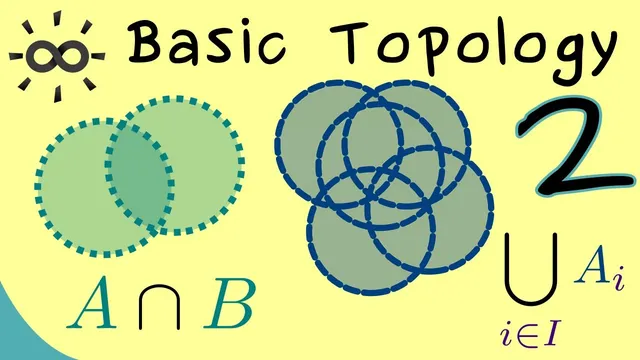
Basic Topology 2 | Topological Spaces
Based on The Bright Side of Mathematics's video on YouTube. If you like this content, support the original creators by watching, liking and subscribing to their content.
A topology on X is a collection T of subsets of X that includes ∅ and X, is closed under finite intersections, and is closed under arbitrary unions.
Briefing
Topology starts with a simple move: take an arbitrary set X and decide which subsets of X should count as “open.” Those chosen subsets form a topology, a collection T ⊆ P(X) (the power set of X) that must satisfy three rules: the empty set and X itself are always in T; the intersection of any two open sets is also open; and the union of any collection of open sets is open, even when the collection is infinite or uncountable. With these closure properties, “open” becomes a structural notion rather than something inherited from geometry.
Once a topology T is fixed, the pair (X, T) is a topological space. The same underlying set X can support many different topologies, and changing the topology can radically change what it means for points to be “near,” which sets to be “large,” and how limits behave. In other words, topology is less about the points themselves and more about the rules for which subsets are considered open.
The course then connects this abstract framework to the familiar setting of metric spaces. On R^n, the standard Euclidean norm ||x|| (described as measuring vector length) induces a metric by turning distances into norms of difference vectors. Any metric, in turn, generates a topology: a set A is open (with respect to the metric) exactly when every point in A sits inside some ε-ball that stays entirely within A. Those ε-balls are the geometric engine behind openness.
A key subtlety follows: the shape of ε-balls depends on the chosen norm. Switching from one norm to another can make the balls look different—squares versus circles, for instance—but the resulting notion of openness on R^n does not change. So the “standard topology” on R^n is robust: it can be obtained from any norm on R^n, even though the geometry of balls varies.
Finally, the discussion emphasizes that topology need not come from a norm or metric at all. One extreme example is the indiscrete topology, where only ∅ and X are open. In that topology, every point is effectively as close as possible to every other point, making convergence and “neighborhood” ideas behave in a very degenerate way. The indiscrete topology also illustrates that not every topology is metric-induced; some topologies cannot be produced by any metric. The groundwork is laid for the next steps—generalizing closed sets and compactness beyond the standard metric setting—while noting that metric-induced topologies that differ from the standard one will be addressed later.
Cornell Notes
A topology on a set X is a collection T of subsets of X (so T ⊆ P(X)) that includes ∅ and X, is closed under finite intersections, and is closed under arbitrary unions. Declaring which subsets are “open” turns X into a topological space (X, T), and different choices of T can make the same underlying set behave very differently. On R^n, any norm induces a metric, and that metric induces a topology via ε-balls; although ε-balls change shape with the norm, the resulting topology on R^n stays the same. Not every topology comes from a metric: the indiscrete topology has only ∅ and X as open sets and cannot be metric-induced. This framework sets up later generalizations of closed sets and compact sets.
What exact conditions must a collection T of subsets of X satisfy to be a topology?
Why does choosing a topology matter even when the underlying set X stays the same?
How does a norm on R^n lead to a topology?
What stays the same when switching norms on R^n, and what changes?
What is the indiscrete topology, and why is it important here?
Review Questions
- Given a set X, how would you test whether a proposed collection T ⊆ P(X) is a topology? List the three closure/containment requirements.
- Explain how a metric induces a topology using ε-balls, and describe what it means for a set A to be open.
- Why can the same set R^n have the same topology from different norms even though the geometric shapes of balls differ?
Key Points
- 1
A topology on X is a collection T of subsets of X that includes ∅ and X, is closed under finite intersections, and is closed under arbitrary unions.
- 2
A topological space is the pair (X, T), where “open set” means “member of T.”
- 3
The same underlying set X can support many different topologies, leading to different notions of closeness and limit behavior.
- 4
On R^n, any norm induces a metric, and that metric induces a topology via ε-balls.
- 5
Changing the norm changes the shape of ε-balls but not the resulting topology on R^n.
- 6
Some topologies are not metric-induced; the indiscrete topology (only ∅ and X open) is a key example.