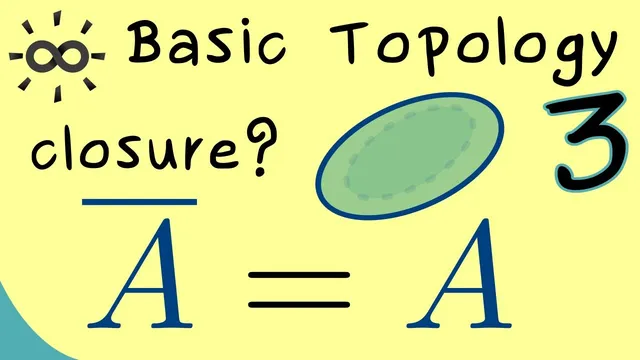
Basic Topology 3 | Closed Sets and Closure
Based on The Bright Side of Mathematics's video on YouTube. If you like this content, support the original creators by watching, liking and subscribing to their content.
A subset B of a topological space X is closed exactly when its complement X \ B is open.
Briefing
Closed sets in topology are defined purely through complements: a subset B of a topological space X is closed exactly when X \ B is open. That complement-based definition matters because it lets the familiar “open/closed duality” from metric spaces carry over to any topology, even when notions like boundaries are unavailable. Once open sets are known, closed sets follow automatically, and the basic closure properties can be derived with set-theoretic logic rather than geometric intuition.
From that definition, three core facts about closed sets drop out immediately. The whole space X is closed because its complement is the empty set, which is open. Likewise, the empty set is closed because X itself is open. More importantly, closed sets behave well under unions and intersections: the union of two closed sets is closed, since the complement of B1 \u222a B2 equals (X \ B1) \u2229 (X \ B2), and intersections of open sets stay open. For arbitrary families, the same complement reasoning shows that any intersection of closed sets is closed—equivalently, complements turn arbitrary intersections of closed sets into arbitrary unions of open sets.
The transcript illustrates these rules with real numbers under the standard topology. Intervals of the form [a,b] are closed because their complements are open rays. It then contrasts finite and infinite intersections: the sets [-1/n, 1/n] are closed for each n, and intersecting over all natural numbers leaves only {0}. That singleton is closed, even though it is not open in the standard topology. The example also highlights a key asymmetry: arbitrary intersections of open sets need not remain open, while arbitrary intersections of closed sets always do.
With closed sets in hand, the closure of an arbitrary subset M is defined as the smallest closed set containing M. Notation is \overline{M}. The construction is set-theoretic: take the intersection of all closed sets B such that M \u2286 B. Because intersections of closed sets are closed, \overline{M} is itself closed, and because it is an intersection of all such candidates, it is minimal among closed supersets of M.
A coarser topology on \u211d (the real line) makes the usefulness of closure concrete. Here, the only nontrivial open sets are symmetric intervals (-a, a) for a>0, along with the empty set and the whole line. In this topology, the interval M=[2,4] is neither open nor closed. Since closed sets are complements of open sets, the smallest closed set containing M must exclude all points that would force the complement to be open. The result is that \overline{M} becomes (-\u221e, -2] \u222a [2, \u221e), i.e., the “gap” around 0 shrinks just enough so that the closed set still contains 2 and 4. The example shows how closure depends on the chosen topology, not just on the subset itself.
Cornell Notes
Closed sets are defined via complements: B \u2286 X is closed exactly when X \ B is open. This yields immediate properties—X and \u2205 are both closed, unions of finitely many closed sets stay closed, and arbitrary intersections of closed sets stay closed. Using these facts, the closure \overline{M} of a subset M is defined as the smallest closed set containing M, constructed as the intersection of all closed supersets of M. The transcript demonstrates the definitions on \u211d with the standard topology (e.g., \u2229_{n}[-1/n,1/n]={0}) and then shows how closure changes under a coarser topology where only symmetric intervals (-a,a) are open. In that coarser topology, \overline{[2,4]} becomes (-\u221e,-2] \u222a [2,\u221e).
Why does defining closed sets as complements of open sets matter when there’s no notion of boundary?
What closure properties follow directly from the complement definition?
How does the example \u2229_{n\u2208\u2115}[-1/n,1/n]={0} illustrate the difference between open and closed behavior?
How is the closure \overline{M} constructed, and why is it guaranteed to be closed?
In the coarser topology on \u211d where open sets are only (-a,a), why does \overline{[2,4]} equal (-\u221e,-2] \u222a [2,\u221e)?
Review Questions
- State the definition of a closed set in a topological space using complements, and derive one closure property from it.
- Explain why \overline{M} is the smallest closed set containing M, and describe how it is constructed.
- Using the coarser topology where open sets are (-a,a), determine what the closure of a different interval [b,c] would look like (in terms of b and the allowed open sets).
Key Points
- 1
A subset B of a topological space X is closed exactly when its complement X \ B is open.
- 2
Closed sets inherit dual properties from open sets: X and \u2205 are always closed.
- 3
The union of two closed sets is closed because complements turn unions into intersections of open sets.
- 4
Any (possibly infinite) intersection of closed sets is closed, since complements turn it into a union of open sets.
- 5
The closure \overline{M} of a set M is defined as the intersection of all closed sets containing M, making it the smallest closed superset.
- 6
Closure depends on the chosen topology: the same subset can have different closures under different open-set collections.
- 7
In the coarser topology on \u211d with open sets (-a,a), the closure of [2,4] becomes (-\u221e,-2] \u222a [2,\u221e).