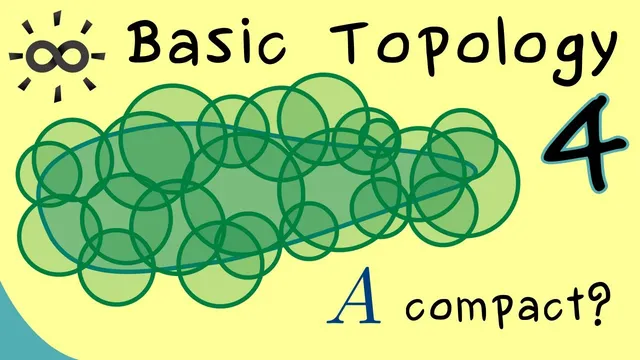
Basic Topology 4 | Compact Sets
Based on The Bright Side of Mathematics's video on YouTube. If you like this content, support the original creators by watching, liking and subscribing to their content.
Compactness is defined relative to a chosen topology: the same set can be compact or not depending on which open sets are allowed.
Briefing
Compactness in topology is the rule that lets mathematicians treat certain infinite sets as if they were “almost finite” with respect to open covers. The key criterion is simple to state but powerful in use: a subset A of a topological space is compact exactly when every open cover of A can be reduced to a finite subcover. That reduction depends on the topology chosen—closed-and-bounded sets are compact in the real numbers with the standard topology, but this equivalence fails in general topological spaces.
To make the definition concrete, the discussion starts with the idea of covering a set A using open sets drawn from the topology. An open cover may involve infinitely many sets, and there is no guarantee that a finite selection will still cover everything. Finite sets behave nicely: if A has only finitely many points, any open cover can be trimmed down to finitely many members that still cover A. Compactness is precisely the extension of this “finite subcover” behavior to certain infinite sets.
Formally, given a collection of open sets {U_i} indexed by some set I, the family is an open cover of A when the union of all U_i contains A. The subset A is compact when, for every such open cover, there exists a finite subset I_0 ⊂ I such that the union over i in I_0 still covers A. The transcript emphasizes that this must hold for every possible open cover, not just for some convenient one. It also notes that other compactness characterizations—like sequence-based ones in metric spaces—are special cases of this general open-cover definition.
The real line example shows what goes wrong without compactness. Using the standard topology on ℝ, one can cover all of ℝ with open intervals (−n, n) for n ∈ ℕ. No finite collection of these intervals can cover ℝ, because any finite choice only reaches some bounded range. So ℝ is not compact.
In contrast, the unit interval [0,1] in ℝ is compact. The proof is built around an arbitrary open cover of [0,1] and a set S of points x in [0,1] such that the smaller interval [0,x] admits a finite subcover. Since [0,0] is finite, 0 lies in S. Openness then supplies “epsilon neighborhoods”: if a point is in S, the cover’s open set containing that point also contains a small interval to the right, pushing the property further. This leads to showing that the supremum of S must actually belong to S.
Finally, a contradiction seals the argument. If sup S were less than 1, openness around sup S would allow extending the finite-subcover property slightly beyond sup S, producing a number larger than sup S that still lies in S—impossible by the definition of supremum. Therefore sup S = 1, meaning [0,1] has a finite subcover for every open cover and is compact. The takeaway is that compactness is a topology-dependent “finite subcover” principle, and the unit interval in ℝ is the canonical example where infinite sets still behave finitely under open covers.
Cornell Notes
Compactness is defined through open covers: a subset A of a topological space is compact if every open cover of A has a finite subcover. This property depends on the topology, not just the underlying set. Finite sets are always compact because any cover can be reduced to finitely many open sets covering the finitely many points. In ℝ with the standard topology, ℝ itself is not compact since intervals (−n,n) cover it but no finite subcollection does. The unit interval [0,1] is compact, and the proof uses an open-cover argument with a set S of points where [0,x] has a finite subcover, then shows sup S must equal 1 via an epsilon-neighborhood step and a contradiction.
What is the exact definition of a compact subset in a general topological space?
Why is ℝ not compact in the standard topology?
How does the proof that [0,1] is compact work at a high level?
Why does openness matter in the step that pushes from x ∈ S to nearby points in S?
What contradiction arises if sup S is assumed to be less than 1?
Review Questions
- State the open-cover definition of compactness and explain what changes when passing from a finite set to an infinite one.
- Give an explicit open cover of ℝ in the standard topology and explain why no finite subcover exists.
- In the proof for [0,1], what is the set S, and how do epsilon-neighborhoods and the supremum argument force sup S = 1?
Key Points
- 1
Compactness is defined relative to a chosen topology: the same set can be compact or not depending on which open sets are allowed.
- 2
A subset A is compact iff every open cover of A admits a finite subcover.
- 3
Finite sets are automatically compact because any cover can be reduced to finitely many open sets covering the finitely many points.
- 4
In the standard topology on ℝ, the cover (−n,n) for n ∈ ℕ shows ℝ is not compact since no finite subcollection can cover all real numbers.
- 5
The unit interval [0,1] is compact, and the proof uses an arbitrary open cover plus a set S of points x where [0,x] has a finite subcover.
- 6
Openness in ℝ provides epsilon-neighborhoods that let the finite-subcover property extend to points slightly to the right.
- 7
A contradiction argument shows the supremum of S must equal 1, forcing a finite subcover for the entire interval [0,1].