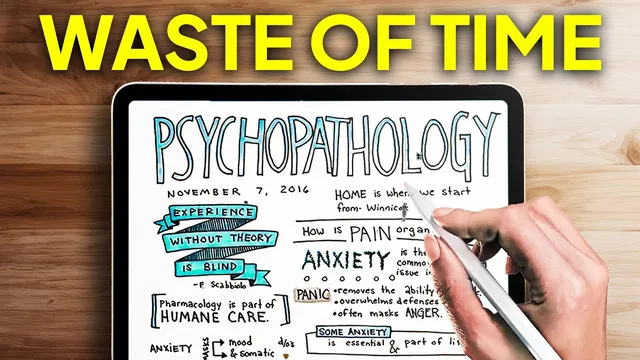
Become a Top 0.1% Student by Avoiding This
Based on Justin Sung's video on YouTube. If you like this content, support the original creators by watching, liking and subscribing to their content.
Learning requires active processing that organizes information; neat transcription alone doesn’t guarantee understanding.
Briefing
Studying effectively often requires notes that look messy at first—because the “mess” is the visible trace of active thinking that turns raw information into a connected mental model. The core claim is that pretty, perfectly structured notes can create an illusion of learning by letting people skip the hardest step: reorganizing information through deliberate processing. When notes are produced without that thinking, they become a reference document rather than evidence of understanding, leaving learners with “learning debt” to pay later.
The argument starts with a three-part pipeline for learning from a textbook: consume the information, think it through so it becomes organized and retained, then write notes in a way that supports that thinking without overloading the brain. Skipping the second step—reading and then transcribing everything into a neat system—means little learning has occurred. The transcript contrasts two options that both spend the same amount of time: spending hours writing notes that only lead to partial recall later versus spending the same hours using notes to learn deeply enough to remember most of it a week later. The difference comes from whether note-taking forces the learner to actively connect ideas.
To show what active processing looks like, the transcript uses an example from a medical text about antibiotics (penicillins). As the learner reads, they notice repeated concepts—like “bacterial cell wall synthesis”—and begin linking related statements together rather than copying the textbook’s structure. That triggers questions: what else inhibits cell wall synthesis, whether the effect is limited to certain antibiotic classes, how “gram positive” and “gram negative” susceptibility changes the picture, and how “aerobic versus anaerobic” conditions fit in. The notes become increasingly tangled because the mind is exploring multiple relationships at once.
That apparent disorder is framed as a feature, not a flaw. The learner treats note-making like assembling a jigsaw puzzle: pieces are tested, moved, and rearranged until a coherent “big picture” emerges. Learning is described as recursive—going back and forth through material from different angles—so the process naturally involves iteration. Messy notes support that recursion by keeping track of connections while understanding is still forming.
The transcript then draws a line between productive mess and “pretty notes” that are cognitively empty. A demonstration pairs note-writing with distractions (catchy music and frequent interruptions) to show that the notes can remain visually polished even when deep thinking is impaired. The takeaway is that if note-taking doesn’t require active engagement—especially during lectures where information arrives quickly—it can slide into passive learning, which wastes time.
Finally, the message isn’t “never make neat notes.” The goal is a sweet spot: start messy to force relational thinking, then clean up later so the final notes look good while still reflecting the deeper understanding built during the messy phase.
Cornell Notes
Effective learning from reading depends on more than capturing information—it requires active processing that organizes ideas into relationships the brain can retain. Notes that look neat from the start can mask skipped thinking, turning note-taking into a time-consuming transcription exercise that delays real understanding. In contrast, starting with messy, non-linear notes helps learners track connections as questions arise (e.g., linking antibiotic effects to recurring themes like bacterial cell wall synthesis, gram positive/negative, and aerobic/anaerobic distinctions). The transcript frames this as recursive learning: going back and rearranging ideas until a coherent conceptual web forms. Neat final notes are fine, but the learning benefit comes from the messy-to-cleanup process that forces engagement.
Why does the transcript treat “pretty notes” as potentially irresponsible for learners?
What are the three steps for learning from a textbook, and where does note-taking fit?
How does the antibiotic example illustrate active note-making?
Why does the transcript claim messy notes can deepen memory and understanding?
What does “recursive” learning mean in this context, and how does it justify iteration?
How does the demonstration attempt to prove that pretty notes may be cognitively empty?
Review Questions
- When does note-taking become “learning debt” according to the transcript, and what step is being skipped?
- In the antibiotic example, what recurring concepts drive the learner to restructure notes non-linearly?
- Why does the transcript say starting messy and then cleaning up can be better than trying to produce a perfect set of notes immediately?
Key Points
- 1
Learning requires active processing that organizes information; neat transcription alone doesn’t guarantee understanding.
- 2
Note-taking should support the thinking step by forcing connections, not just creating a reference document.
- 3
Spending hours writing notes that only enable partial recall later is less effective than using the same time to learn deeply.
- 4
Non-linear, messy notes can reflect the brain’s relational work and help build a conceptual web.
- 5
Cleaning up notes later is valuable because learning is recursive—ideas need to be revisited and rearranged.
- 6
Visually polished notes can still be passive if attention is diverted, producing an illusion of learning.
- 7
Neat final notes are fine, but the benefit comes from the messy-to-cleanup process that requires engagement.