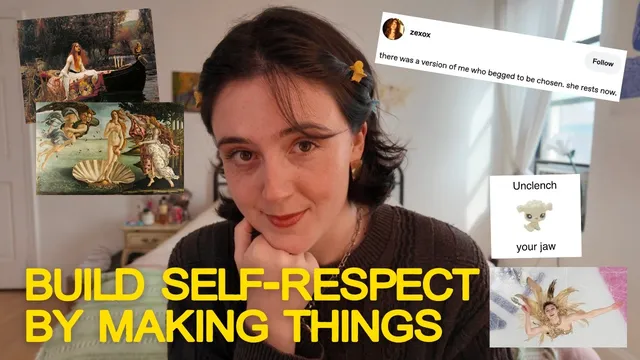
Become Your Own Muse
Based on Anna Howard's video on YouTube. If you like this content, support the original creators by watching, liking and subscribing to their content.
Self-respect is framed as integrity and disciplined follow-through—doing what one commits to, even when emotions like fear of loss are present.
Briefing
Self-respect is framed as a decision-making framework that can protect creative work from romantic heartbreak—and, just as importantly, can reshape how people create when culture tries to dictate what “women” (and other marginalized identities) are allowed to be. The core throughline links intimacy and art: insecurities that surface in love often reappear in creative practice, especially when sharing work publicly triggers fear of loss. The remedy isn’t a mood shift but a repeatable choice—honoring commitments, aligning actions with values, and returning to a practice even when rejection or uncertainty is likely.
A personal turning point illustrates how that plays out. After pausing the podcast for months—partly after dating derailed motivation—she recommits through a moment of romantic disappointment: being ghosted after a partner asked for lyrics to a song. The intoxicating pride of creating lyrics becomes a signal that attention should return to a process that can “reciprocate,” not to pining. That leads to a concrete self-respect decision: one hour a day devoted to improving her podcast skills. The same principle also shows up as a refusal to chase validation that doesn’t fit. In this framing, self-respect means choosing a creative path that can be sustained by integrity rather than by external approval.
The discussion then widens into art history and cultural power. A central contrast is drawn between “self-love” and “self-respect.” Self-love is described as acceptance without accountability, while self-respect demands integrity, disciplined follow-through, and steadfast alignment with values. That distinction becomes a lens for examining how women are represented—often through male-controlled viewing and institutional gatekeeping. Drawing on Katherine Cormick’s Women in the Picture, the narrative argues that women historically weren’t allowed to look: access to studying, professional spheres, and even the world of men was restricted, shaping who could create images and who could be seen. The result is a long pipeline of archetypes that flatten women’s complexity.
Venus becomes the symbolic battleground. The myth of Venus’s birth is treated as more than a romantic origin story; it’s described as violent and patriarchal in its implications, with Venus portrayed as emerging from a butchered male body rather than female reproductive power. From there, the talk connects classical imagery to modern advertising and pop culture, including how “ideal femininity” gets normalized. It also highlights acts of protest and reimagining: suffragette Mary Richardson slashing Diego Velasquez’s “Rogue Venus” in 1914 to expose hypocrisy about respect for nude women versus real women’s bodies; and later creative works that demystify taboo realities like menstruation or challenge how “freak show” narratives were used to objectify Sarah Bartman.
The closing emphasis returns to agency: creating what’s missing, following internal guidance, and treating every decision as potential art. Online platforms are positioned as a contemporary “room of one’s own,” enabling attentional sovereignty and making it easier for women, people of color, and non-binary creators to share work. The message lands as both practical and political: self-respect in creative life means returning to the maker role—choosing commitments, resisting imposed narratives, and building a practice that can’t be taken away by heartbreak or cultural pressure.
Cornell Notes
Self-respect is presented as a decision-making framework that links romantic resilience to creative resilience. When fear of heartbreak or loss shows up, the response isn’t to wait for confidence—it’s to honor commitments and return to a practice that aligns with personal values. A personal example shows recommitting to a daily creative hour after being ghosted, using the pride of making as a compass. The talk then expands into art history through Katherine Cormick’s Women in the Picture, arguing that women were historically restricted from “looking,” which shaped representation and institutional power. Venus becomes a case study for how patriarchal myths and images normalize idealized femininity, prompting protest and reimagining as forms of creative self-respect.
How does “self-respect” function as a practical tool rather than a feeling?
What personal example shows self-respect operating across romance and creativity?
Why does the talk connect creative agency to art history and representation?
What role does Venus play in the discussion of patriarchal imagery?
How are protest and reimagining presented as forms of self-respect in art?
What does “creating what you’re seeking” mean in this framework?
Review Questions
- How does the talk distinguish self-love from self-respect, and why does that distinction matter for creative consistency?
- What evidence from art history is used to argue that women were historically restricted from “looking,” and how does that shape representation today?
- In the Venus examples, what kinds of creative actions are treated as self-respect—protest, demystification, or narrative reimagining—and what is the common goal?
Key Points
- 1
Self-respect is framed as integrity and disciplined follow-through—doing what one commits to, even when emotions like fear of loss are present.
- 2
Romantic insecurity and creative insecurity are treated as connected; fear of heartbreak can also drive avoidance of sharing art.
- 3
A concrete self-respect strategy is choosing a daily creative practice (one hour a day in the example) that can sustain pride and growth independent of romantic outcomes.
- 4
Art history is used as a power map: restricting who can look and who can be seen helps explain why women’s complexity is often flattened in cultural images.
- 5
Venus is used as a case study for how patriarchal myths and institutions normalize idealized femininity while erasing female agency.
- 6
Protest and reimagining—whether vandalism-as-critique, demystifying taboo realities, or rewriting marginalized histories—are presented as creative self-respect.
- 7
Online platforms are positioned as modern “rooms of one’s own,” enabling attentional sovereignty and broader access for underrepresented creators.