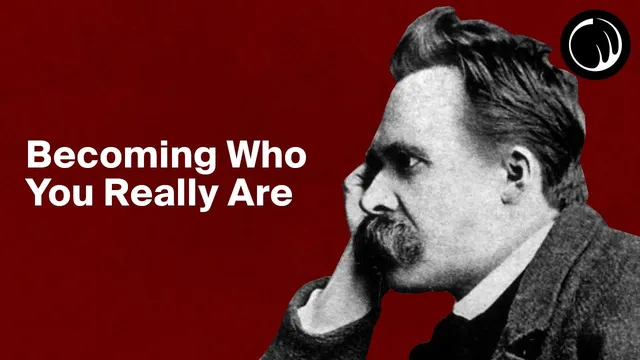
Becoming Who You Really Are - The Philosophy of Friedrich Nietzsche
Based on Pursuit of Wonder's video on YouTube. If you like this content, support the original creators by watching, liking and subscribing to their content.
Nietzsche treats the end of Christian certainty as a moral and psychological crisis that can produce nihilism without new value-creation.
Briefing
Friedrich Nietzsche’s core insight is that the collapse of Christian certainty (“God is dead”) doesn’t automatically produce freedom or meaning—it threatens to dissolve Europe’s moral framework into nihilism unless people replace inherited values with something they actively create. The stakes are personal and cultural at once: when universal, objective truth and fixed moral rules lose credibility, individuals face a vacuum where suffering can feel pointless and life can lose direction.
Nietzsche’s warning is rooted in a diagnosis of modernity. He rejects the idea that there is a single, capital-T objective truth to be discovered; instead, “facts” function as interpretations shaped by human perspectives. That shift matters because it undermines the traditional claim that morality and meaning come from an external, stable source. In his view, the arts and humanities can help communicate deeper truths and restore connection, but they can also become hollow—turned into academic routine or commodified entertainment. So he pushes further: meaning can’t be outsourced to culture, institutions, or collective belief systems. It must be generated by individuals through creative self-fashioning.
Nietzsche’s proposed alternative centers on the Overman (often translated as “Superman”)—not as a literal species, but as an idealized model of what a person might become by overcoming fear and weakness. The Overman embodies defiant independence and vigorous self-directed desire, including a willingness to break from herd morality. This stance is tied to Nietzsche’s broader claim that human life is fundamentally driven by the “will to power,” an inner drive toward growth and self-mastery rather than mere domination over others. The engine of transformation is “self-overcoming”: a recurring cycle of dissatisfaction, improvement, and renewed self-discovery.
Suffering sits at the center of the moral problem. Nietzsche doesn’t treat pain as something to eliminate at all costs; he argues that suffering becomes valuable when it’s interpreted as fuel for strength. Where pessimists like Arthur Schopenhauer emphasize minimizing suffering, Nietzsche frames the curse as not suffering itself but meaninglessness—the failure to find a “why” that makes endurance worthwhile. With a self-chosen “why,” he suggests, people can tolerate almost any “how.”
The biography reinforces the tension in his philosophy. Nietzsche’s life included intellectual rupture—leaving Christian theology after critical exposure—followed by years of isolation, illness, and intense writing that produced Human, All Too Human, The Gay Science, Thus Spoke Zarathustra, Beyond Good and Evil, and On the Genealogy of Morals. Yet his later years ended in mental breakdown after an episode of compassion toward a flogged horse, followed by madness and death in 1900 at age 55.
Nietzsche’s legacy remains powerful but contested. His ideas can inspire self-creation and resilience, but they also risk being misread as permission for cruelty or endless self-destruction in the name of growth. Even so, his work resists a single “how to live” system; it invites readers to interpret, disagree, and build their own direction—an approach meant to keep meaning alive after inherited certainties collapse.
Cornell Notes
Nietzsche’s central concern is what happens when Christian certainty collapses: without replacement values, societies drift toward nihilism and individuals can experience suffering as meaningless. He rejects universal objective truth, arguing that “facts” are interpretations shaped by human perspectives. To counter the vacuum, he emphasizes individual meaning-making through creative self-expression and the ideal of the Overman—an image of someone who overcomes fear and weakness. This process is powered by the will to power (growth and self-mastery) and self-overcoming, where suffering becomes fuel once a person finds a “why.” The result is a life-affirming ethic grounded in personal interpretation rather than inherited moral authority.
Why does Nietzsche treat the phrase “God is dead” as a warning rather than a celebration?
What does Nietzsche mean by denying universal objective truth?
How does the Overman function in Nietzsche’s philosophy?
What is the will to power, and how is it different from physical dominance?
Why does Nietzsche treat suffering as potentially beneficial?
How does Nietzsche’s life complicate his philosophy of self-overcoming?
Review Questions
- How does Nietzsche connect the collapse of Christian faith to the rise of nihilism?
- In what ways does Nietzsche’s idea of “no facts only interpretations” change how people should think about morality and truth?
- Explain how self-overcoming, the will to power, and suffering relate to Nietzsche’s answer to the problem of meaning.
Key Points
- 1
Nietzsche treats the end of Christian certainty as a moral and psychological crisis that can produce nihilism without new value-creation.
- 2
He rejects universal objective truth, arguing that “facts” operate as interpretations shaped by human perspectives.
- 3
Meaning cannot be reliably outsourced to culture or institutions; it must be actively created by individuals through creative self-expression.
- 4
The Overman functions as an ideal model for self-mastery and independence, representing a break from herd morality.
- 5
Nietzsche’s will to power is primarily inner growth and psychological/spiritual strength, not mere domination over others.
- 6
Self-overcoming is the recurring process that turns dissatisfaction into growth, using suffering as fuel once a person has a “why.”
- 7
Nietzsche’s legacy is influential but contested, partly because his ideas can be misread or applied in harmful ways.