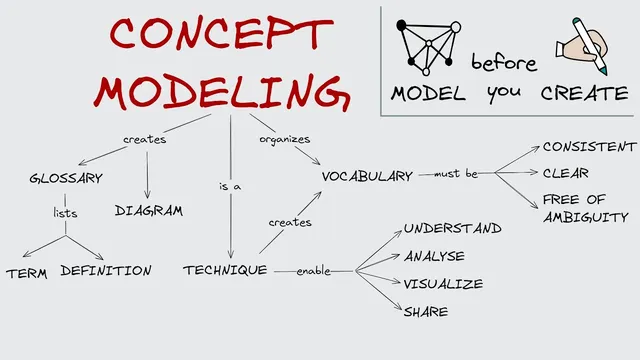
Before You Write: Frame Your Thoughts with Concept Modeling
Based on Zsolt's Visual Personal Knowledge Management's video on YouTube. If you like this content, support the original creators by watching, liking and subscribing to their content.
Start concept modeling with a focus question to constrain scope and prevent clutter.
Briefing
Concept modeling—using concept maps (also called concept diagrams or concept models)—is presented as a practical way to organize understanding before writing, teaching, or producing any new content. The core idea is to start with a structured “model” of key concepts and their relationships, so later output (articles, videos, presentations, proposals) is coherent, thorough, and aligned with a clear vocabulary. The payoff is twofold: it improves content quality and strengthens learning by building mental scaffolding around new material.
The walkthrough begins by creating a concept map in Excalidraw inside Obsidian MD, emphasizing that free-form drawing plus link notes makes the workflow effective for visual PKM. The process starts with a focus question to keep the map from becoming cluttered. Using the example focus question—“what are the key elements of a diagram”—the creator lists initial terms such as shapes, lines, labels, key, scale, scope, audience, intention, and topic. From there, the map is built top down: a central concept stands out (often with a different color), then details branch downward.
A concept map is defined through three core elements: shapes for concepts or ideas, arrows for relationships, and labels that describe how concepts connect. Arrows are treated like propositions: combining the source and target concepts with the connector label should form simple sentences. For example, an arrow labeled “explains” can connect “diagram” to “topic,” yielding a readable relationship. As the model develops, the map gains structure through additional grouping and lateral connections.
The transcript also distinguishes between “easy-to-see” visual elements and “behind-the-scenes” elements that influence the final representation. Shapes, lines, labels, and keys are described as visible components, while scope, audience, and intention are framed as invisible constraints that still shape how the diagram should look and what it should communicate. Scale is treated as a lateral dependency as well—depending on audience and intention—while topic is connected to scope. The map can be expanded by defining what “topic” might include: a process, a concept, a book, a system, or other objects of understanding.
A crucial distinction is then drawn between modeling and illustration. Modeling happens upfront, before writing or producing content, by clarifying thoughts and defining vocabulary. Illustration is described as retroactive: once content already exists, visualization is added to represent it. Concept modeling is also positioned as a learning tool—when reading about something new, mapping key concepts creates mental scaffolding that supports understanding and recall.
Finally, the transcript contrasts concept maps with mind maps using a “double bubble map” reference. Concept maps are hierarchical (top down), relationship-focused, and more rigorous and formal. Mind maps are free-form (center out), association-driven, often colorful, and geared toward brainstorming, note taking, problem solving, and organizing ideas. The takeaway is direct: start with a concept model for the topic, then convert that model into text—rather than writing first and trying to diagram later—so knowledge gaps are surfaced and complex ideas are made explicit.
Cornell Notes
Concept modeling via concept maps is presented as a structured way to clarify thinking before writing or learning. The method starts with a focus question, then builds a top-down model using three elements: shapes for concepts, arrows for relationships, and labels that turn connections into readable propositions. Scope, audience, intention, and scale act as “invisible” constraints that shape how the final diagram should look and what it should communicate. Modeling is contrasted with illustration: modeling happens upfront to define vocabulary and ensure coherence, while illustration is retroactive after content exists. Concept maps are also differentiated from mind maps by their hierarchy and relationship emphasis.
What are the three core building blocks of a concept map, and how do they work together?
Why start with a focus question, and how does it prevent concept maps from getting out of hand?
What’s the difference between “visible” visual elements and “invisible” ones in diagram modeling?
How does the transcript define modeling versus illustration in content creation?
How do concept maps differ from mind maps, beyond just appearance?
What learning benefit does concept modeling provide when encountering new information?
Review Questions
- If a concept map connection can’t be turned into a simple sentence by following the arrow direction, what does that suggest about the model?
- How would you incorporate scope, audience, and intention into a concept map even if they aren’t immediately visible as “diagram elements”?
- Why does the transcript recommend converting a concept model into text rather than creating the diagram after writing?
Key Points
- 1
Start concept modeling with a focus question to constrain scope and prevent clutter.
- 2
Build concept maps top down using shapes (concepts), arrows (relationships), and labeled connectors (propositions).
- 3
Use lateral connections to refine precision as the model matures, not just vertical branching.
- 4
Treat scope, audience, and intention as influential constraints that shape the diagram even when they aren’t visually obvious.
- 5
Modeling should happen before content production to define vocabulary and ensure coherence; illustration comes after content exists.
- 6
Use concept maps as learning scaffolding when processing new material to surface knowledge gaps and strengthen recall.
- 7
Prefer concept maps for relationship-focused, structured understanding; use mind maps for free-form brainstorming and association-driven organization.