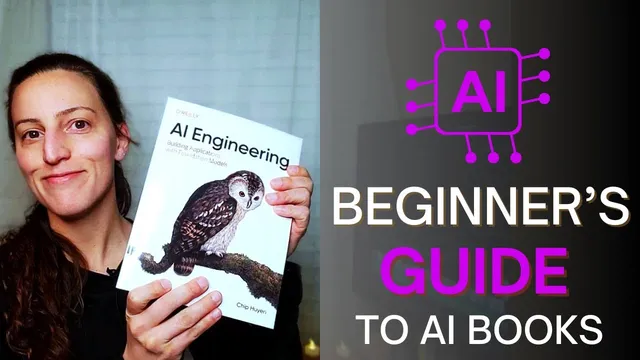
Beginner’s Guide to Reading AI & Machine Learning Books – Follow Along with a PhD Student
Based on Code Mechanics: My PhD Life in AI & Robotics's video on YouTube. If you like this content, support the original creators by watching, liking and subscribing to their content.
Start technical reading by scanning front matter and the table of contents to build a mental map of where concepts fit before diving into details.
Briefing
A PhD student recommends a “scaffolding” method for learning from AI and machine learning books: skim the front matter and table of contents first to build a mental map of where concepts live, then dive into chapters with purpose. The core idea is that technical material sticks better when readers start with high-level context—knowing what each section is for and how it connects—before chasing details. Instead of reading like a novel (starting at chapter one and moving straight through), the approach treats the book like a blueprint: establish the structure, then fill in the technical rooms.
The process begins with a quick scan of the prologue, author notes, and other front matter, followed by jumping directly to the table of contents. That initial pass is used to determine whether the early chapters are mostly framing and background or whether they contain immediately actionable technical depth. In the example book, *AI Engineering: Building applications with Foundation models* by Chip Huan (spelled as heard in the transcript), the table of contents signals that the opening material focuses on the rise of AI engineering, foundation model use cases, planning AI applications, and an “AI engineering stack.” The reader treats this as contextual scaffolding—useful for orientation, not necessarily for deep technical mastery.
From there, the reader moves to later chapters to locate the kinds of details that match their current needs. Chapter 2, for instance, is flagged as more practical for foundation models, emphasizing training data, modeling, post-training, and sampling. The reader uses this to create a mental map of foundation-model-specific mechanics. Evaluation sections also stand out: one chapter highlights evaluation methodology, including model metrics and “exact evaluation,” while another section introduces “AI as a judge,” suggesting evaluation via voting or comparative judgments—potentially relevant to research that uses generative AI.
The table of contents also helps distinguish between methodology and implementation. A subsequent chapter on evaluating AI systems is expected to be more tied to how models are built and run, while earlier evaluation content may provide the conceptual groundwork needed to understand later system-level evaluation. The reader notes gaps in their own knowledge—especially around evaluation—and marks chapters that could close them.
Other chapters are prioritized based on real-world relevance. Retrieval-augmented generation (RAG) and agents are noted as a growing area, even if not currently used. Fine-tuning techniques, memory bottlenecks, and dataset engineering are treated as likely “sticky note” material, particularly because the reader is working with large robotics datasets rich in sensor data. Inference optimization is also flagged as immediately useful because deployed robot inference is currently slow.
Finally, the reader values chapters on architecture and user feedback as a bridge from research demos to consistent real-world behavior. The index and epilogue are checked for how easily information can be retrieved later. Overall, the method is designed to improve retention by connecting new concepts to existing knowledge and by targeting the right chapters at the right time—starting with structure, then moving to depth.
Cornell Notes
The learning strategy centers on building a “concept map” before deep reading. Instead of starting at chapter one, the reader scans front matter and jumps to the table of contents to understand how the book is organized and which chapters provide background versus technical depth. While browsing, they mentally tag chapters that match current needs—like training data, evaluation, fine-tuning, dataset engineering, inference optimization, and user feedback. This scaffolding approach helps technical ideas “imprint” through layered context, then later details become easier to place and remember. It also supports targeted skimming: jump to the most relevant chapters first, then return for deeper study when gaps appear.
Why does the reader avoid starting at chapter one like a novel?
How does the table of contents guide what to read first in *AI Engineering: Building applications with Foundation models*?
What distinction matters in the evaluation-related chapters?
Why is “AI as a judge” singled out?
Which chapters are prioritized because they align with robotics research and deployment constraints?
How does user feedback fit into the learning plan?
Review Questions
- When building a mental map from a technical book, what specific steps come before reading chapter one, and what do those steps accomplish?
- How does the reader differentiate between evaluation methodology and evaluation of AI systems, and why does that matter for learning order?
- Which chapters in the example book are prioritized for robotics work, and what practical problem does each one address?
Key Points
- 1
Start technical reading by scanning front matter and the table of contents to build a mental map of where concepts fit before diving into details.
- 2
Use the table of contents to identify which chapters are primarily background versus chapters with practical mechanics.
- 3
Treat evaluation topics as layered: learn evaluation methodology and metrics first, then move to system-level evaluation that depends on implementation context.
- 4
Prioritize chapters based on current research and deployment needs—dataset engineering for robotics data, inference optimization for slow on-robot performance.
- 5
Flag sections that close known knowledge gaps (e.g., differences between model metrics and exact evaluation) so later reading has a clear purpose.
- 6
Mark chapters likely to become reference points (fine-tuning, memory bottlenecks) and return to them as projects evolve.
- 7
Check the index early to make future lookup efficient, especially when the index is more reliable than in other books.