Beyond the Mandelbrot set, an intro to holomorphic dynamics
Based on 3Blue1Brown's video on YouTube. If you like this content, support the original creators by watching, liking and subscribing to their content.
Holomorphic dynamics studies iterating complex-derivable functions and classifies outcomes as convergence to fixed points/cycles, escape to infinity, or chaotic behavior.
Briefing
Holomorphic dynamics turns the Mandelbrot set from a one-off curiosity into a recurring pattern: iterating complex-analytic functions produces stable behaviors (fixed points or cycles) separated by fractal boundaries where nearby starting points diverge into radically different outcomes. The core setup is simple—take a complex function that has a complex derivative (polynomials, exponentials, trig functions, and many rational functions qualify), then repeatedly apply it to an initial value. The orbit either settles into a cycle, converges to a limit point, escapes to infinity, or behaves chaotically; and when the chaotic cases are visualized, the dividing lines often form intricate fractals.
The discussion connects this general framework to two landmark constructions. Newton’s method, iterated in the complex plane, yields “Newton fractals” by coloring each starting seed according to which root it converges to. In parallel, the classic Mandelbrot set arises from a different choice: fix the starting value z = 0 while varying a parameter c in the quadratic map z ↦ z^2 + c. Points c for which the orbit stays bounded form the Mandelbrot set, while those that escape are colored by how quickly they diverge. The key contrast is structural: Mandelbrot images scan parameter space (changing the function), whereas Newton fractals scan initial-value space (changing the seed).
To build a theory rather than just pictures, the transcript emphasizes fixed points and—crucially—stability. A fixed point satisfies f(z) = z, and whether nearby points are drawn in or pushed away is determined by the derivative at that point. If |f′(z*)| < 1 the fixed point is attracting; if |f′(z*)| > 1 it is repelling; and for Newton’s method, roots of the polynomial become super-attracting because the derivative at those points is 0. The same logic extends to periodic orbits: two-cycles, n-cycles, and the fact that periodic points proliferate rapidly because solving f^n(z) = z becomes a high-degree polynomial problem.
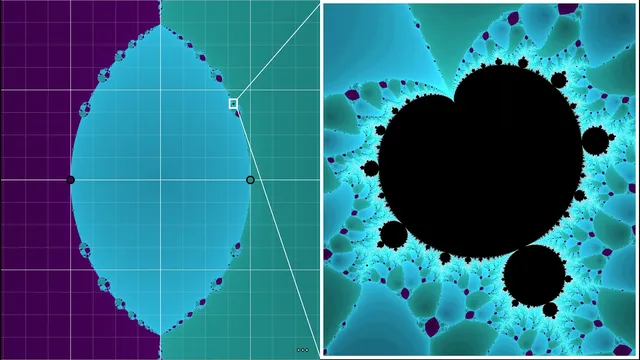
A practical numerical question then appears: can Newton’s method get trapped in an attracting cycle that is not a root? Yes. For a specific cubic, Newton iteration can converge to a genuine attracting two-cycle, meaning some initial guesses never reach any root. Visualizing which cubics have such “bad” attracting cycles leads to a striking universality. A theorem attributed to Fatou implies that if a rational map has an attracting cycle, at least one critical point of an iterate must lie in that cycle. In the cubic Newton setting, this translates into a test using only the midpoint (the average) of the three roots: if that midpoint falls into an attracting cycle, then the polynomial has one. Scanning the third root λ while holding two roots fixed produces a parameter-space diagram whose zoomed-in black region matches the Mandelbrot set’s iconic cardioid-and-bulb geometry. The Mandelbrot shape thus emerges as a general feature of parameter spaces for Newton-type dynamics, not just the quadratic family.
Finally, the transcript explains why fractal boundaries are unavoidable. Boundaries between different basins have a “multicolor” property: arbitrarily small neighborhoods around a Julia set point eventually contain points with every available limiting behavior. That forces boundaries to be rough rather than smooth. The Fatou set consists of points that fall into predictable stable behavior; the Julia set is the complement, where nearby points expand apart and behave chaotically. A Julia-set “stuff-goes-everywhere” principle—linked to Montel’s theorem—states that iterating a neighborhood of a Julia point eventually spreads across the complex plane (with at most two exceptions). This supplies a logical bridge from chaos to fractals: maximal instability at the Julia set boundary is what generates the intricate, self-similar-looking shapes seen in these dynamical pictures.
Cornell Notes
Holomorphic dynamics studies what happens when complex-derivable functions are iterated. Orbits may converge to fixed points or cycles, escape to infinity, or behave chaotically; the chaotic regime produces fractal boundaries between outcomes. Stability is determined by derivatives: attracting fixed points satisfy |f′(z*)|<1, repelling ones satisfy |f′(z*)|>1, and Newton’s method makes polynomial roots super-attracting because f′(z*)=0. Newton iteration can also converge to attracting cycles that are not roots, so parameter-space diagrams can be built by coloring polynomials whose root-averages fall into such cycles. Fatou’s theorem yields a powerful shortcut: for cubic Newton maps, checking the midpoint (average of the three roots) suffices to detect attracting cycles—leading to a Mandelbrot-like cardioid/bulb structure in the scan.
What does it mean for a complex function to be “holomorphic,” and why does that matter for dynamics?
How does stability of a fixed point get decided using derivatives?
Why do cycles proliferate, and how does that connect to solving polynomial equations?
How can Newton’s method converge to an attracting cycle that is not a root?
What does Fatou’s theorem contribute to detecting attracting cycles in cubic Newton maps?
Why are Julia sets fractal and never smooth along their boundaries?
Review Questions
- In Newton’s method, why do polynomial roots become super-attracting fixed points, and how does that relate to the derivative of the Newton map?
- For the quadratic family f(z)=z^2+c, how does the degree of the equation f^n(z)=z grow with n, and what does that imply about the number of periodic points?
- What is the practical “single-point test” for whether a cubic Newton map has an attracting cycle, and how does Fatou’s theorem justify it?
Key Points
- 1
Holomorphic dynamics studies iterating complex-derivable functions and classifies outcomes as convergence to fixed points/cycles, escape to infinity, or chaotic behavior.
- 2
Mandelbrot sets arise by fixing z=0 and varying the parameter c in z↦z^2+c, while Newton fractals arise by fixing the function and varying the initial seed z0.
- 3
Stability of fixed points and cycles is controlled by derivatives: |f′|<1 implies attraction and |f′|>1 implies repulsion; Newton’s method makes polynomial roots super-attracting because the derivative at roots is 0.
- 4
Newton’s method can converge to attracting cycles that are not roots, creating numerical “traps” for some initial guesses.
- 5
Fatou’s theorem yields a shortcut for cubic Newton maps: if an attracting cycle exists, the midpoint (average) of the three roots must fall into it, so scanning can be done by testing one point per polynomial.
- 6
Zooming into the parameter-space region where that midpoint is trapped produces a Mandelbrot-like cardioid-and-bulb structure, showing the Mandelbrot shape’s universality beyond the quadratic family.
- 7
Fractal Julia-set boundaries are forced by a multicolor neighborhood property and reinforced by a “stuff-goes-everywhere” principle tied to Montel’s theorem, linking maximal chaos to rough geometry.