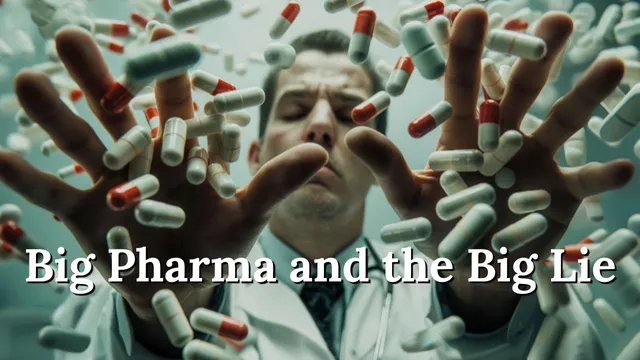
Big Pharma and the Big Lie – The Chemical Imbalance Theory of Mental Illness
Based on Academy of Ideas's video on YouTube. If you like this content, support the original creators by watching, liking and subscribing to their content.
The transcript claims psychiatric drugs are justified to the public through a “chemical imbalance” narrative that links neurotransmitter defects to mental illness and presents medication as correction.
Briefing
Psychiatric drugs are widely sold on a simple story: mental illness stems from “chemical imbalance” in the brain, and medication fixes that imbalance. The transcript argues that this narrative—marketed as medical truth—has little solid biological evidence behind it, yet became powerful enough to reshape psychiatry, public attitudes, and pharmaceutical profits.
The case begins with how psychiatry gained legitimacy in the early 20th century by adopting a materialist view that mind problems must have physical causes. A German psychiatrist, Emil Kraepelin, is credited with popularizing the idea that disorders like depression, anxiety, and schizophrenia arise from underlying brain and body pathology. That shift helped psychiatry move toward aggressive biological interventions, including insulin shock therapy, lobotomy, electroconvulsive therapy (ECT), and even treatments such as malaria therapy and cyanide-based approaches. The transcript frames these as largely ineffective and sometimes deadly, creating a crisis for psychiatry compared with faster progress in general medicine.
The turning point, it says, came in the 1950s with the first generation of psychiatric drugs. Chlorpromazine (marketed as Thorazine) is described as a breakthrough neuroleptic discovered during antimalarial research, while other drugs were found through searches for unrelated medical targets—anxiolytics from antibacterial work and antidepressants from tuberculosis research. These medications triggered a “psychopharmacological revolution,” bringing enthusiasm, new textbooks, and major marketing opportunities. The transcript highlights how companies sold drugs not just to institutions but to the public, citing milestones such as Miltown (meprobamate) and Valium (diazepam), and notes that early drug success also boosted psychiatry’s status.
But side effects and dependence problems undermined the early pitch. The transcript points to regulatory action in the U.S. that placed benzodiazepines under the Controlled Substances Act, and it describes a cultural backlash: an anti-psychiatry movement led by Thomas Szasz, fueled by allegations that psychiatric drugs were used for social control and by highly publicized testimonies about harm in juvenile institutions. Popular media such as One Flew Over the Cuckoo’s Nest is cited as helping cement the critique.
To regain momentum, the transcript claims psychiatry and pharmaceutical science rebranded the old biological premise with a more specific mechanism: neurotransmitter imbalance. It credits Joseph Schildkraut’s 1965 hypothesis in the American Journal of Psychiatry as a catalyst for the modern “chemical imbalance theory,” then describes how drug mechanisms were turned into a storytelling template—serotonin and norepinephrine for depression, dopamine for schizophrenia—despite what it portrays as weak or missing evidence. The transcript argues the logic is circular: if a drug changes a neurotransmitter and symptoms improve, the condition must have been caused by that imbalance.
A central claim is that the public campaign was orchestrated through a coalition involving the American Psychiatric Association, the National Institute of Mental Health, and the National Alliance on Mental Illness, backed by pharmaceutical funding and media amplification. Depression awareness programs, magazine covers featuring Prozac, and books like Peter Kramer’s Listening to Prozac are presented as part of a push to normalize diagnosis and treatment. The transcript then asserts the scientific foundation is absent: neurotransmitter levels fluctuate, there is no agreed “normal” baseline, no reliable test exists to identify a chemical imbalance in an individual, and studies linking serotonin to depression are described as flawed or contradicted by later analyses.
The bottom line offered is that “chemical imbalance” functions more effectively as rhetoric than as biology—an explanation that helps justify long-term medication use even as the transcript maintains that the underlying theory is unsupported. It closes by promising a follow-up look at what psychiatric drugs do to the brain and mind if the imbalance premise is wrong.
Cornell Notes
The transcript argues that psychiatric drugs are marketed around a “chemical imbalance” theory: depression and other mental illnesses supposedly result from faulty neurotransmitter levels, and medication corrects those defects. It traces how psychiatry gained authority by adopting a materialist, brain-based model and then riding the wave of early psychopharmacology, when drugs like Thorazine, Miltown, and Valium boosted both treatment and legitimacy. When public concern grew over side effects and coercive uses, the transcript claims the field rebranded with neurotransmitter explanations—serotonin/norepinephrine for depression and dopamine for schizophrenia—despite lacking evidence that clinicians can measure a true imbalance or define a normal baseline. The result, it says, was a large-scale public relations campaign that made the theory feel like medical fact even as the biological case remains unproven.
Why did psychiatry’s status rise when brain-based explanations took hold?
What role did early psychiatric drugs play in changing public and professional attitudes?
How did the “chemical imbalance” story replace earlier controversies about psychiatric drugs?
Why does the transcript claim the chemical imbalance logic is scientifically weak?
What does the transcript say about the scale and structure of the public campaign for depression treatment?
Review Questions
- What historical developments does the transcript use to explain psychiatry’s shift toward biological explanations of mental illness?
- According to the transcript, what specific scientific problems undermine the claim that neurotransmitter imbalances cause mental disorders?
- How does the transcript connect marketing, media coverage, and institutional authority to the spread of the chemical imbalance theory?
Key Points
- 1
The transcript claims psychiatric drugs are justified to the public through a “chemical imbalance” narrative that links neurotransmitter defects to mental illness and presents medication as correction.
- 2
It traces psychiatry’s rise in legitimacy to materialist brain-based theories associated with Emil Kraepelin, which encouraged biological interventions for mental disorders.
- 3
It describes early psychopharmacology—such as Thorazine, Miltown, and Valium—as boosting psychiatry’s status and creating major commercial incentives for pharmaceutical companies.
- 4
It argues that later backlash over side effects and coercive uses helped set the stage for a rebranded neurotransmitter explanation of mental illness.
- 5
The transcript says neurotransmitter-based explanations rely on circular logic (drug changes neurotransmitters; improvement is treated as proof of the imbalance cause).
- 6
It claims there is no reliable way to test for a patient’s specific chemical imbalance because neurotransmitter levels fluctuate and no agreed normal baseline exists.
- 7
It portrays the spread of the chemical imbalance theory as driven by coordinated institutional and media campaigns, especially around depression and Prozac.