BIGGEST EXPLOSIONS
Based on Vsauce's video on YouTube. If you like this content, support the original creators by watching, liking and subscribing to their content.
Deflagration keeps expelled gases subsonic, so it produces rapid burning without a shockwave.
Briefing
Explosions come in two fundamentally different flavors: subsonic burns that spread through material without a shockwave, and true detonations that drive a supersonic pressure front. That distinction matters because it determines whether an energetic material is useful for controlled propulsion—like gunpowder—or dangerous enough to shatter structures and generate the characteristic blast effects seen in large-scale tests.
Smokeless powder in modern ammunition typically deflagrates rather than detonates. In this regime, the expelled gases never exceed the speed of sound, so no shock wave forms. The goal for a bullet’s propellant is precisely that: release energy fast enough to accelerate the projectile, but not so abruptly that the gun or the shooter takes damage from an uncontrolled detonation. Slow-motion comparisons highlight the difference. Smokeless powder burns strongly and quickly, yet the motion of gases remains subsonic, producing a rapid burn without the violent pressure-front behavior of detonation.
Nitroglycerin provides a stark contrast. It is fragile enough that a mechanical jolt can trigger detonation, causing the material to “immediately explode” rather than burn through. Consumer fireworks generally rely on black powder or similar compositions that lack the power to reliably detonate. Even loud, often illegal items such as quarter sticks, M80s, and cherry bombs are described as using flash powder rather than high explosives like dynamite—meaning they produce dramatic effects without necessarily achieving the supersonic detonation regime.
From there, the scale jumps to large munitions and beyond. Some of the largest shells in service are about 48 inches across; when they detonate in the air, they produce one kind of aerial burst, while failures that burst on the ground look different. Regardless of the explosive material—conventional charges, nuclear weapons, asteroid impacts, or earthquakes—strength is commonly expressed as TNT equivalence: how much TNT would be needed to produce a comparable energy release.
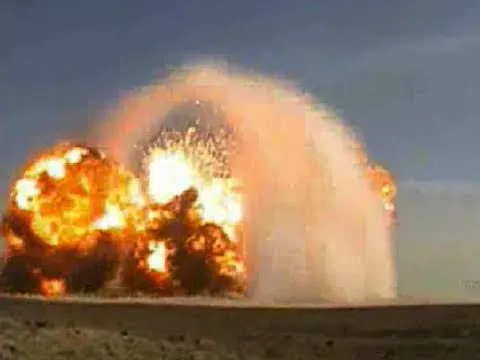
A concrete benchmark comes from a defense contractor disposing of explosives with an energy release of roughly 100 tons of TNT. Detonations generate a shockwave, a moving pattern of high and low pressure. In extreme cases, the low-pressure region can be so rarefied that water vapor condenses momentarily, forming a visible cloud. Shock condensation clouds were also observed in U.S. tests in Hawaii in 1965, where the goal was to understand how nuclear attacks might affect naval ships. The U.S. detonated an equivalent TNT amount on an island with ships anchored nearby.
The transcript then escalates through historical nuclear testing: underwater detonations were tested with an equivalent of about 8,000 tons of TNT, compared with the 15,000-ton TNT energy of the Hiroshima bomb in 1945. The most powerful human-made device mentioned is the Tsar Bomb, tested by the Soviet Union in 1961. Detonated about 2.5 miles above Earth to limit destruction, it released energy equivalent to 50 million tons of TNT. Its mushroom cloud rose beyond the normal atmosphere into the mesosphere, dwarfing other large nuclear test clouds.
Finally, the comparison turns cosmic. While 50 million tons is enormous, a supernova is estimated to release energy equivalent to ten octillion million tons of TNT—an explosion of an entire star. The segment closes with a nuclear-armed cannon concept, underscoring how far human technology can reach, even as stellar explosions dwarf it all.
Cornell Notes
Explosions split into two regimes: deflagration and detonation. Deflagration is a fast burn where expelled gases stay subsonic, so no shockwave forms—typical of smokeless powder used in bullets. Detonation is when energy release creates a supersonic pressure front, producing a shockwave and effects like shock condensation clouds. Large explosive events are compared using TNT equivalence, letting very different phenomena (conventional blasts, nuclear tests, impacts) be measured on the same scale. The transcript culminates in nuclear history (Tsar Bomb at 50 million tons TNT equivalent) and then outscales it with supernovas, estimated at ten octillion million tons of TNT equivalent.
What physical condition separates deflagration from detonation?
Why do gun propellants aim for deflagration rather than detonation?
How do nitroglycerin and smokeless powder illustrate the difference?
How is explosion strength compared across very different events?
What made the Tsar Bomb’s test unusual, and what was its TNT equivalence?
Why does the transcript end by shifting from nuclear blasts to supernovas?
Review Questions
- How would you predict whether an explosive produces a shockwave based on the speed of the expelled gases?
- Why does TNT equivalence provide a useful common scale for comparing conventional explosives, nuclear tests, and impacts?
- What tradeoff does deflagration offer for firearms compared with detonation?
Key Points
- 1
Deflagration keeps expelled gases subsonic, so it produces rapid burning without a shockwave.
- 2
Detonation occurs when expelled gases move supersonically, creating a shockwave of high and low pressure.
- 3
Smokeless powder in ammunition is designed to deflagrate to accelerate bullets without damaging the gun or shooter.
- 4
Nitroglycerin can detonate when mechanically triggered, demonstrating how some materials transition from burning to shock-driven release.
- 5
Explosion strength is often standardized using TNT equivalence, enabling comparisons across very different energy sources.
- 6
U.S. nuclear tests in Hawaii in 1965 used TNT-equivalent detonations to study how nuclear blasts would affect naval ships.
- 7
The Tsar Bomb (50 million tons TNT equivalent) and supernovas illustrate how human-made explosions are still tiny compared with stellar-scale events.