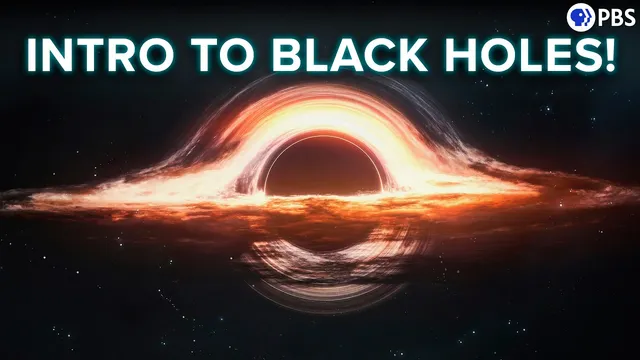
Black Holes. Explained. For 1.5 Hours.
Based on PBS Space Time's video on YouTube. If you like this content, support the original creators by watching, liking and subscribing to their content.
A black hole forms when a collapsing stellar core exceeds a critical mass so that the Schwarzschild radius overlaps the shrinking stellar radius, creating an event horizon.
Briefing
Black holes are real astrophysical objects, but they also function as the universe’s most punishing “stress test” for physics—forcing general relativity and quantum mechanics into the same arena. The core pathway to making one starts with a massive star: once fusion in the iron core stops releasing energy, the core collapses. Electrons get crushed into protons, producing a neutron star—an ultra-dense quantum object stabilized by degeneracy pressure from the Pauli exclusion principle. Push the neutron star past a critical mass (about three solar masses), and the star’s radius shrinks until it overlaps the would-be event horizon. At that point the event horizon forms, the interior becomes causally disconnected from the outside universe, and collapse continues toward a central singularity of infinite curvature (where known physics breaks down).
The transcript emphasizes that the “black hole interior” isn’t merely a deeper region of space; it changes the meaning of time itself. Outside observers never see anything cross the horizon in finite time, but the infalling matter experiences an inward cascade where all future-directed paths lead to the singularity. In the mathematical description (notably the Schwarzschild solution), the event horizon behaves like a coordinate singularity—an artifact of how spacetime coordinates are labeled—while the central singularity is a genuine curvature blow-up. The horizon also marks a causal flip: below it, the roles of space and time switch in the geometry, so the radial coordinate becomes timelike and unidirectional. That switch is what makes “falling” inevitable; resisting acceleration only delays the end by the slowest possible causal route.
Beyond formation and interior structure, the transcript connects black holes to cosmology and the early universe. General relativity implies that sufficiently dense regions collapse into black holes, but the early universe’s rapid expansion and near-uniform density prevented most matter from doing so. Tiny density fluctuations—visible today as the cosmic microwave background’s slight irregularities—seeded structure, but in some models the fluctuations could have been much stronger in the earliest moments, allowing primordial black holes (PBHs) to form. PBHs are intriguing because they might contribute to dark matter, yet their abundance is constrained by the lack of expected microlensing “twinkling,” by disruptions to star clusters and binary systems, and by evaporation limits from Hawking radiation. The remaining viable mass windows are narrow: roughly asteroid-mass PBHs (~10^21 kg) or rarer, heavier PBHs (tens of solar masses), with ongoing observational pressure from gravitational-wave detections such as LIGO’s merger signals.
The transcript then pivots to why black holes aren’t perfectly “black” in quantum theory. In 1974, Steven Hawking showed that quantum fields near an event horizon produce radiation with a thermal spectrum, implying black holes slowly evaporate. The calculation is a workaround—mixing quantum modes in curved spacetime without a full theory of quantum gravity—but it yields a robust result: radiation looks thermal, with a temperature inversely related to black hole mass. Different derivations (including tunneling pictures) converge on the same spectrum, strengthening confidence that the effect is real even if the underlying mechanism remains subtle.
Finally, black holes reshape thermodynamics and information. The no-hair theorem suggests only mass, spin, and charge matter externally, yet entropy and the second law demand something else. Jacob Bekenstein’s insight links black hole entropy to the area of the event horizon, not its volume, and Hawking’s radiation ties that entropy to a temperature. This area law leads to the Bekenstein bound—an upper limit on information in a region—and motivates the holographic principle, where the universe’s bulk information may be encoded on a surrounding surface. The transcript closes by illustrating how modern telescopes hunt for the earliest black-hole-powered quasars, using redshifted spectra to infer both cosmic age and the masses of supermassive black holes that formed astonishingly early.
Cornell Notes
Black holes form when a collapsing stellar core exceeds a critical mass, causing the star’s radius to shrink until it overlaps the event horizon. The interior then becomes causally disconnected from the outside universe, and spacetime geometry forces a “time/space flip” below the horizon so that inward collapse is inevitable. Quantum theory adds another layer: Hawking radiation implies black holes emit particles with a thermal spectrum and therefore evaporate over time. In thermodynamics and information theory, black hole entropy scales with event-horizon area, not volume, aligning with the second law and motivating the holographic principle. Primordial black holes could have formed in the early universe and might contribute to dark matter, but microlensing, dynamical disruption, and Hawking evaporation strongly constrain their possible masses.
How does a neutron star’s quantum stability relate to the Pauli exclusion principle and degeneracy pressure?
Why does adding mass to a neutron star make it smaller in radius, and how does that lead to an event horizon?
What is the difference between the event horizon’s “singularity” and the central singularity?
How does Hawking radiation emerge without a full quantum gravity theory?
Why does black hole entropy scale with area, and what does that imply for information?
What evidence constrains primordial black holes as dark matter candidates?
Review Questions
- What physical mechanism sets the critical mass for black hole formation from a neutron star, and how do quantum principles enter the argument?
- How do coordinate choices change the interpretation of the event horizon, and why can’t the central singularity be similarly removed?
- What chain of reasoning links horizon area to entropy and then to the holographic principle?
Key Points
- 1
A black hole forms when a collapsing stellar core exceeds a critical mass so that the Schwarzschild radius overlaps the shrinking stellar radius, creating an event horizon.
- 2
Neutron stars are stabilized by degeneracy pressure tied to the Pauli exclusion principle; pushing them further relies on Heisenberg uncertainty to evade that pressure until collapse becomes unavoidable.
- 3
The event horizon’s mathematical singularity is largely coordinate-based, while the central singularity reflects diverging curvature that cannot be removed by coordinate changes.
- 4
Quantum fields near horizons produce Hawking radiation with a thermal spectrum, implying black holes evaporate even though the underlying calculation is a workaround without full quantum gravity.
- 5
Primordial black holes could have formed from early-universe density fluctuations, but microlensing, dynamical disruption, and Hawking evaporation strongly constrain their possible masses.
- 6
Black hole entropy scales with event-horizon area, aligning with the second law and leading to the Bekenstein bound and the holographic principle.
- 7
Observations of high-redshift quasars and gravitational-wave events help test black-hole growth histories and the possible existence of primordial black holes.