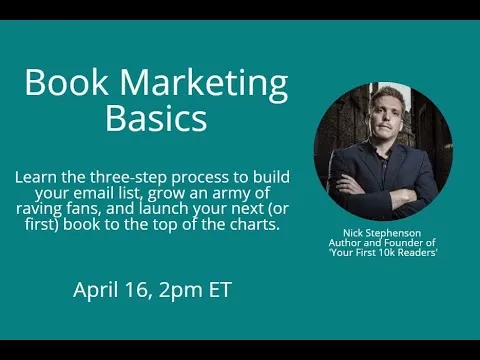
Book Marketing Basics with Nick Stephenson, Founder of 'Your First 10k Readers'
Based on ProWritingAid's video on YouTube. If you like this content, support the original creators by watching, liking and subscribing to their content.
Treat book marketing as a funnel: traffic → conversion (sales or email signup) → automation and scaling.
Briefing
Book marketing becomes manageable when it’s treated like a system with three measurable stages: drive traffic, convert that traffic into sales or email signups, then automate and scale what works. Nick Stephenson, founder of “Your First 10k Readers,” frames most author marketing as a funnel problem—authors get overwhelmed by trying “everything,” but results come from tightening the links between clicks, purchases, and long-term reader relationships.
The funnel starts with where sales originate. Stephenson breaks book sales into two primary traffic sources: people clicking through to a retailer page (Amazon, iBooks, Kobo, etc.) and people coming from an author’s email list. Click-through traffic is harder to reuse because non-buyers often disappear, while email subscribers can be contacted repeatedly for future launches, promotions, and review requests. He emphasizes that email is especially powerful for launches because it delivers “free” clicks compared with paid ads, and it can also help generate reviews.
To decide what to invest in, he introduces three core metrics: conversion rate (clicks that become purchases), read-through rate (buyers who go on to buy subsequent books in a series/catalog), and earnings per click (average profit per click). The key idea is that profitability depends on the full chain, not just the first book. In a series, earnings per click can be much higher than expected because later titles monetize the same initial buyer. He suggests estimating read-through using Amazon dashboard data over roughly 90 days by dividing total earnings by copies sold of the “main” title.
With the numbers in mind, Stephenson lays out “traffic” strategies, warning authors not to do everything at once. For organic discovery, he recommends Amazon-focused SEO: choose specific categories and seven keyword phrases, using Amazon’s autocomplete and search result counts to avoid competing in overly broad keyword buckets. For low-budget traffic, he pushes “perma free,” keeping the first book in a series permanently free on major stores (with Amazon price-matching via KDP support) so downloads feed read-through into paid books. He also recommends reader magnets—free incentives tied to email signup—placed in the book and across author touchpoints.
For reach expansion, he highlights joint promotions (reciprocal promotion communities and anthology/cross-promotion tactics) and contests/giveaways that collect opt-in email subscribers. He also covers merchandising opportunities through retailer programs (notably Kobo Writing Life promotions and distributor routes like Draft2Digital) and paid acquisition via Amazon ads, Facebook ads, BookBub ads, and email blast services. Paid campaigns should be treated as momentum builders, and he advises “promo stacking” (running multiple smaller discounts over time) to sustain sales rather than creating a single spike.
Conversion is the next bottleneck. Stephenson argues that most optimization should focus on the Amazon book page—especially the cover and the description—because small percentage improvements can dramatically change ad profitability. He cites testing results from large ad impression volumes where cover composition and genre-appropriate design elements (including typography choices) improved click-through and conversion rates, and where description quality shifted from plot-summary to stakes-driven sales copy. He also stresses operational conversion basics: reviews, formatting quality in the “look inside,” and strong internal linking to the next book.
Finally, he ties conversion to email automation. Reader magnets feed landing pages and thank-you/download flows, supported by tools like BookFunnel and email platforms such as Mailchimp or MailerLite. Automated sequences introduce the backlist and prepare readers for launches, while broadcast emails and pre-launch teasers (cover reveals, samples, launch bonuses) convert the “on the fence” majority. The practical takeaway is a decision filter: any marketing action should clearly answer whether it creates traffic, improves conversion, and/or automates/scales. If it doesn’t, it’s likely wasted effort.
Cornell Notes
Book marketing works best when authors treat it as a funnel with three pillars: traffic, conversions, and scaling/automation. Traffic comes mainly from two places—retailer page clicks and an email list—so building email subscribers is a long-term asset that paid ads can’t replicate. Profitability depends on more than first-book sales: read-through rate (buyers who continue to later books) and earnings per click determine whether ads are worth it. Conversion improvements should prioritize the Amazon book page, especially cover design and the description, because small percentage gains can flip ad campaigns from loss to profit. Once the funnel is set, automation via reader magnets, landing pages, and email sequences lets authors repeatedly monetize the same readers during launches.
What are the three metrics Stephenson uses to judge whether marketing spend will pay off?
Why does an email list matter more than one-time retailer clicks?
How does “perma free” support read-through in a series?
What two elements of the Amazon book page get the most optimization attention?
How do reader magnets and automation fit into the conversion stage?
What does “promo stacking” mean, and why does it matter?
Review Questions
- If an author knows their conversion rate and earnings per click, what additional metric becomes crucial for series profitability?
- Which two components of an Amazon product page should be tested first when click-through is low, and why?
- What decision rule should an author apply before spending time on a new marketing tactic?
Key Points
- 1
Treat book marketing as a funnel: traffic → conversion (sales or email signup) → automation and scaling.
- 2
Build an email list because it enables repeated contact for launches and promotions, unlike one-time retailer clicks.
- 3
Track conversion rate, read-through rate, and earnings per click to judge whether ad spend is profitable.
- 4
Optimize the Amazon book page—especially cover design and the description—because small percentage gains can dramatically change ad ROI.
- 5
Use “perma free” for series read-through by keeping book one permanently free and linking readers to subsequent titles.
- 6
Drive conversions with reader magnets, landing pages, and automated email sequences (e.g., BookFunnel plus Mailchimp or MailerLite).
- 7
Use promo stacking and pre-launch email campaigns with launch bonuses to sustain momentum and convert “on the fence” readers.