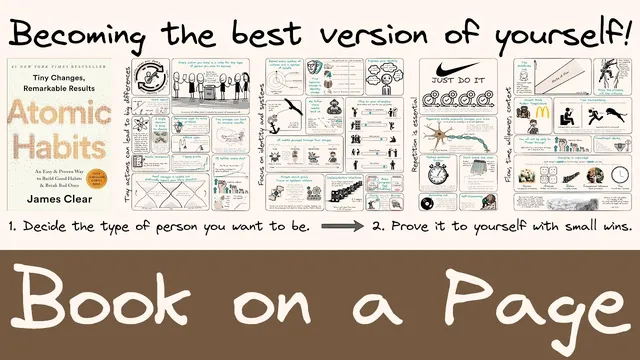
Book on a Page Summary of Atomic Habits by James Clear
Based on Zsolt's Visual Personal Knowledge Management's video on YouTube. If you like this content, support the original creators by watching, liking and subscribing to their content.
Treat each repeated action as reinforcement for identity; long-term life outcomes follow the habits that accumulate.
Briefing
Atomic Habits centers on a simple but consequential idea: every action functions like a vote for the kind of person someone is becoming. Over time, those votes accumulate into habits, and habits shape identity—until daily behavior starts to determine the quality of life. The book’s practical warning is blunt: good habits tend to produce good outcomes, bad habits tend to compound into problems, and some habits can spiral into disaster. Habits matter not because they’re dramatic, but because they’re persistent—often running in the background while people focus on goals.
Rather than treating change as a matter of willpower, the framework reframes habits as problem-solving behaviors that reduce stress. An “atomic habit” is a tiny behavior embedded in a larger system, much like atoms form molecules. The key insight is that small actions can create big differences by shifting direction rather than trying to force a sudden turn. Yet the path to improvement isn’t smooth. Habits often appear to do nothing until a critical threshold is crossed, after which performance jumps. The transcript also flags skepticism about the popular “1% improvement” framing: even if the math feels modest, willpower limits and the difficulty of breaking old routines make sustained exponential progress hard to guarantee. Still, the underlying message remains: the right atomic habits move people toward their targets.
The book’s second pillar is identity-based change paired with systems thinking. Sustainable progress comes from becoming the type of person who naturally performs the desired behavior, not from obsessing over a distant outcome. “Behavior change is identity change,” and people “fall to the level of their systems” rather than rising to the level of their goals. That identity must be supported by a system built around the habit loop: cue, craving, response, and reward. A strong system makes the habit obvious (clear triggers), attractive (motivating), easy (low friction), and satisfying (reinforcing repetition).
Several practical tools illustrate how to design that loop. Implementation intentions increase clarity by attaching a behavior to a specific event—“when I get home from work, I will call Mom.” Studies on voting behavior highlight that people who plan the “how” are more likely to follow through than those who only state an intention. A sales example uses a daily “paper clip” ritual to turn progress into an immediate, countable reward, reinforcing consistency.
The transcript then emphasizes repetition over perfection: repeating a habit strengthens the brain through myelination, making future attempts feel easier. Habit trackers help maintain presence and momentum, but two risks are highlighted—getting stuck in a “narrative rut” (repeating the same story about oneself) and experiencing self-dissonance (forcing behaviors that don’t fit identity). Flow is used as a balancing concept: match challenge to skill so time disappears, enjoy the process, and seek problems worth solving.
Finally, the framework treats willpower as unreliable and context as decisive. Since modern life often delivers delayed consequences, self-control alone fails; instead, make bad habits impractical and use commitment devices to shape future behavior. The result is a flexible approach: reflect, review progress, and keep adjusting systems. The “holy grail” isn’t one dramatic change but a long chain of small improvements—enough to compound into a different life.
Cornell Notes
Atomic Habits argues that small behaviors accumulate into identity and long-term outcomes: every action reinforces the kind of person someone becomes. Sustainable change comes from identity-based systems, not from chasing goals with willpower. Habits run through a loop—cue, craving, response, reward—so effective systems make the next action obvious, attractive, easy, and satisfying. Repetition strengthens the brain (myelination), so showing up matters more than perfection, while habit trackers and planned triggers (implementation intentions) improve follow-through. Because context drives behavior and willpower depletes, commitment devices and environment design reduce reliance on self-control.
How does “every action is a vote” translate into a practical model for habit change?
Why does identity-based change outperform goal-chasing in the long run?
What does a “good system” look like when mapped onto the habit loop?
How do implementation intentions and clarity increase follow-through?
Why does repetition beat perfection, and what biological mechanism is cited?
How do context and commitment devices reduce dependence on willpower?
Review Questions
- What are the four stages of the habit loop, and which design changes strengthen each stage?
- How does identity-based change differ from goal-based motivation, and why does the transcript claim systems ultimately determine outcomes?
- What are the two major pitfalls of repetition mentioned, and how would you detect them in your own habit practice?
Key Points
- 1
Treat each repeated action as reinforcement for identity; long-term life outcomes follow the habits that accumulate.
- 2
Design habits as systems using the cue–craving–response–reward loop: make the next step obvious, attractive, easy, and satisfying.
- 3
Shift from outcome obsession to identity-based behavior (“become the type of person who does this”), supported by consistent systems.
- 4
Use implementation intentions to reduce ambiguity by linking actions to specific events, improving follow-through.
- 5
Prioritize repetition over perfection; repeating a habit strengthens neural pathways (myelination) and lowers the friction of starting.
- 6
Track habits to maintain momentum and awareness, but watch for narrative rut and self-dissonance when routines stop fitting identity.
- 7
Reduce reliance on willpower by changing context and using commitment devices so bad habits become harder to execute.