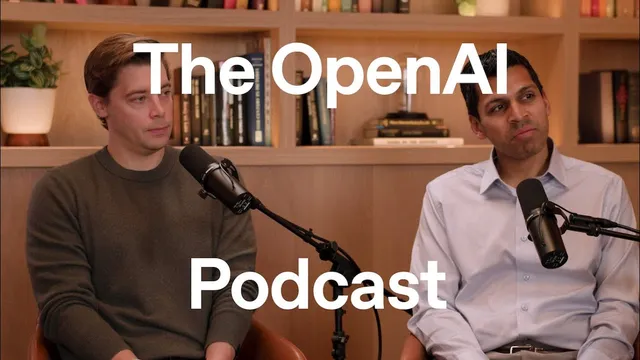
Brad Lightcap and Ronnie Chatterji on jobs, growth, and the AI economy — the OpenAI Podcast Ep. 3
Based on OpenAI's video on YouTube. If you like this content, support the original creators by watching, liking and subscribing to their content.
ChatGPT’s conversational interface is treated as a major adoption unlock because it reduces user uncertainty and turns AI into an interactive workflow.
Briefing
AI’s biggest near-term labor story isn’t mass job elimination—it’s a shift in who can do valuable work, faster and at lower cost, and how that reshapes economies, education, and professional services. Brad Lightcap and Ronnie Chatterjee frame the change around “deployment at scale”: turning research into tools people actually use, then measuring how those tools alter productivity, decision-making, and the pace of growth across industries.
Lightcap, OpenAI’s Chief Operating Officer, ties the inflection point to ChatGPT’s November 2022 launch, when AI moved from developer experimentation to everyday use at scale. The key unlock wasn’t only model capability; it was the conversational interface that made people instantly know what to do—turning a “blank canvas” into an interactive workflow. From there, OpenAI’s focus becomes product-led deployment: understanding how usage patterns differ by country and industry, working with customers and partners, and building safeguards and compliance so the technology can be safely integrated.
Chatterjee, OpenAI’s Chief Economist, describes his role as developing indicators that forecast where the economy is headed as AI is deployed broadly. His emphasis is external and global—engaging policymakers and institutions across London, Brussels, Delhi, Washington, and beyond—to translate economic research into guidance people can act on. The anxiety around AI and work is acknowledged, but the response is framed as adaptation plus opportunity: AI changes what tasks are feasible, not the need for judgment and leadership.
A central example is software engineering. Lightcap points to tools like Cursor and Windsurf and argues that AI can raise productivity dramatically—potentially by an order of magnitude—by changing the toolset available to engineers. Chatterjee then translates that into economic terms: if engineers can write and refine far more code, the question becomes what organizations can build with that expanded capacity. The same logic extends beyond coding to scientific research and professional services.
On sectors likely to be transformed first, Chatterjee expects faster change where regulation and “red tape” are lower, while healthcare and education—despite major upside—will move more slowly due to compliance requirements like HIPAA and delivery rules. He also argues that adoption accelerates when workers already using AI bring it into the workplace, a pattern seen in enterprise software rollouts.
Both guests highlight scientific discovery as a major frontier. Chatterjee describes science as a corridor of “doors” that researchers can’t explore all at once; AI can help peek behind many doors to choose better targets. Lightcap adds that the real leverage comes from breadth across complex workflows—models that can reason across multiple handoffs in processes like drug development—while still requiring expert judgment.
The conversation repeatedly returns to “agency”: the ability to decide what to do, delegate effectively, and steer AI toward outcomes. That, they say, is why EQ, critical thinking, resilience, and decision-making matter more—not less—when intelligence becomes cheaper. Education is singled out as a fast-growing use case, with OpenAI working with institutions such as Cal State University to lower barriers for curriculum creation and support students and teachers, including those with learning impediments.
Ultimately, the economists’ and operators’ shared thesis is that lowering the cost of intelligence expands demand and unlocks new markets—so the economy doesn’t just lose tasks; it gains new ones, new customers, and new forms of work that require human judgment and connection.
Cornell Notes
The discussion centers on how AI deployment at scale changes work: not by simply removing jobs, but by expanding who can do high-value tasks and how quickly they can be done. Brad Lightcap links the shift to ChatGPT’s conversational interface, which made AI usable at mass adoption and turned “blank canvas” demos into actionable workflows. Ronnie Chatterjee, focusing on economic indicators, argues that the biggest impacts will vary by industry and geography—moving fastest where regulation is lighter and where workers already adopt AI at work. Across software engineering, science, and professional services, the bottleneck shifts toward human judgment, decision-making, and “agency,” while education and healthcare face slower adoption due to compliance constraints like HIPAA. The practical takeaway: prepare for a labor market where skills that steer and evaluate AI become more valuable as intelligence gets cheaper.
What does “deployment at scale” mean in this conversation, and why does it matter for jobs?
Why is the conversational interface treated as an “unlock,” not just a UI change?
How does Chatterjee predict economic impact, and what variables does he emphasize?
What’s the argument for AI accelerating science rather than replacing scientists?
What does “agency” mean here, and which human skills become more valuable?
Why do the guests expect education to adopt AI faster than some other sectors?
Review Questions
- Which specific factors does the discussion identify as slowing AI adoption in healthcare and education, and how does that affect job change timelines?
- How do Lightcap and Chatterjee connect AI productivity gains in software engineering to broader economic outcomes?
- What skills do the guests say become more valuable as AI makes intelligence cheaper, and how do they justify that claim?
Key Points
- 1
ChatGPT’s conversational interface is treated as a major adoption unlock because it reduces user uncertainty and turns AI into an interactive workflow.
- 2
OpenAI’s COO role centers on deployment: integrating AI into real customer and partner environments with safety and compliance, not only building models.
- 3
The chief economist role focuses on forecasting using indicators across industries and geographies, then translating findings into guidance for businesses and policymakers.
- 4
AI’s biggest economic bottleneck shifts toward human judgment and “agency,” especially in domains like science where expert decision-making and experimental validation remain essential.
- 5
Regulation and compliance requirements (including HIPAA) are expected to slow AI-driven change in healthcare and education compared with less regulated sectors.
- 6
Education is described as a fast-moving adoption area because AI lowers the cost of curriculum and content creation for teachers and professors.
- 7
Lowering the price of intelligence is expected to expand demand and create new markets, which can increase opportunities rather than only displacing existing tasks.