Build a Business That Runs Itself - 5 Stages of AI Integration
Based on Tiago Forte's video on YouTube. If you like this content, support the original creators by watching, liking and subscribing to their content.
Stage one (“hero”) fails predictably when the founder remains the decision-making bottleneck, creating exhaustion and growth breakpoints around the third or fourth teammate.
Briefing
The core idea is that “a business that runs itself” isn’t a fantasy—it follows a predictable five-stage path, and AI can accelerate the transitions. The biggest practical takeaway is that progress depends less on willpower and more on removing bottlenecks: first by taking decisions out of the founder’s hands, then by turning human know-how into documented processes, and finally by embedding AI into those processes so routine work becomes automated while humans handle only exceptions.
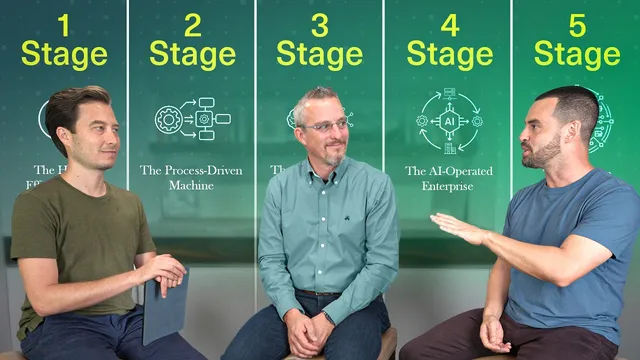
Stage one is the “hero” model, where the founder is the decision-making bottleneck. In this setup, most major choices run through the owner, and the workload tends to be punishing—often 70–80+ hours per week, including nights and weekends. Growth hits breakpoints as the organization adds people, because communication complexity and decision volume rise sharply; the discussion points to around the third or fourth teammate as a common moment when the founder can’t keep up. Even when growth happens, it’s fragile because it relies heavily on the founder’s talent and working memory. A key psychological trap is identity: the owner’s ego and self-concept become tied to being the indispensable “Hotel California” figure who can check in but never truly leave.
AI enters stage one with a specific purpose: reduce the founder’s cognitive load by clarifying roles and responsibilities. The recommended first move is to use AI (via a “master prompt” approach) to generate job descriptions and to map the “hats” the owner and team wear. The point isn’t perfection; it’s getting to an 80% draft quickly so humans can refine. AI also helps simplify overly complex job descriptions and can act like a management consultant—suggesting leadership-team functions and drafting role schematics. A major time-saver comes from eliminating the slow feedback loops that normally require HR leaders and managers to iterate for weeks.
Stage two shifts from heroics to delegated decisions. Once roles are defined, decision authority is delegated with clear boundaries—such as budgets with escalation rules (e.g., spend up to a set amount without approval). Delegation forces a reckoning: if the wrong people are in the wrong roles, micromanagement returns. The discussion highlights a competency filter using the traction-style acronym GWC (wants it, has it, is capable of it / has capacity), emphasizing that trust and capability must match the delegated scope. The benefits are both personal and organizational: owners gain autonomy, work becomes more leveraged, and the company’s ceiling rises from roughly “around 10 people” to something closer to 150, because managers can supervise supervisors and front-line teams.
Stage three becomes process-driven. Leadership teams document processes and then add technology to track, enforce, and audit them—so performance is measurable and problems are caught before customers complain. The contrast is stark: stage two may know that a customer journey step failed only after the fact, while stage three can flag missed steps in real time, assign accountability, and reduce reliance on exceptional memory. A real example from an acquired CPA practice illustrates the payoff: by redesigning and sequencing steps for collections, a process that once took weeks was compressed to days, improving cash flow dramatically.
Stage four is the AI-augmented powerhouse, where AI is embedded into daily operations. Standards are updated to reflect what AI can do faster (documentation, research, personalization, prediction), and humans focus on exception handling—unexpected deviations that the system can’t anticipate. The discussion gives concrete mechanics: meeting transcription tools feeding CRMs, AI extracting action items, and integrations (e.g., via Slack) generating personalized follow-ups and updating reporting automatically. Humans remain in the loop for review and corrections, but routine reporting and follow-up work becomes largely automated.
Stage five is the “AI-first” business that runs itself within defined parameters. The practical limitation is that only certain business models and functions can be fully automated; the most likely early targets are marketing-to-lead and other high-volume, low-exception workflows. The future is framed as hyperpersonalization (“audience of one”): AI can generate tailored content, education paths, and customer experiences at scale, while humans handle the parts people still value—real relationships and expert judgment. Finally, the discussion ties automation to competitive strategy: as software becomes easier to replicate, moats shift toward brand, network effects, and especially data.
Action steps end with a call to identify the current stage and the target stage, using a free diagnostic tool that generates a customized roadmap.
Cornell Notes
The five-stage model explains how businesses evolve from founder dependence to systems that largely run themselves. Stage one (“hero”) traps owners in decision bottlenecks and exhaustion; stage two (“delegated decisions”) replaces bottlenecks with role clarity and delegated authority; stage three (“process-driven machine”) adds documented processes plus technology to track, audit, and enforce them. Stage four (“AI-augmented powerhouse”) embeds AI into daily workflows, raising standards and shifting humans to exception handling. Stage five (“AI-first”) automates more end-to-end functions for simple business models, enabling hyperpersonalized experiences at scale—while moats increasingly rely on brand, network effects, and data.
Why does stage one stall so many businesses, even when founders have strong vision?
What is the practical first AI use in stage one?
How does stage two delegation work without collapsing into micromanagement?
What changes from stage two to stage three besides “having processes”?
What does “exception handling” mean in the AI-augmented stage?
Why does stage five matter, and what’s the realistic limitation?
Review Questions
- Which specific bottleneck defines stage one, and what communication/complexity breakpoints were cited as common growth limits?
- How do stage three systems change the timing of problem detection compared with stage two?
- In stage four, what criteria determine whether a task should be automated by AI versus handled by humans as an exception?
Key Points
- 1
Stage one (“hero”) fails predictably when the founder remains the decision-making bottleneck, creating exhaustion and growth breakpoints around the third or fourth teammate.
- 2
AI can accelerate stage one by generating role clarity—especially job descriptions and leadership-team function maps—so owners can step away from constant decision-making.
- 3
Stage two (“delegated decisions”) works only when roles, decision boundaries, and delegated authority are paired with the right people using a wants/capable/capacity competency filter (GWC).
- 4
Stage three (“process-driven machine”) requires technology to track, enforce, and audit processes; documentation alone isn’t enough to prevent reactive firefighting.
- 5
Stage four (“AI-augmented powerhouse”) depends on updating standards to reflect AI’s strengths (documentation, research, personalization, prediction) and shifting humans to exception handling.
- 6
Stage five (“AI-first”) is most feasible for simple, automation-friendly business models, enabling hyperpersonalized experiences while humans handle relationship and expert-judgment needs.
- 7
As automation makes software easier to replicate, moats increasingly hinge on brand, network effects, and data rather than code alone.