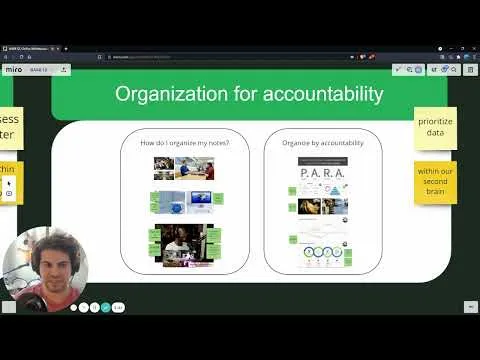
Building a Second Brain - course ideas visualized in Miro (feat. Michael Dean)
Based on Tiago Forte's video on YouTube. If you like this content, support the original creators by watching, liking and subscribing to their content.
A second brain should convert information into decisions and outputs through capture, organizing, distilling, and expression—not just storage.
Briefing
A second brain isn’t just a place to store notes—it’s a structured system for turning incoming information into usable output, while preventing information overload from hijacking attention. The recap centers on a practical framework built around a “power method” for managing knowledge: capture what matters, organize it for accountability, distill it into clearer notes, and express it by recombining notes into something shareable. The payoff is cognitive freedom: fewer mental tabs, more room for problem-solving and creativity, and a workflow that keeps projects moving toward a personal vision.
The course context is framed around three recurring pressures. First, information overload is inevitable, so the real skill is navigation—knowing what to capture, what to defer, and what to transform. Second, perspective acts like a “laser,” deciding what gets attention and how it gets distilled into decisions and creation. Third, the system is meant to move life in a specific direction, not just accumulate content. A final reflection highlights a bottleneck: too many apps and sources compete for attention, so the second brain must function as an organizing layer that reduces friction between where information lands and where it becomes useful.
To address overload at multiple scales, the recap connects principles to workflows. At the highest level, the reactivity loop describes how constant incoming stimuli can trap people in reacting instead of deciding. Capturing allows later assessment—whether something belongs “tomorrow” or “sometime later.” Organizing for accountability then becomes prioritization through PARA: Projects (immediate outcomes), Areas (ongoing responsibilities), Resources (interests without urgency), and Archive (inactive storage). A key metaphor makes this concrete: projects are on the stove, areas are in the fridge, resources are in the closet, and archive is the freezer—illustrated by a claim that only about 5% of one person’s notes were active, reinforcing the need to separate what’s currently actionable from what’s merely stored.
Compression and return on attention tackle the next bottleneck: notes are often too long and too hard to revisit. The strategy is to optimize notes so each return is faster and more relevant—progressively summarizing so the second time you touch a note, you understand it quickly. Return on attention also acknowledges a common reality: work gets interrupted, so the system should convert partial progress into reusable modules. That’s where modularity and “packets” come in—small, high-value chunks that can be recombined to generate momentum across future projects.
The techniques are visualized as a navigation metaphor. Capture is a centralized “fuel” zone for inspiration, while PARA acts like the city layout for accountability and discovery. Progressive summarization functions as signage: each note should be glanceable enough to decide whether it’s worth entering for deeper detail. Intermediate packets are cargo—picked up from past work and loaded into new projects. The recap also emphasizes instant relevance: bolding, highlighting, and summaries at the top so notes communicate their value immediately, without waiting for perfect storefronts. Finally, system synergy ties it together: packets aren’t just for finishing one project; they’re designed to be shared, refined, and reused.
Exercises translate the mindset into action through thought experiments: curiosity (a living list of questions), project list scoping (distinguishing areas from projects), divergence vs. convergence (knowing when to play broadly versus edit for clarity), and just-in-time retrieval (using repeatable kickoff and completion procedures). Kickoff involves searching for associations and pulling from projects, areas, and resources; completion involves integrating outcomes back into the second brain—turning completed work into reusable SOPs, testimonials, call notes, and optimized task steps. The result is a second brain that doesn’t just store knowledge—it actively fuels new expression mode projects with accumulated, compressed assets.
Cornell Notes
The recap argues that a second brain should function as a decision-and-creation system, not a passive archive. It uses a workflow—capture, organize, distill, and express—to turn incoming information into reusable outputs while reducing information overload. PARA (Projects, Areas, Resources, Archive) structures prioritization so only a small portion of notes stays “active,” with the rest stored appropriately. Compression and progressive summarization make notes easier to revisit, and modular “packets” preserve partial progress so work can restart quickly. Thought experiments like curiosity, scoping, divergence/convergence, and just-in-time retrieval ensure the system supports both project kickoff and completion, feeding future work with integrated assets.
Why does the reactivity loop matter, and how does capture break it?
How does PARA turn prioritization into a practical system?
What is “compression,” and why does it improve return on attention?
What do “storefronts” and “instant relevance” mean in note design?
How do divergence and convergence change how packets are created?
What does just-in-time retrieval require at kickoff and completion?
Review Questions
- How does PARA’s stove/fridge/closet/freezer metaphor help prevent notes from competing for attention?
- What practices make a note “glanceable,” and how does that support instant relevance during active projects?
- In what ways do divergence/convergence and just-in-time retrieval work together to improve both project kickoff and long-term reuse?
Key Points
- 1
A second brain should convert information into decisions and outputs through capture, organizing, distilling, and expression—not just storage.
- 2
The reactivity loop is broken by capturing inputs for later assessment, reducing impulsive reacting to incoming stimuli.
- 3
PARA provides a prioritization map: Projects for immediate outcomes, Areas for ongoing responsibilities, Resources for interests, and Archive for inactive material.
- 4
Compression and progressive summarization make notes faster to revisit by refining them each time they’re touched.
- 5
Modular “packets” preserve partial progress so interrupted work can be reused and recombined for future projects.
- 6
Instant relevance turns notes into “storefronts” using top summaries, bolding, and highlighting so users can decide quickly whether to go deeper.
- 7
Kickoff and completion should both actively use the second brain: gather associations at the start and integrate reusable assets back into it at the end.