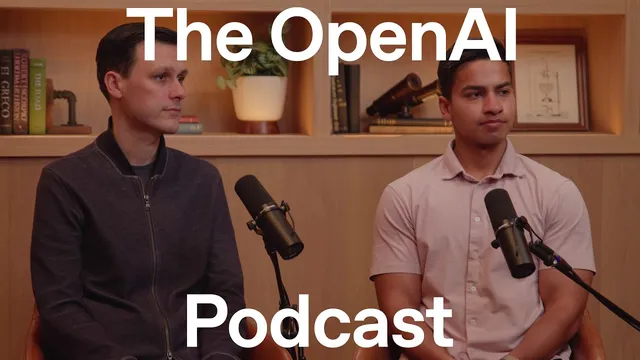
Building AI for better healthcare — the OpenAI Podcast Ep. 14
Based on OpenAI's video on YouTube. If you like this content, support the original creators by watching, liking and subscribing to their content.
OpenAI’s health strategy treats safety, privacy, and evaluation as foundational to model development, not as post-launch fixes.
Briefing
OpenAI’s health push centers on a practical goal: make AI useful in everyday care while treating safety, privacy, and clinical evaluation as core engineering tasks—not add-ons. The discussion ties that mission to a clear problem in healthcare—fragmented systems, missed opportunities for patient engagement, and limited clinician time—then lays out how large language models can be deployed to reduce gaps, support decision-making, and help patients follow care plans more easily.
A major theme is that adoption is already happening at consumer scale. Nate Gross cites roughly 900 million ChatGPT users weekly, with about one in four making health-related queries—around 40 million people per day. That demand drives a strategy that is both proactive and reactive: meet people where they are, but do it with guardrails designed for medical stakes. The “ChatGPT Health” approach is described as secure and empowered, including encrypted conversations and protections intended to prevent training on users’ healthcare data. Unlike general search, the system is positioned as context-aware, using features that let people bring their own information so answers are grounded in what matters to them.
On the model-development side, Karan Singhal frames healthcare as a high-stakes domain where evaluation must be rigorous and multidimensional. The work begins with safety and grounding, using evaluation to identify gaps between what models can do and what people actually use them for in real conversations. HealthBench is highlighted as a key tool: built with a cohort of about 250 physicians, it evaluates multi-turn interactions across many dimensions of performance. Singhal describes HealthBench as measuring roughly 49,000 performance dimensions, including whether responses match the user’s level (layperson vs. clinician), whether the model seeks context before answering, and how it handles incomplete inputs—illustrated by the idea that asking for more context is often the safest move when a user types only a fragment.
Both guests argue that OpenAI’s advantage comes from integrating health into the full training and deployment lifecycle. That includes pre-deployment evaluation, HealthBench, monitoring in production traffic, privacy-preserving safety checks, and continuous collaboration with physicians. Gross adds that training involved thousands of physician-created conversations and large rubric sets used to score and improve responses, with emphasis on healthcare realities that don’t resemble multiple-choice exams. He stresses three practical requirements: grounding in the latest medical literature and guidelines (including regional or institutional differences), handling uncertainty to reduce overconfident hallucinations, and escalating appropriately when more information or testing is needed.
Looking ahead, the blockers are less about raw model capability and more about integration and trust. Singhal points to challenges like combining data across modalities—wearables, lab tests, and long-term history—and improving how people use ChatGPT for health. Gross emphasizes professional trust: clinicians need answers tied to current guidelines and their local context, plus connectivity across siloed healthcare systems. The plan includes partnerships and standards-based electronic health record syncing so patients can bring context quickly and consentedly. A concrete example of deployment is an AI clinical co-pilot study with PandaHealth in Nairobi clinics, where monitoring clinician interactions in electronic health records and interrupting only when something concerning appears led to statistically significant reductions in diagnostic and treatment errors.
The conversation ends with a feedback loop argument: rapid consumer adoption and real-world clinician use generate the data needed to improve models, unlock longer-context reasoning, and even surface new therapeutic value—such as AI finding direct uses for medications previously “sitting on a shelf.” The overarching message is that healthcare AI must raise the floor for access, sweep the floor to save clinician time, and raise the ceiling for transformative impact—while keeping safety and privacy tightly engineered into the system.
Cornell Notes
OpenAI’s health strategy aims to deliver AI assistance that clinicians and patients can actually rely on, while making safety, privacy, and evaluation part of the core engineering process. Consumer demand is already large—tens of millions of health queries daily—so “ChatGPT Health” is positioned as secure (encrypted, with protections intended to prevent training on users’ healthcare data) and context-aware. For model development, HealthBench is central: built with about 250 physicians and designed to grade multi-turn conversations across roughly 49,000 performance dimensions, including tailoring to user expertise and asking for context when inputs are incomplete. The next frontier is not only better models, but better deployment—connecting siloed systems, grounding answers in current guidelines, and monitoring real workflows to reduce diagnostic and treatment errors.
Why is healthcare described as a uniquely difficult target for AI compared with general Q&A?
What is HealthBench, and what makes it different from simpler evaluation approaches?
How do the safeguards for ChatGPT Health relate to training and privacy?
What does “grounded in the latest medical literature” mean in practice for clinician trust?
What deployment challenge is highlighted beyond model accuracy?
What evidence is offered that AI can reduce clinical errors after deployment?
Review Questions
- How does HealthBench’s design (multi-turn, physician-built rubrics, and context-seeking behavior) aim to reduce real-world safety gaps in healthcare AI?
- What mechanisms are described for handling uncertainty and preventing overconfident hallucinations in medical settings?
- Why is workflow monitoring and interruption—rather than only offline evaluation—presented as important for reducing diagnostic and treatment errors?
Key Points
- 1
OpenAI’s health strategy treats safety, privacy, and evaluation as foundational to model development, not as post-launch fixes.
- 2
ChatGPT Health is positioned as encrypted and designed to avoid training on users’ healthcare data, while enabling context-aware answers grounded in user-provided information.
- 3
HealthBench uses a physician cohort and a large rubric framework (about 250 physicians; ~49,000 performance dimensions) to grade multi-turn health conversations for both safety and usefulness.
- 4
Clinician trust depends on grounding answers in current medical literature and guidelines, including regional or institutional differences, plus the ability to handle uncertainty and escalate appropriately.
- 5
A major blocker is healthcare integration: siloed systems and point-solution deployments make it hard for information to flow, so standards-based EHR syncing and connectors are central.
- 6
Real-world workflow monitoring can improve outcomes; a PandaHealth study in Nairobi reported statistically significant reductions in diagnostic and treatment errors when clinicians used an AI co-pilot that only interrupted when concerns arose.
- 7
The long-term vision emphasizes a feedback loop from adoption and deployment to model improvements, including longer-context reasoning and new therapeutic value discovery.