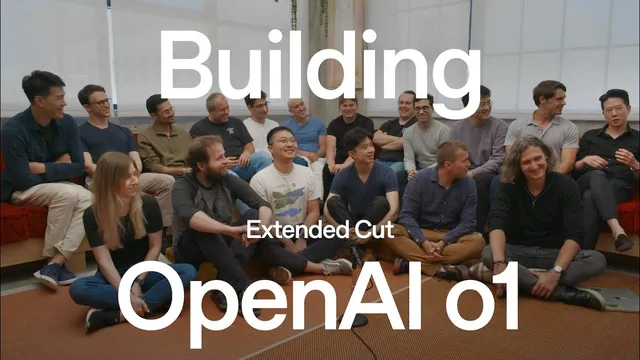
Building OpenAI o1 (Extended Cut)
Based on OpenAI's video on YouTube. If you like this content, support the original creators by watching, liking and subscribing to their content.
OpenAI’s o1 and o1 mini are reasoning-first models designed to spend more time thinking before answering, aiming to improve results on complex tasks.
Briefing
OpenAI’s latest preview models, o1 and o1 mini, put “reasoning” at the center: they spend more time thinking before answering, aiming to turn extra deliberation into better outcomes on hard tasks like math, coding, and complex planning. The release comes with two sizes—o1 preview for a fuller reasoning experience and o1 mini for lower cost and faster latency—both trained under a similar framework designed to make the model reflect, correct, and improve its own intermediate work.
Reasoning is framed as more than slower responses. For simple questions, immediate recall is enough; for complex problems—writing a business plan, solving puzzles, or tackling difficult engineering—quality improves when the system can allocate time to think. That time is treated as a controllable ingredient in performance. Internally, the team describes the core shift as combining two training paradigms: reinforcement learning-style approaches inspired by deep reinforcement learning successes (including AlphaGo) and scaling gains seen in supervised learning under the GPT paradigm. The goal is a general-domain system that can use thinking time to produce more reliable answers.
A key turning point described by researchers was moving beyond human-written “chains of thought” as training data. Instead, reinforcement learning is used to generate and refine its own reasoning traces, with the result outperforming approaches that rely on humans providing the thought process. Early experiments also highlighted a practical gap: when models were pushed on math, they often produced answers without questioning their own mistakes. The early o1 models showed a different behavior—self-questioning, reflection, and higher scores on math tests—suggesting the training approach was changing how the model monitors and corrects itself.
Scaling the system brought major hurdles. Training large models is portrayed as a narrow success path with many failure modes, requiring careful infrastructure and evaluation. As performance improved, standard industry evaluation suites became less informative, forcing the team to find new ways to detect when models were “going off the rails.” Verification also became more time-consuming because the models can reach human-competitive levels—described as having the equivalent of several PhDs—meaning outputs still need rigorous checking.
Beyond benchmarks, the team shared concrete ways o1 is used day-to-day: test-driven development for coding (writing unit tests first, then having o1 implement), debugging via error-message interpretation, and learning through more careful explanations with fewer hallucinations. Others described using it as a brainstorming partner for technical topics and writing, where the model can revise and critique ideas rather than simply generate a first draft.
o1 mini is positioned as a cost-effective entry point to the o1 reasoning pipeline. It’s designed to be a reasoning specialist—less focused on broad world knowledge—while aiming to match prior “mini” performance levels for general capability. The broader vision is a progression from models that think in minutes toward systems that can deliberate for much longer, potentially enabling new capabilities in engineering and science through planning, error correction, and knowledge generation. The release is also treated as a team milestone: building reliable training infrastructure and iterating on both algorithms and systems, while maintaining a culture where ideas come from many places and opinions evolve with results.
Cornell Notes
OpenAI’s o1 and o1 mini are reasoning-focused models trained to “think more before answering,” using extra deliberation to improve outcomes on difficult tasks. The training approach blends reinforcement learning ideas (inspired by deep RL successes) with scaling gains from supervised learning in the GPT paradigm, and it emphasizes self-generated reasoning traces refined through RL rather than relying on humans to write the thought process. Researchers say early o1 models began to question their own mistakes—an important shift for math and other error-prone domains. The team also highlights the engineering challenge of scaling and verifying models that can reach human-competitive performance, requiring new evaluation methods beyond standard benchmarks. o1 mini extends the same reasoning pipeline to a lower-cost, lower-latency audience, with a tradeoff in broad world knowledge.
What does “reasoning model” mean in practical terms, beyond just producing longer answers?
Why did the team move away from training on human-written chains of thought?
What problem did early reasoning models aim to fix in math performance?
What makes scaling and evaluation so difficult as reasoning models get stronger?
How do people use o1 in day-to-day work, according to the transcript?
What tradeoffs define o1 mini compared with o1 preview?
Review Questions
- How does reinforcement learning training on self-generated reasoning traces differ from training that relies on human-written thought processes?
- Why do evaluation methods need to change as model performance improves, according to the transcript?
- What workflow changes does test-driven development introduce when using o1 for coding and debugging?
Key Points
- 1
OpenAI’s o1 and o1 mini are reasoning-first models designed to spend more time thinking before answering, aiming to improve results on complex tasks.
- 2
The training approach blends reinforcement learning ideas with supervised learning scaling, targeting general-domain reasoning rather than narrow behavior.
- 3
A central breakthrough described is using RL to generate and refine the model’s own chain of thought, outperforming approaches that depend on human-written reasoning traces.
- 4
Scaling introduces many failure modes, and stronger models require more rigorous verification and evaluation beyond saturated benchmark suites.
- 5
o1 is used in practice for coding via test-driven development, for debugging through error-message interpretation, and for learning and brainstorming with more careful explanations.
- 6
o1 mini brings the reasoning pipeline to a lower-cost, lower-latency model, trading some broad world knowledge for reasoning capability.
- 7
The long-term goal is models that can deliberate for much longer than minutes, enabling planning, error correction, and potentially new scientific and engineering capabilities.