Business Parks Suck (but they don't have to)
Based on Not Just Bikes's video on YouTube. If you like this content, support the original creators by watching, liking and subscribing to their content.
Business parks feel oppressive when they’re built around car access and treat transit and walking as secondary afterthoughts.
Briefing
Business parks feel miserable in North America largely because they’re built for cars first and transit and walking only as an afterthought—but a Dutch airport-area business park shows how quickly that changes when public transportation is treated as “first-class.” The core contrast isn’t just a better bus shelter or a nearby train stop. It’s an entire system of design choices that makes arriving by transit fast, reliable, comfortable, and socially respected.
In a Toronto-area business park near the airport, commuting by public transit could take 50 minutes to over an hour, with transfers that were undermined by traffic and schedules that didn’t match real-world conditions. The alternative—driving—wasn’t financially realistic for a student, and complaints at work were met with the blunt advice to “buy a car.” The result was a routine of cold waits, long walks along wide, high-speed roads, and a constant sense of being treated as a second-class commuter. Even in a region with “good” transit by U.S. and Canadian standards, the environment still pushed people toward driving through hostile street design and inconvenient access.
That experience is contrasted with a business park in the Netherlands near an airport, where transit access is straightforward and frequent enough that schedules barely matter. The journey involves easy connections by train, a short walk, and—crucially—bus infrastructure that isn’t trapped in traffic. Buses run on dedicated, raised lanes that avoid traffic lights and delays, arriving every few minutes even outside rush hour. The bus stop itself is spacious and comfortable, with stairs and an elevator, signaling that transit riders are expected and accommodated.
Road and intersection design reinforces that priority. Dutch traffic signals give transit vehicles priority when they arrive, then grant safe crossing phases to pedestrians and cyclists based on detection. Pedestrians can cross without pressing buttons and without navigating multiple lanes of fast-moving traffic. Even the road layout is more walkable: instead of a single six-lane “strode,” crossings are broken into narrower segments with a grassy median, reducing the need to scan for gaps and eliminating the feeling of exposure.
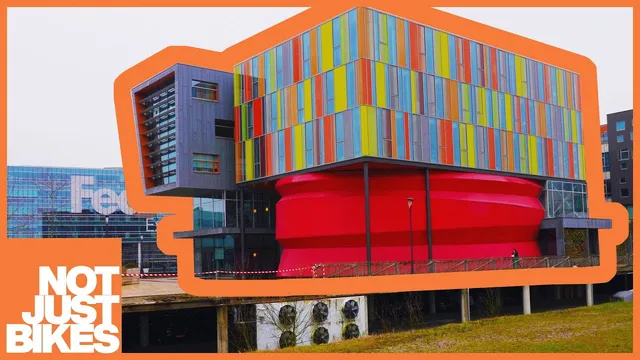
The Dutch park also feels inviting to walk through—offices sit beside sidewalks rather than across seas of parking. Buildings and site amenities support that pedestrian experience, including underground parking that doesn’t spill risk onto sidewalks, bicycle access integrated into the architecture, and water management handled through attractive canals rather than ugly stormwater ponds.
The takeaway is blunt: business parks in North America often function as “non-places” where nobody wants to be, and the commuting experience compounds that emptiness. Over time, some improvements may arrive—more frequent buses, for example—but if routes remain circuitous, walking access worsens, and car-first street design persists, the fundamental problem remains. The Netherlands example suggests the fix isn’t one feature; it’s coordinated respect for transit users, reliable service, safe crossings, and a built environment that makes walking, cycling, and riding transit genuinely convenient.
Cornell Notes
Business parks often feel soul-crushing in North America because they’re designed for cars first and treat transit and walking as optional add-ons. A Dutch airport-area business park demonstrates what changes when public transportation is prioritized: frequent trains, easy transfers, buses on dedicated lanes that avoid traffic lights, and comfortable, spacious stops. Intersection control gives transit vehicles priority, then pedestrians and cyclists, enabling crossings without button-pressing or long waits. Road design reduces exposure by splitting wide roads into narrower segments with medians, and buildings front onto walkable sidewalks rather than parking lots. The result is a commute that’s faster, safer, and socially respected—so people don’t feel like second-class citizens for arriving without a car.
Why does the North American business park commute feel worse than a simple lack of transit amenities?
What specific transit infrastructure makes the Dutch airport-area business park work so well?
How do Dutch traffic signals reduce waiting and conflict for pedestrians and cyclists?
What road design choices make walking across the Dutch business park feel manageable?
Why does the “whole place” design matter as much as transit frequency?
Review Questions
- Which elements create the strongest sense of being a “second-class citizen” in the North American business park commute: time, safety, comfort, or social treatment? Explain using examples from the transcript.
- How do dedicated bus lanes and intersection priority work together to make transit reliable in the Dutch business park?
- What design changes would most improve a car-first business park if only a few upgrades were possible?
Key Points
- 1
Business parks feel oppressive when they’re built around car access and treat transit and walking as secondary afterthoughts.
- 2
In the Toronto-area example, public transit commuting suffered from traffic-driven delays, inconvenient transfers, and long, cold walks along high-speed roads.
- 3
The Dutch airport-area business park works because transit is prioritized end-to-end: frequent trains, easy walking connections, and buses running on dedicated lanes that avoid traffic lights.
- 4
Dutch intersection control uses detection and priority phases to minimize conflicts and reduce waiting for pedestrians, cyclists, and transit riders.
- 5
Road geometry matters: splitting wide roads into narrower crossing segments with medians makes walking safer and less stressful.
- 6
A pleasant pedestrian environment—sidewalk-adjacent offices, underground parking, integrated bicycle access, and attractive site design—turns commuting into something people can enjoy.
- 7
The core lesson is systemic: improving one element (like adding a sidewalk) won’t fix a car-first “non-place” without coordinated transit reliability, safe crossings, and equal respect for riders.