BUSTED: How AI Uncovered Italian Minister's Dirty Secret—Fake Data and Lies!
Based on Andy Stapleton's video on YouTube. If you like this content, support the original creators by watching, liking and subscribing to their content.
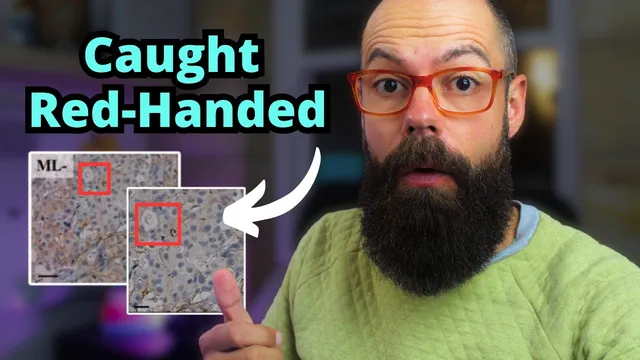
Duplicated cell microscopy images are presented as evidence of improper reuse in publications linked to the Italian Health Minister.
Briefing
An Italian Health Minister with a scientific background is linked to duplicated microscopy images across published papers—an integrity breach that AI image-checking tools can detect far more reliably than unaided visual inspection. The case centers on reused cell microscopy figures presented as different cancer types. One example pairs a “Figure 4B” image from one paper with a “Figure 1” image from another; the images match exactly, including the scale bar size, even though the claims differ—prostate cancer cells in one instance and breast cancer cells in the other. That mismatch is biologically implausible and points to figure reuse rather than independent experimental results.
The investigation also highlights why such problems can slip through peer review and day-to-day reading. Microscopy images can vary in resolution, cropping, and manipulation, making manual comparison difficult—especially when researchers are scanning many papers. In this instance, the human-eye approach could spot one obvious duplication, but other suspected repeats were harder to confirm. That’s where an AI-based figure forensics tool, ImageTwin, enters: it flags integrity issues by comparing uploaded article PDFs against a database containing more than 21 million images and by detecting potential plagiarism or image manipulation patterns. The tool reportedly surfaced a duplication location that would be “almost impossible” to catch by visual checking alone, pinpointing the matching region inside the figure.
Beyond the immediate scandal, the discussion broadens to accountability and systemic pressure. The Health Minister is quoted as saying there was no prior knowledge of the issue and that images were trusted from a provider. The critique is that corresponding authors—especially those listed as contact points for the work—carry responsibility for verifying authenticity across the full dataset and figures. Publishing many papers without adequate quality control is framed as a failure of that role, not a defensible excuse.
The broader pattern of political and academic misconduct is also used to contextualize the stakes. Past German cases involved politicians whose theses were later challenged for plagiarism or fabrication, and the transcript notes a pathway in which obtaining a PhD could help people enter politics. Separately, Pakistan is mentioned in connection with fake degrees tied to eligibility rules for public office.
Finally, the transcript argues that the strain on journal editors—who must detect fraud, paper mills, and plagiarism while often lacking resources—creates conditions where AI assistance becomes necessary. A cited paper in the Journal of Mental Health describes editor anxiety and exhaustion from the constant vigilance required to keep untruth out of the publication record. The takeaway is practical: researchers and institutions may need to budget for AI figure-integrity checks (the transcript cites a cost of 25 Euros per scan) to avoid building follow-on work on potentially fabricated or manipulated findings.
Cornell Notes
The scandal involves duplicated cell microscopy images attributed to an Italian Health Minister, with the same image reused while the papers claim different cancer types. Manual detection can be unreliable because microscopy figures can be cropped, resized, or otherwise altered, so human comparison may miss subtler repeats. An AI tool called ImageTwin is presented as a solution: it scans uploaded PDFs, compares figures against a database of over 21 million images, and flags likely duplication or manipulation. The discussion also stresses responsibility for scientific integrity, especially for corresponding authors who must verify the authenticity of figures and data. Broader editor workload and limited resources are cited as reasons AI-assisted checks may be needed to protect the scientific record.
What specific evidence suggests figure fabrication or improper reuse in the Italian Health Minister’s publications?
Why are duplicated microscopy images hard to catch using only human visual inspection?
How does ImageTwin work, and what makes it effective for detecting integrity issues?
What accountability argument is made about corresponding authors when image problems surface?
Why does the transcript connect editor stress and anxiety to the need for AI fraud detection?
What practical recommendation is offered to researchers who want to avoid relying on potentially fabricated findings?
Review Questions
- How do identical microscopy images with different stated cancer types undermine the credibility of experimental claims?
- What limitations of manual figure comparison does the transcript attribute to microscopy image duplication detection?
- According to the transcript, what responsibilities fall on corresponding authors when figure integrity issues are discovered?
Key Points
- 1
Duplicated cell microscopy images are presented as evidence of improper reuse in publications linked to the Italian Health Minister.
- 2
One described example matches images across different papers while the cancer-type claims differ, making the reuse biologically implausible.
- 3
Manual detection is portrayed as unreliable because microscopy figures can be altered through resolution changes and cropping/zooming.
- 4
ImageTwin is presented as an AI tool that flags likely figure duplication or manipulation by scanning PDFs and comparing against a database of over 21 million images.
- 5
The transcript argues corresponding authors must verify authenticity and cannot rely on “trusted the provider” as a sufficient defense.
- 6
Editor workload and limited resources are cited as drivers of stress and missed fraud, supporting the case for AI-assisted integrity checks.
- 7
Researchers are encouraged to run AI figure checks on suspicious papers to avoid wasting time on potentially fabricated results.