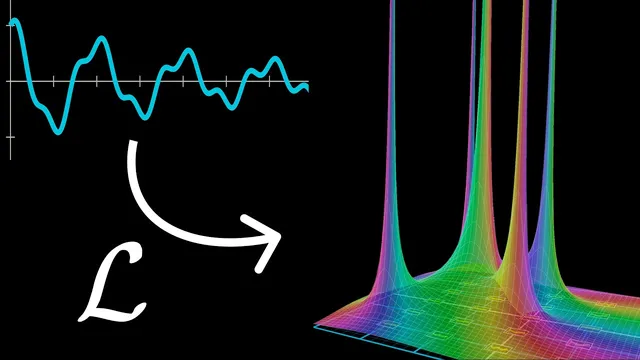
But what is a Laplace Transform?
Based on 3Blue1Brown's video on YouTube. If you like this content, support the original creators by watching, liking and subscribing to their content.
Laplace transforms convert differentiation in time into multiplication by s in the transformed domain, turning differential equations into algebraic problems.
Briefing
Laplace transforms turn differential-equation problems into algebra by converting derivatives into multiplication and by revealing a function’s hidden exponential components. The core insight is that when a function can be written as a sum of exponentials, the Laplace transform exposes those exponentials as “poles” in the complex s-plane—sharp spikes located at specific complex values of s. That pole structure matters because it tells you which exponential modes are present and with what weights, letting complicated time-domain behavior become simpler algebraic expressions in the s-domain.
The discussion starts by restating why exponentials are so central: differentiating an exponential e^(st) reproduces the same form, scaled by s. That property is what makes the Laplace transform powerful for differential equations—every derivative becomes multiplication by s once the transform is applied. The lesson then builds intuition for how exponentials behave when s is complex. If s has an imaginary part, e^(st) oscillates; if the real part is negative, the magnitude decays; if it’s positive, the magnitude grows. Many physics-driven functions can be decomposed into exponential pieces, such as cosine t splitting into two rotating complex exponentials e^(it) and e^(-it), and the driven harmonic oscillator ultimately involving four exponential terms.
To “see” those exponential pieces, the Laplace transform is defined as an integral: multiply f(t) by e^(-st) and integrate from t = 0 to infinity. The new variable s is complex, and the transform’s output can be viewed across the s-plane. A key preview is that if f(t) is a sum of exponentials, the transformed function develops spikes at the corresponding s-values. For example, the integral of e^(-st) alone behaves like 1/s when the integral converges (specifically, when the real part of s is positive). The integral diverges on the left half-plane because e^(-st) grows exponentially there, but the expression 1/s still provides a meaningful extension via analytic continuation.
That analytic continuation is the mathematical mechanism that reconciles “undefined” integrals with well-defined formulas elsewhere. Complex analysis is more rigid than real analysis: if a function is analytic on a region, extending it while preserving differentiability is either impossible or unique. This uniqueness lets the transform’s formula extend beyond the literal convergence region, producing a consistent pole structure.
From there, the lesson generalizes the pole idea. The Laplace transform of e^(at) becomes 1/(s − a), a simple pole at s = a. Linearity then explains how sums of exponentials map to sums of rational terms with poles at each exponential’s exponent. Applying this to cosine t, written as 0.5 e^(it) + 0.5 e^(-it), yields a transformed expression with poles at s = i and s = −i. The narrative also connects Laplace and Fourier transforms: when s is purely imaginary, the Laplace transform closely resembles the Fourier transform, differing mainly in the integration bounds and conventions.
The chapter closes by emphasizing what’s gained: poles in the s-plane reveal exponential content, and even when functions aren’t discrete sums of exponentials, Laplace transforms still express many functions as continuous superpositions of exponentials. The next step is promised as a “test drive” on an actual differential equation, after which the broader theory—reinventing the transform and relating it to Fourier inversion—will be developed.
Cornell Notes
Laplace transforms convert time-domain behavior into an s-domain function whose singularities (poles) reveal the exponential building blocks of the original signal. Exponentials matter because differentiating e^(st) reproduces the same exponential shape scaled by s, turning derivatives into multiplication in the transformed world. The transform is defined by integrating f(t)e^(-st) from 0 to infinity, which converges only when the real part of s is large enough; complex analysis then extends the result uniquely via analytic continuation. For the basic case, the transform of 1 is 1/s, and more generally the transform of e^(at) is 1/(s − a), a simple pole at s = a. Linearity lets sums like cosine t produce multiple poles, exposing its e^(it) and e^(-it) components.
Why do exponentials dominate differential-equation methods, and how does that connect to Laplace transforms?
How does the Laplace transform definition create poles in the s-plane?
What does convergence have to do with the left vs. right half of the s-plane?
Why can formulas like 1/s still be meaningful even where the integral diverges?
How does linearity let cosine t reveal two poles?
In what way is the Laplace transform related to the Fourier transform?
Review Questions
- What property of exponentials makes derivatives turn into multiplication by s after applying the Laplace transform?
- For which values of s does the integral of e^(-st) from 0 to infinity converge, and what happens on the imaginary axis?
- How do poles at s = a in the transformed function correspond to exponential terms e^(at) in the original function?
Key Points
- 1
Laplace transforms convert differentiation in time into multiplication by s in the transformed domain, turning differential equations into algebraic problems.
- 2
Complex exponentials e^(st) oscillate when s has an imaginary part and decay or grow depending on the sign of Re(s).
- 3
When f(t) contains exponential terms e^(at), the Laplace transform produces simple poles at s = a, revealing those exponential rates.
- 4
The transform integral converges only in regions where e^(-st) decays (typically Re(s) > 0 for the basic e^(-st) case).
- 5
Analytic continuation extends the transform’s rational formulas beyond the literal convergence region, uniquely when the function is analytic.
- 6
Linearity lets sums of exponentials map to sums of rational terms, so cosine t yields poles at s = i and s = −i.
- 7
On the imaginary axis, the Laplace transform closely matches the Fourier transform, linking pole-based exponential analysis to frequency-domain methods.