But What IS A Lens Flare?
Based on minutephysics's video on YouTube. If you like this content, support the original creators by watching, liking and subscribing to their content.
Lens flares arise when a small fraction of light reflects or scatters inside a multi-element camera lens instead of passing through the intended optical path.
Briefing
North American eclipse photos that show a “ghostly” eclipse floating away from the sun are lens flares—light that bounces around inside a camera lens instead of following the intended path. The effect matters because it can produce a surprisingly clear image of a partial or annular eclipse without specialized solar filters, and it also turns a common optical nuisance into a diagnostic tool for how lens flare forms.
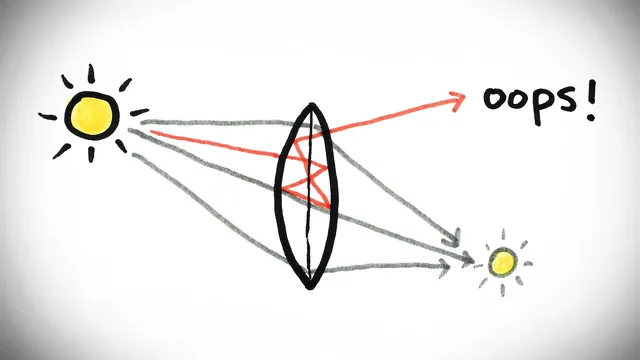
Lens flares are fundamentally an optical defect. Camera lenses are built from multiple glass “lens elements” (including the aperture), and real glass inevitably reflects, absorbs, and scatters a small fraction of incoming light even when anti-reflective coatings are used. In an ideal design, nearly all light would be bent correctly through each element to reach the sensor. In practice, a tiny portion—say 1%—takes unintended routes, ricocheting within the lens, re-emerging, or striking the sensor. Most of the time the flare is too dim to notice because it is faint relative to the properly transmitted light; the human eye and camera exposure effectively ignore it when brightness contrast is low.
When the light source is extremely bright, that balance changes. Lens flares come in many forms—glows, rings, rays, starbursts, disks, and rainbow arcs—depending on lens geometry, element placement, coatings, focus/zoom/aperture settings, brightness, and even the direction of incoming light. Any light with a line of sight to the front of the lens can contribute, whether or not the source is inside the frame. Lens makers try to minimize these internal reflections, but they can’t eliminate them entirely.
The sun is bright enough that even after being “darkened” by the small fraction that contributes to flare (down to 1%, 0.1%, or even 0.01%), the flare can still be comparable in brightness to other parts of the image. In eclipse photographs, some of the sun’s light likely illuminates or scatters off an element inside the lens rather than passing straight through. That internal stray light can generate a flare pattern that resembles an eclipse.
Two features make eclipse flares especially revealing. First, when the flare itself looks like the eclipsed sun, it indicates that the flare is a real optical image formed by the lens system—not merely a blurry orb. Second, the flare can appear cleanly exposed: its brightness must be reduced enough that it doesn’t create overwhelming haze that would wash out the scene. In effect, the camera is photographing the eclipse through a lens defect rather than through a solar filter.
The transcript also notes a common confusion: sometimes a bright “eclipse” appears directly where the sun should be, not opposite it. In that case, the effect isn’t a flare at all; clouds can dim the sun enough for the camera to capture a direct image without flare artifacts. The deciding factor is relative brightness—whether a feature is produced by internal lens reflections (a true flare) or by the object being imaged directly.
Cornell Notes
Lens flares are internal reflections and scattering inside a camera lens caused by imperfect transmission through multiple glass elements and the aperture. Most flares are invisible because the unwanted light is much dimmer than the correctly transmitted light. The sun’s brightness changes that equation: even a tiny fraction of stray light can remain bright enough to create visible flare patterns. During an eclipse, the flare can form an image that resembles the eclipsed sun, letting people see the eclipse without specialized solar filters—provided safe viewing practices are followed. Relative brightness also explains “false alarms,” where clouds dim the sun enough to produce a direct image rather than a flare.
What physical mechanism turns a bright light source into a lens flare?
Why are most lens flares hard to notice in everyday photos?
What changes during a solar eclipse that makes flare images of the eclipse visible?
Why can eclipse flares look like an actual image of the eclipsed sun rather than a random blur?
How can clouds produce an eclipse-looking image that isn’t a flare?
What practical clue helps distinguish a flare from a direct image using the “hand behind it” test?
Review Questions
- How does relative brightness determine whether a lens flare becomes visible in a photograph?
- What lens and camera factors (e.g., aperture shape, coatings, focus/zoom) influence the specific appearance of flare patterns?
- Why can an eclipse flare sometimes appear mirrored or offset relative to the sun, and how would you tell it apart from a direct image caused by cloud dimming?
Key Points
- 1
Lens flares arise when a small fraction of light reflects or scatters inside a multi-element camera lens instead of passing through the intended optical path.
- 2
Anti-reflective coatings reduce flare but cannot eliminate internal reflections and scattering entirely.
- 3
Most flares are invisible because the unwanted light is far dimmer than the correctly transmitted light in the final image.
- 4
Extremely bright sources like the sun make even tiny stray-light fractions bright enough to produce visible flare artifacts.
- 5
Eclipse photos can show a flare that resembles the eclipsed sun, indicating the lens can form an optical image through unintended internal paths.
- 6
Clouds can dim the sun enough for a direct image to be captured, creating an eclipse-looking result that is not a flare.
- 7
Relative brightness—whether stray light competes with scene brightness—determines whether flare patterns dominate or disappear.