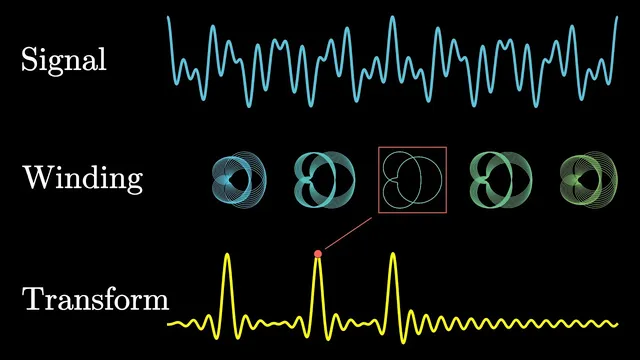
But what is the Fourier Transform? A visual introduction.
Based on 3Blue1Brown's video on YouTube. If you like this content, support the original creators by watching, liking and subscribing to their content.
Fourier analysis aims to recover pure frequency components from a time signal that looks complicated due to interference.
Briefing
Fourier analysis is built around one practical question: given a signal that’s messy in time—like the air-pressure trace from a sound—how can it be broken into the pure frequencies that actually make it up? The core insight developed here is a geometric “frequency separator” that turns a time signal into a wrapped, rotating picture. When the rotation rate matches a component frequency, the wrapped shape stops canceling itself out and a clear peak appears; when it doesn’t match, the contributions average away.
The starting example is a pure tone at 440 Hz, where air pressure oscillates smoothly up and down. Add another pure tone at a different frequency and the time trace becomes more complicated: peaks and troughs sometimes reinforce and sometimes cancel. The microphone records the combined pressure over time, but the goal is to recover the underlying frequencies. The method proposed is to treat the signal as a curve and “wrap” it around a circle. At each moment, the height of the curve becomes the radial distance from the center, producing a rotating vector-like shape in a 2D plane. A second frequency—called the “wrapping frequency”—controls how fast the curve is wound around the circle.
As the wrapping frequency changes, the wrapped curve’s center of mass shifts. For most wrapping rates, positive and negative contributions around the circle balance out, keeping the center near the origin. But when the wrapping frequency aligns with a signal component, the wrapped curve’s peaks line up on one side of the circle and troughs on the other, pushing the center of mass away from the origin. That alignment produces a sharp rise in the measured quantity (initially tracked via the sine-coordinate of the center of mass). In the simplified “Fourier approximation” picture, the most important feature is the peak at the true component frequency.
The same mechanism works when the signal contains multiple frequencies. Combining two tones—say 3 Hz and 2 Hz—creates a time-domain waveform that looks like interference. Feeding that combined signal into the wrapping-and-centering process yields a wrapped representation that looks chaotic at first, yet the center-of-mass peaks reappear precisely at the component frequencies. The crucial property is linearity in practice: applying the Fourier-like operation to each pure tone and then combining results matches what happens when the combined signal is processed directly. That’s what makes filtering possible: a high-frequency nuisance tone shows up as a peak at high frequency, and suppressing that peak removes the unwanted component.
To move from the geometric sketch to the actual Fourier transform, the explanation upgrades the 2D center-of-mass idea into complex numbers. The wrapping rotation is encoded using Euler’s formula, where exponentials of imaginary numbers represent rotation on the unit circle. The final expression becomes an integral (or, in real applications, a finite-time integral) of the signal multiplied by a complex rotating factor. The real part corresponds to the sine-coordinate-style measurement used earlier, while the imaginary part captures the complementary coordinate.
A key practical nuance is that the true Fourier transform uses only part of the integral—effectively normalizing by time length rather than scaling by it indefinitely—so the magnitude at a frequency grows when that frequency persists. The discussion ends by promising that the full transform’s deeper structure extends beyond frequency extraction, with more mathematical reach in a follow-up. A brief sponsor segment closes with a Jane Street puzzle about vector sums on a 3D surface.
Cornell Notes
The Fourier transform is motivated by a concrete problem: a microphone records a time signal (air pressure vs. time) that looks complicated, but it can be decomposed into pure frequencies. A geometric “wrapping” construction turns the time signal into a curve wrapped around a circle; changing the wrapping rate shifts the curve’s center of mass. When the wrapping rate matches a component frequency, the wrapped curve stops canceling around the circle, producing a peak in the measured quantity. The real Fourier transform formalizes this by encoding rotation with complex exponentials (via Euler’s formula) and computing an integral of the signal times a rotating complex factor. Peaks in the resulting complex output identify the signal’s frequency components, enabling tasks like filtering unwanted tones.
Why does wrapping a time-domain signal around a circle reveal its frequencies?
What does the center of mass represent in the Fourier-style construction?
How does the method handle signals made of multiple frequencies?
Why introduce complex numbers and Euler’s formula?
What’s the role of the integral, and why does time length matter?
Review Questions
- In the wrapping construction, what specific alignment condition causes the center-of-mass peak to appear at a component frequency?
- How do complex exponentials encode the two-dimensional (sine/cosine) rotation that the geometric sketch describes?
- Why does a persistent pure tone produce a larger Fourier magnitude than a frequency that only briefly aligns with the wrapping rate?
Key Points
- 1
Fourier analysis aims to recover pure frequency components from a time signal that looks complicated due to interference.
- 2
A geometric “wrapping” step turns signal height over time into a curve wrapped around a circle, controlled by a separate wrapping frequency.
- 3
When the wrapping frequency matches a signal’s component frequency, the wrapped curve’s contributions stop canceling and the center of mass shifts sharply, producing a peak.
- 4
For multi-tone signals, peaks still appear at each component frequency even though the time-domain waveform looks messy.
- 5
The real Fourier transform formalizes the wrapping idea using complex exponentials (Euler’s formula) and an integral of the signal against a rotating complex factor.
- 6
Filtering corresponds to suppressing frequency-domain peaks (e.g., removing a high-frequency nuisance tone).
- 7
In practice, finite observation windows and normalization determine how strongly peaks grow and how mismatched frequencies average out.