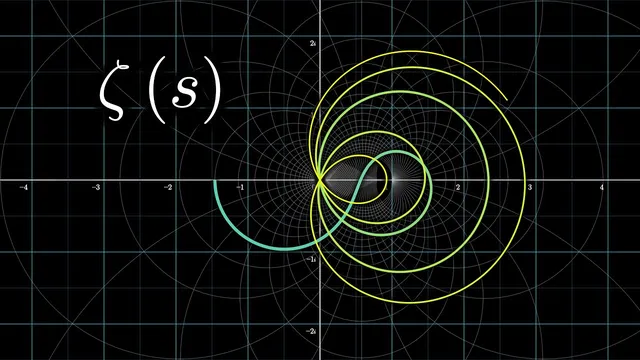
But what is the Riemann zeta function? Visualizing analytic continuation
Based on 3Blue1Brown's video on YouTube. If you like this content, support the original creators by watching, liking and subscribing to their content.
The zeta function is initially defined by ζ(s)=∑_{n=1}^∞ 1/n^s only for Re(s)>1, where the series converges.
Briefing
The Riemann zeta function becomes understandable once its “analytic continuation” is treated as a rigid, geometry-driven extension: start with a complex-valued function defined by an infinite series only where it converges (real part of s greater than 1), then extend it into the rest of the complex plane in exactly one way that preserves angles. That uniqueness is what makes the famous values—like ζ(−1) = −1/12—and the location of its zeros meaningful, including the million-dollar Riemann hypothesis about where the non-trivial zeros lie.
For real inputs, the zeta function is initially defined by the series ζ(s) = Σ_{n=1}^∞ 1/n^s, which converges only when Re(s) > 1. When s = 2, the sum becomes 1 + 1/4 + 1/9 + … and approaches π^2/6, illustrating why the function is tied to deep constants. But plugging in negative integers breaks the series: ζ(−1) would formally correspond to 1 + 2 + 3 + …, which diverges, and ζ(−2) would correspond to 1 + 4 + 9 + …, which also diverges—so the “trivial zeros” at negative even numbers cannot be read off from the original series.
The bridge to the full function is complex analysis. When s is complex (say s = 2 + i), each term n^{−s} splits into n^{−Re(s)} times a rotation coming from n^{−i·Im(s)}. That rotation has magnitude 1, so it doesn’t blow up the term sizes; it only turns them around in the complex plane. As a result, the series still converges for Re(s) > 1, but the partial sums trace a spiral-like path toward a complex value. Visually, varying s across the right half-plane produces a transformed “grid” of inputs mapped to outputs elsewhere in the complex plane.
The key geometric constraint is analyticity. Complex functions that have derivatives everywhere preserve the angles between intersecting curves—an angle-preserving property that can be pictured by how a grid’s lines meet after transformation. Because this constraint is so strong, there is essentially only one analytic way to extend a function beyond where its original series definition works. That “jigsaw puzzle” logic is analytic continuation: extend the zeta function into the left half-plane by demanding that the extension remain analytic, which forces a unique answer.
Once extended, the zeta function has zeros at negative even integers (the trivial zeros) and additional “non-trivial zeros” inside the critical strip. Riemann’s hypothesis claims every non-trivial zero lies on the critical line where Re(s) = 1/2. The Clay Math Institute’s million-dollar prize is tied to proving this placement. The same analytic continuation also yields ζ(−1) = −1/12, giving the striking formal identity 1 + 2 + 3 + … = −1/12—despite the fact that the original series diverges—because the extension is uniquely determined by the convergent region. The upshot: the zeta function’s extended values aren’t arbitrary “regularizations”; they are the only angle-preserving continuation consistent with the convergent series.
Cornell Notes
The Riemann zeta function starts as a convergent series ζ(s)=∑_{n=1}^∞ 1/n^s only when Re(s)>1. For complex s, the imaginary part doesn’t change term magnitudes; it rotates each term in the complex plane, so the series still converges and the sums spiral to a complex value. To define ζ(s) where Re(s)≤1, mathematicians use analytic continuation: extend the function in the only way that stays analytic (angle-preserving for intersecting curves). This uniqueness explains how ζ(−1)=−1/12 and why ζ has trivial zeros at negative even integers, even though the original series diverges there. The same continuation produces the non-trivial zeros in the critical strip, where the Riemann hypothesis predicts they all lie on Re(s)=1/2.
Why does the series definition of ζ(s) fail for negative integers, and what replaces it?
How does a complex exponent turn into a “rotation” rather than a blow-up?
What does “analytic” mean geometrically, and why does it force a unique continuation?
How do trivial zeros and ζ(−1)=−1/12 arise despite divergence of the original series?
What is the critical strip and what does the Riemann hypothesis claim about zeros?
Review Questions
- What role does the condition Re(s)>1 play in the convergence of ζ(s), and what changes when s is complex?
- Explain analytic continuation using the angle-preserving property of analytic functions. Why does this make the extension essentially unique?
- How can ζ(−1)=−1/12 be consistent with the divergence of 1+2+3+…? What mechanism produces the value?
Key Points
- 1
The zeta function is initially defined by ζ(s)=∑_{n=1}^∞ 1/n^s only for Re(s)>1, where the series converges.
- 2
For complex s=a+bi, the imaginary part contributes only rotations (unit-modulus factors), so convergence depends mainly on a=Re(s).
- 3
Analytic functions preserve angles between intersecting curves, providing a geometric intuition for having derivatives everywhere.
- 4
Requiring the extension to remain analytic turns analytic continuation into a rigid, essentially unique “jigsaw puzzle” beyond the series’ convergence region.
- 5
The analytically continued zeta function has trivial zeros at negative even integers and satisfies ζ(−1)=−1/12 even though the original series diverges there.
- 6
Non-trivial zeros lie in the critical strip, and the Riemann hypothesis predicts they all sit on the critical line Re(s)=1/2.
- 7
The million-dollar prize is tied to proving the non-trivial zeros’ location on the critical line, a claim with far-reaching consequences for mathematics.