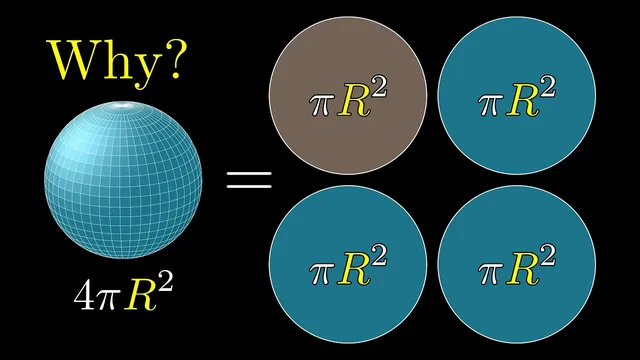
But why is a sphere's surface area four times its shadow?
Based on 3Blue1Brown's video on YouTube. If you like this content, support the original creators by watching, liking and subscribing to their content.
Unwrapping a cylinder with radius R and height 2R yields a rectangle of area (2πR)(2R)=4πR², matching the sphere’s surface area once projection preserves area patch-by-patch.
Briefing
A sphere’s surface area comes out to 4πR² for a reason that can be felt geometrically: when surface patches are “projected” onto a related flat shape, two distortions—stretching in one direction and squashing in the other—cancel perfectly, leaving equal area. That cancellation is the engine behind the classic formula and also explains why a sphere’s surface area is four times the area of its shadow (a circle of radius R).
The first route starts by trading the sphere for a cylinder. Take the sphere of radius R and imagine the cylinder that shares the same radius and height as the sphere—specifically, the cylinder’s curved side without its top and bottom. Unwrapping that curved side gives a rectangle whose width is the cylinder’s circumference, 2πR, and whose height is the sphere’s diameter, 2R. Multiplying yields 4πR², matching the sphere’s surface area.
The deeper question is why the sphere should equal that cylinder at all. The argument uses a “many tiny rectangles” approximation of the sphere’s surface. Each small patch has a local orientation; when projected outward (like a shadow cast by lights along the z-axis), the patch’s width increases because it spans a longer distance near the poles, while its height decreases because the patch is slanted relative to the direction of projection. With careful geometry, those two scaling factors turn out to be reciprocal: the width stretch factor is R/d while the height squish factor is d/R, so the product—and therefore the patch area—stays unchanged. As the patches get thinner and thinner, the approximation becomes exact, making the total surface area equal to the cylinder’s unwrapped area.
To connect the “four circles” intuition directly to the sphere, the unwrapped cylinder picture can be reorganized into four circle pieces. Each circle can be unwrapped into a triangle by relating concentric rings to horizontal slices; four such triangles fit neatly into the rectangle that represents the cylinder’s label. This gives a satisfying geometric bridge between the sphere’s curved surface and the flat circle geometry.
A second, more direct approach compares the sphere to the shadow of rings. Slice the sphere into thin horizontal rings parallel to the xy-plane. Each ring’s shadow on the xy-plane forms part of a circle of radius R. Using ring thickness proportional to R·dθ and computing both the ring’s area and the shadow’s area via trigonometry, one finds that the shadow of a ring at angle θ has exactly half the area of a specific ring on the sphere—specifically, the ring corresponding to a complementary angle. That pairing implies that the total area of the circle shadow is exactly one-fourth the sphere’s surface area.
Finally, the “four times” relationship isn’t unique to spheres. For any convex three-dimensional shape, the average area of all its shadows over all orientations equals one-fourth of its surface area. In other words, the sphere’s shadow ratio is a special, highly symmetric instance of a general geometric law.
Cornell Notes
The sphere’s surface area is 4πR² because area is preserved under a carefully chosen projection: small surface patches stretch in one direction and compress in the perpendicular direction by exactly reciprocal factors. Approximating the sphere with many tiny rectangles, projecting them outward onto a cylinder (same radius and height) keeps each patch’s area unchanged, so the total sphere area matches the cylinder’s unwrapped rectangle area (2πR by 2R). A second method slices the sphere into thin rings parallel to the xy-plane and compares each ring’s area to the area of its shadow on the xy-plane; trig shows each shadow ring corresponds to every second ring on the sphere with a fixed area ratio. Together these yield the key fact: the circle shadow area is exactly one-fourth the sphere’s surface area. The same “one-fourth” ratio generalizes to all convex 3D shapes when averaged over orientations.
Why does projecting small surface rectangles from the sphere onto a cylinder preserve area?
How does the cylinder-unwrapping argument produce 4πR²?
What is the “four circles” connection, and how do circles become triangles in the unwrapping?
In the ring-and-shadow method, how are ring thickness and ring area approximated?
Why does the circle shadow end up being exactly one-fourth the sphere’s surface area?
Review Questions
- In the projection argument, what geometric quantity is d, and why does the product of the width and height scaling factors equal 1?
- How does the choice of θ (angle from the z-axis) determine both the ring thickness (R·dθ) and the ring’s circumference?
- What pairing relationship between rings (every second ring / complementary angle) makes the shadow area sum to one-fourth of the sphere’s surface area?
Key Points
- 1
Unwrapping a cylinder with radius R and height 2R yields a rectangle of area (2πR)(2R)=4πR², matching the sphere’s surface area once projection preserves area patch-by-patch.
- 2
Approximating the sphere with tiny rectangles and projecting them outward shows each patch’s area stays constant because width stretches by R/d while height squishes by d/R.
- 3
The “four circles” intuition can be made concrete by unwrapping circles into triangles using the linear growth of circumference with radius, letting four such pieces fit into the cylinder’s unwrapped rectangle.
- 4
Slicing the sphere into thin rings parallel to the xy-plane and comparing each ring to its shadow on the xy-plane gives a direct route to the one-fourth relationship.
- 5
Trigonometry reveals that a ring’s shadow corresponds to a different ring on the sphere (a complementary pairing), and that correspondence fixes the area ratio.
- 6
The one-fourth shadow-to-surface-area ratio generalizes: for any convex 3D shape, the average shadow area over all orientations equals one-fourth its surface area.