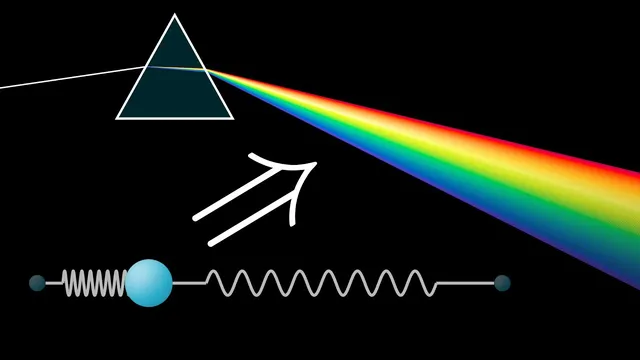
But why would light "slow down"? | Visualizing Feynman's lecture on the refractive index
Based on 3Blue1Brown's video on YouTube. If you like this content, support the original creators by watching, liking and subscribing to their content.
Refractive index can be interpreted as the cumulative phase shift that a wave acquires from many thin layers of a material.
Briefing
Light bends in a prism because different colors drive different microscopic oscillations inside the glass, and those oscillations shift the wave’s phase by different amounts. The key move is to stop treating “slowing down” as a mysterious property of light in matter and instead treat it as the cumulative result of tiny phase kicks that each thin layer of material gives to an incoming electromagnetic wave.
A standard prism story starts with the idea that light travels at speed c in vacuum but at a smaller speed in glass, and Snell’s law then predicts the bending angle. That account is serviceable, but it leaves two questions hanging: what does “slowing” really mean for a wave, and why should the amount of slowing depend on color (frequency)? The explanation here reframes the problem in terms of phase. Imagine the glass as many thin layers stacked along the direction of travel. Each layer slightly changes the wave by “kicking back” its phase—mathematically, the wave after the layer looks like the same oscillation but with a small extra shift inside the sine function. When many such layers act in sequence, the net effect becomes indistinguishable from a wave that oscillates with the same frequency but has a shorter effective wavelength, which corresponds to a reduced phase velocity. That is the first conceptual bridge to the refractive index: the index measures how strongly the material’s layers cumulatively shift phase.
To justify why a layer produces a phase kick at all, the explanation zooms into the electromagnetic origin of light. Light is an electromagnetic wave: an accelerating charge creates ripples in the electric field that propagate at speed c, which is best thought of as the speed of causality. When an incoming light wave reaches a material, it forces charges in the material (electrons and ions) to wiggle. A sheet of charges oscillating in sync radiates a secondary wave. Most of the secondary radiation cancels in directions other than perpendicular to the sheet, but along the forward direction it adds to the incoming field. Crucially, the combined field looks almost like the original wave, except for a small phase shift. Repeating this layer-by-layer produces the effective phase slowdown.
The color dependence comes from how strongly those charges wiggle under driving by the light. Each charge is modeled as a driven harmonic oscillator: a particle bound by an effective spring with resonant angular frequency ωr, pushed by an external oscillatory force from the incoming light at angular frequency ωL. In steady state, the oscillation amplitude is large when ωL is close to ωr and small when ωL is far away, because the response contains a denominator proportional to (ωr² − ωL²). That amplitude controls the strength of the secondary wave from each layer, which controls the phase kick. Larger phase kicks mean a larger refractive index effect, so different frequencies bend by different amounts—producing the prism’s rainbow separation.
The account also notes an important missing ingredient: real materials have damping (a velocity-dependent drag term). Without it, the model would imply unrealistic perfect transmission. Finally, it points to follow-up material addressing subtleties like refractive index values below 1, birefringence, and how “slowing” differs for wave packets carrying information.
Cornell Notes
Prism refraction can be understood as the cumulative effect of tiny phase shifts that many thin layers of a material impose on an incoming electromagnetic wave. Each layer’s charges oscillate in response to the light and emit a secondary wave; adding the secondary wave to the incoming field produces a small forward phase lag. When many layers act together, that phase lag shows up as an effective reduction in phase velocity, which is what refractive index quantifies. The refractive index depends on color because the driven oscillation amplitude of charges depends on the light’s frequency relative to the material’s resonant angular frequency ωr, through a response factor involving (ωr² − ωL²). Damping is needed to account for absorption and reflection in real materials.
How does “slowing down” in a medium translate into something you can compute from wave behavior?
Why does a layer of oscillating charges create a forward phase shift rather than a completely different wave?
What determines how strongly the charges wiggle when light hits them?
Why does refractive index depend on color in this framework?
What role does damping play, and why is it necessary?
How does the explanation connect to the idea of causality and the speed c?
Review Questions
- In the layer-by-layer phase-kick picture, what observable wave change corresponds to the refractive index?
- How does the driven harmonic oscillator response factor involving (ωr² − ωL²) explain why blue and red light refract differently?
- Why must a damping (velocity-dependent) term be included in the oscillator model for real materials?
Key Points
- 1
Refractive index can be interpreted as the cumulative phase shift that a wave acquires from many thin layers of a material.
- 2
A single layer’s charges emit a secondary wave; adding it to the incoming field produces a small forward phase lag.
- 3
The effective “slowing” of light in matter corresponds to accumulated phase lag, which is equivalent to a reduced phase velocity (shorter effective wavelength at fixed frequency).
- 4
Color dependence arises because the amplitude of charge oscillations depends on the light frequency relative to the material’s resonant angular frequency ωr.
- 5
A driven harmonic oscillator model links the strength of the phase kick to a response factor proportional to (ωr² − ωL²).
- 6
Damping is required to account for absorption and reflection; without it, the model would predict unrealistic perfect transmission.
- 7
The microscopic explanation connects electromagnetic causality (propagation at speed c) to macroscopic refractive behavior.