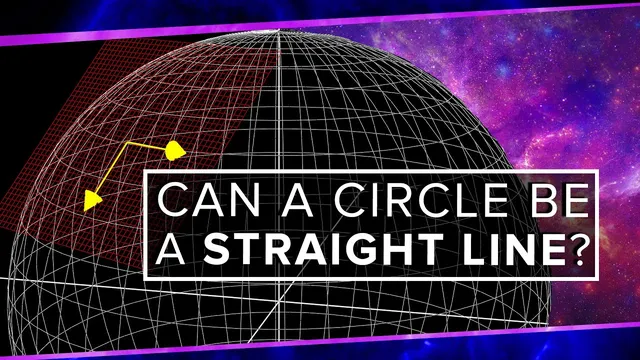
Can a Circle Be a Straight Line?
Based on PBS Space Time's video on YouTube. If you like this content, support the original creators by watching, liking and subscribing to their content.
A curve is defined as straight by whether tangent vectors remain tangent under parallel transport along the curve, not by shortest-path distance.
Briefing
Gravity’s “no-force” framing in general relativity hinges on a geometric idea: motion follows straightest-possible paths in curved spacetime, not trajectories pushed by a gravitational pull. But before spacetime curvature can be made concrete, the meaning of “straight line” and “curved space” has to be rebuilt from geometry alone—using how tangent directions behave under parallel transport, not how things look in everyday 3D intuition.
The episode starts with a flat Euclidean 2D plane and asks how to define “straight” without relying on the usual shortest-path intuition. The proposed test uses vectors: take a vector at point A tangent to a candidate curve, then “parallel transport” it to point B along that curve by sliding it while keeping its direction parallel throughout. If the transported vector stays tangent to the curve at every intermediate point, the curve counts as straight. If it fails—remaining tangent only at the start but not along the way—then the curve is not straight. This definition is local and operational: it depends on how directions compare at nearby points, not on global distance formulas.
A sphere provides the stress test. An ant confined to the sphere’s surface can’t access the third dimension, so it must judge straightness using only in-surface parallel transport. Under that rule, only segments of great circles behave as straight lines; other paths fail because parallel-transported tangents stop aligning with the curve. From the outside, the vectors aren’t “really parallel” in 3D, but the ant’s universe forces a consistent internal geometry. The key takeaway is that straightness is not a universal visual label—it’s a property defined relative to the space’s rules for parallelism.
The discussion then generalizes from straight curves to curved spaces. A space is declared flat if parallel transport produces no net change: transport a vector from A to B along two different paths and the vector arrives at B unchanged. Equivalently, parallel transport around any closed loop returns the vector to its original orientation. If the vector comes back rotated or altered, the space is curved. A related “nearby geodesics” criterion—two initially parallel geodesics that start to converge or diverge—turns out to match the parallel-transport definition.
Importantly, curvature doesn’t always match 3D intuition. A cylinder is geometrically flat even though it’s curved in the everyday sense: locally, parallel lines remain parallel when the surface is unrolled, so the parallel-transport tests show no intrinsic curvature. The cylinder differs from a plane in topology (global connectedness), while curvature and geometry are local. Likewise, 3D space around Earth is curved in principle, but measuring it is difficult; the real payoff for gravity comes from four-dimensional curved spacetime, where these geometric rules govern how free-falling objects move.
By the end, the episode sets up the next step: even flat spacetime already has counterintuitive geometry, so the “straight line” concept in relativity can’t be imported from Euclidean space. The groundwork is laid for later episodes to connect spacetime curvature to the observed effects usually attributed to gravity—without invoking a gravitational force.
Cornell Notes
The episode rebuilds the meaning of “straight line” and “curved space” using geometry alone, preparing for general relativity’s claim that gravity is not a force. A curve is straight if a tangent vector parallel-transported along it stays tangent everywhere along the way. A space is flat if parallel transport between the same points (or around closed loops) returns vectors unchanged; otherwise the space is curved. On a sphere, this rule picks out geodesics—great-circle segments—as the straightest paths, even though they aren’t “shortest” in the usual sense. The approach also shows why everyday 3D intuition can mislead: a cylinder can be geometrically flat despite being “curved” in appearance, because curvature is a local property.
How does parallel transport define a “straight” curve when shortest-path intuition fails?
Why does an ant on a sphere conclude that only certain paths are straight?
What criterion distinguishes a flat space from a curved one using parallel transport?
Why can a cylinder be “flat” even though it looks curved?
Why does the episode emphasize four-dimensional spacetime rather than just 3D space?
Review Questions
- In what precise sense does a curve qualify as “straight” under the parallel-transport definition?
- How do the two parallel-transport tests for flatness—path independence between A and B, and return to the original vector after a closed loop—relate to each other?
- Why does the cylinder example show that curvature is a local geometric property rather than a purely visual one?
Key Points
- 1
A curve is defined as straight by whether tangent vectors remain tangent under parallel transport along the curve, not by shortest-path distance.
- 2
On a sphere, the straightest paths for an in-surface observer are geodesics—segments of great circles—found by applying parallel transport within the surface.
- 3
A space is flat if parallel transport between the same endpoints is path-independent; it is curved if transport depends on the chosen path.
- 4
Parallel transport around closed loops provides an equivalent flatness test: returning with the same vector orientation indicates flatness.
- 5
Geodesics are not guaranteed to be the shortest routes between two points; in some spaces they can be longer than alternatives.
- 6
Curvature is a local property defined by parallel transport behavior; topology can differ (as on a cylinder) without introducing geometric curvature.
- 7
Gravity’s “no force” picture requires this geometric groundwork because the relevant notion of straightness lives in curved spacetime, not ordinary Euclidean space.