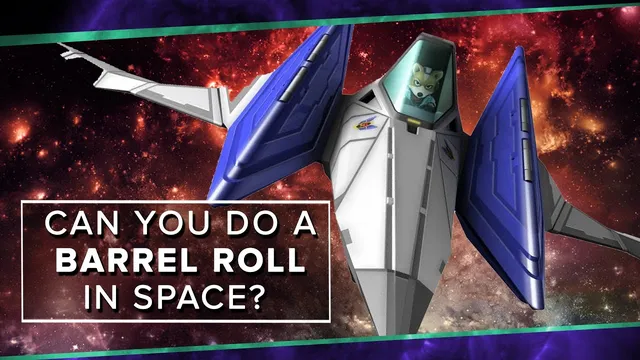
Can A Starfox Barrel Roll Work In Space?
Based on PBS Space Time's video on YouTube. If you like this content, support the original creators by watching, liking and subscribing to their content.
In atmosphere, a “barrel roll” is effectively an aileron roll: differential lift from opposing aileron deflections creates torque, and reversing the deflections cancels rotation.
Briefing
“Star Fox” gets one space maneuver right: a barrel roll can be physically plausible in vacuum if the ship uses stored angular momentum rather than relying on wing control surfaces or repeated thruster bursts. In atmosphere, a barrel roll is essentially an aileron roll—differential lift from flipping left and right wing control surfaces creates torque, and reversing the ailerons cancels the rotation. Space removes that option because there’s no air to push on the wings, and without friction a spinning object keeps spinning until an external torque changes its angular momentum.
The core fix is to treat the ship like a gyroscope system. Angular momentum is conserved, so the way to start and stop a rotation is to transfer angular momentum between internal components and the rest of the craft. The proposed mechanism uses a pre-spun flywheel (a rotating mass) mounted inside the ship. If the flywheel’s angular momentum initially points along the direction needed for a clockwise roll, the fuselage can be arranged so the net angular momentum of the whole system matches what the maneuver requires. Flipping the flywheel 180 degrees reverses the flywheel’s angular momentum vector; conservation then forces the fuselage to acquire an equal and opposite angular momentum so the total stays constant. That transfer produces the barrel roll. To stop after a full 360 degrees, the flywheel is flipped back to its original orientation, reversing the transfer and canceling the rotation.
This internal-torque approach avoids the fuel cost of firing thrusters to generate large torques repeatedly. It also mirrors real spacecraft and telescope attitude control. Space telescopes such as Hubble and Kepler can reorient using angular momentum conservation, with flywheels spun in fixed directions and driven opposite to the desired telescope motion—similar in spirit to a teacup ride where the platform rotates in response to internal motion. The International Space Station uses control moment gyros (CMGs) to manage orientation by changing the angular momentum of internal spinning wheels.
Still, the “Star Fox” version isn’t a free lunch. Flipping a flywheel can’t be instantaneous; during the flip, the flywheel’s angular momentum vector sweeps through partially sideways directions. If the total angular momentum must remain unchanged, the ship would need additional “wonky” rotation during the transition, meaning the nose would tilt off-axis for part of each maneuver. The transcript frames this as an engineering challenge: design a method to keep the ship aligned during gyro flips without using thrusters.
Beyond the physics of the barrel roll, the discussion pivots to a separate set of audience questions about what could destroy Earth, rejecting highly speculative ideas like “grey goo” nanobots and proton decay due to lack of experimental basis. It also addresses collision odds from galaxy mergers and rogue objects, emphasizing that vast empty space makes catastrophic encounters extraordinarily unlikely. The takeaway is that one game mechanic aligns with real conservation laws, while many other dramatic space scenarios don’t survive contact with physics.
Cornell Notes
A barrel roll in space can be physically viable if the ship relies on conservation of angular momentum using internal flywheels rather than wing control surfaces or repeated thruster firings. In vacuum, a spinning craft won’t naturally stop because there’s essentially no friction; it keeps rotating until a torque changes its angular momentum. By pre-spinning a flywheel and flipping it 180 degrees, the craft transfers angular momentum between the wheel and the fuselage, producing the roll; flipping it back cancels the rotation. Real systems like space telescopes and the ISS use similar flywheel-based attitude control (e.g., control moment gyros). The main complication is that flipping a wheel takes time, so the ship may tilt unless the design compensates during the transition.
Why do ailerons fail as a way to roll in space?
What physical principle makes a flywheel-based barrel roll possible in vacuum?
How does flipping a flywheel 180 degrees translate into a barrel roll?
How do real spacecraft attitude systems relate to this “Star Fox” idea?
What complication arises because the flywheel flip can’t be instantaneous?
Why are thruster-based roll maneuvers considered wasteful in this context?
Review Questions
- In a frictionless environment, what determines whether a rotating spacecraft keeps spinning or stops, and how does that change the role of thrusters?
- Describe the angular momentum transfer sequence needed to start and then stop a barrel roll using a pre-spun flywheel.
- What specific effect during a non-instantaneous flywheel flip could cause the ship’s nose to tilt, and why does conservation of angular momentum force that behavior?
Key Points
- 1
In atmosphere, a “barrel roll” is effectively an aileron roll: differential lift from opposing aileron deflections creates torque, and reversing the deflections cancels rotation.
- 2
In space, wing control surfaces can’t generate torque because there’s no aerodynamic force; a spinning craft won’t slow down without an applied torque.
- 3
A flywheel-based approach works by transferring angular momentum internally while keeping the total angular momentum of the ship-plus-wheel system conserved.
- 4
Flipping a pre-spun flywheel 180 degrees reverses the wheel’s angular momentum vector, forcing the fuselage to acquire complementary angular momentum and producing the roll.
- 5
Stopping the roll requires flipping the flywheel back to restore the original angular momentum distribution.
- 6
Real attitude-control systems use similar physics: space telescopes (Hubble, Kepler) and the ISS’s control moment gyros (CMGs).
- 7
Because flywheel flips take time, the ship may tilt off-axis during the transition unless the control scheme compensates without thrusters.